
Building a credible brand hinges on how your business presents itself visually and strategically. Did you know that 75% of consumers judge a brand’s credibility based on its visual aesthetics? For UK business owners, creative direction is the unifying force that transforms scattered design efforts into cohesive brand experiences. This guide clarifies what creative direction is, why it matters, and how to implement it effectively to strengthen your brand identity and connect authentically with your audience.
Table of Contents
- What Is Creative Direction?
- Why Creative Direction Matters For UK Businesses
- The Role Of Creative Directors
- Common Misconceptions About Creative Direction
- Frameworks For Applying Creative Direction
- Case Studies From UK Business
- Implementing Creative Direction In Your Business
- Enhance Your Brand With Expert Creative Direction
- Frequently Asked Questions About Creative Direction
Key takeaways
| Point | Details |
|---|---|
| Creative direction unifies strategy and design | It blends storytelling, visual identity, and strategic leadership to create consistent brand experiences across all channels. |
| Drives measurable business outcomes | Cohesive brand presentation increases revenue by 33% and boosts emotional engagement by over 40% for UK businesses. |
| Requires strategic leadership skills | Creative directors align creative teams with business goals, managing designers, copywriters, and marketing specialists. |
| Common misconceptions limit effectiveness | Many confuse creative direction with art direction alone, missing its broader strategic and team leadership scope. |
| Proven frameworks enable practical application | Structured workflows reduce project delays by 15% and help UK businesses maintain brand coherence. |
What is creative direction?
Creative direction is the strategic oversight of all creative elements that shape your brand identity. It goes beyond individual design tasks to orchestrate how your business communicates visually, verbally, and emotionally across every customer touchpoint. Creative direction blends design, strategy, and storytelling to create a unified brand experience that resonates with your target audience.
For UK business owners, understanding this concept is essential to building recognition and trust. Creative direction encompasses the full spectrum of brand expression:
- Visual identity systems including logos, colour palettes, typography, and imagery
- Messaging frameworks that define tone, voice, and brand storytelling
- Marketing campaign concepts that align with business objectives
- Digital and physical touchpoints from websites to packaging
- Team coordination ensuring consistency across departments
Unlike art direction, which focuses primarily on visual execution within specific projects, creative direction provides the overarching vision that guides all creative work. It bridges your branding strategy with tangible creative output, ensuring every design choice reinforces your business values and market position. This strategic layer transforms isolated design efforts into a cohesive brand ecosystem that customers recognise and trust.
Why creative direction matters for UK businesses
The commercial impact of effective creative direction extends far beyond aesthetic appeal. Research shows that brands with consistent presentation across platforms see 33% higher revenue compared to those with fragmented visual identities. For UK businesses competing in crowded markets, this cohesion directly influences customer decisions and loyalty.
Creative direction strengthens three critical business outcomes:
- Brand credibility: Consistent visual and verbal messaging builds immediate trust with potential customers, reducing the friction in conversion pathways.
- Customer engagement: Strategic creative direction improves emotional connection by over 40%, making your brand more memorable and shareable.
- Market differentiation: A distinctive creative vision separates your business from competitors, particularly in saturated UK sectors like retail, hospitality, and professional services.
The relationship between visual coherence and business performance is particularly pronounced in digital environments. UK consumers interact with brands across multiple channels daily, from social media to email to physical stores. When creative direction unifies these experiences, customers develop stronger brand recall and preference. This alignment also streamlines internal operations, as teams work from shared creative guidelines rather than reinventing visual approaches for each campaign.
Understanding the role of design in business helps contextualise why creative direction deserves strategic investment. It is not merely about making things look attractive but about creating a systematic approach to brand communication that drives growth. Businesses that treat creative direction as a strategic function rather than an afterthought consistently outperform competitors in customer acquisition and retention metrics. Your brand story becomes more compelling when every creative element works in concert, and writing a brand story that resonates requires this unified creative vision.

The role of creative directors
Creative directors serve as the strategic architects of brand identity, bridging business objectives with creative execution. They oversee visual, verbal, and narrative elements to ensure every output aligns with your brand’s mission and audience expectations. This leadership role coordinates multidisciplinary teams including graphic designers, copywriters, web developers, and marketing specialists.
The responsibilities extend across the entire creative lifecycle:
- Developing overarching creative concepts that reflect business goals
- Establishing brand guidelines and visual systems
- Leading brainstorming sessions and concept development
- Reviewing and approving creative work for consistency and quality
- Collaborating with stakeholders to balance creative vision with commercial realities
Success in this role demands a unique combination of skills. Key competencies include leadership, strategic thinking, and creativity management, enabling directors to inspire teams whilst maintaining focus on measurable outcomes. Unlike individual contributors who execute specific tasks, creative directors maintain the holistic view, ensuring that a website redesign, social media campaign, and product packaging all speak the same brand language.
Pro Tip: If your business lacks the resources for a full-time creative director, consider engaging specialist agencies or fractional creative leadership. This approach provides strategic oversight without the overhead, particularly valuable for small to mid-sized UK businesses building their first cohesive brand identity.
The impact of skilled creative leadership is tangible. Teams guided by clear creative direction produce work faster and with fewer revisions because everyone understands the strategic framework. This efficiency translates directly to cost savings and faster time-to-market for campaigns. For UK business owners exploring branding strategy, recognising the creative director’s role helps you structure teams and workflows for maximum brand impact.
Common misconceptions about creative direction
Misunderstanding creative direction leads to fragmented brand identities and missed growth opportunities. Over half of entry-level UK marketing professionals conflate creative direction with art direction alone, limiting their strategic perspective. Clarifying these misconceptions enables more effective implementation.
The most prevalent errors include:
- Confusing creative direction with art direction: Art direction focuses on visual execution within projects, whilst creative direction provides the strategic vision guiding all brand communications.
- Assuming it only applies to large businesses: Businesses of any size benefit from creative direction; small UK companies often see proportionally greater impact from cohesive branding.
- Treating it as purely aesthetic: Effective creative direction integrates business strategy, market positioning, and customer psychology alongside visual design.
- Underestimating the leadership component: Creative direction requires team management and stakeholder coordination, not just individual creative talent.
- Believing it stifles creativity: Clear creative frameworks actually enhance innovation by providing direction and reducing wasted effort on off-brand concepts.
These misconceptions stem from a narrow view of what creative work entails. When business owners see design as decoration rather than strategic communication, they miss opportunities to build brand equity systematically. A London-based consultancy recently noted:
“Many UK businesses invest in individual design projects without the connective tissue of creative direction, resulting in a collection of attractive but disconnected assets that fail to build lasting brand recognition.”
Correcting these assumptions starts with recognising creative direction as a business function, not just a creative one. Your branding strategy should incorporate creative leadership from the outset, ensuring every investment in design and marketing compounds rather than contradicts previous efforts. This shift in perspective transforms how you approach brand building, moving from tactical execution to strategic orchestration.
Frameworks for applying creative direction
Practical frameworks transform abstract creative direction principles into actionable workflows. UK businesses implementing structured approaches report 15% fewer project overruns and significantly improved brand coherence across channels. These models balance creative exploration with business discipline.
A proven creative direction framework includes these sequential phases:
- Discovery and strategy: Define brand values, target audience, competitive positioning, and business objectives that creative work must support.
- Concept development: Generate multiple creative directions aligned with strategy, exploring visual and verbal approaches that differentiate your brand.
- Refinement and testing: Narrow concepts based on stakeholder feedback and customer research, ensuring chosen direction resonates with intended audiences.
- Execution planning: Develop detailed brand guidelines, asset libraries, and workflows that enable consistent implementation across teams and channels.
- Implementation and governance: Roll out creative direction systematically, establishing approval processes and quality controls that maintain brand integrity.
- Measurement and iteration: Track brand recognition, customer engagement, and business metrics to refine creative approaches over time.
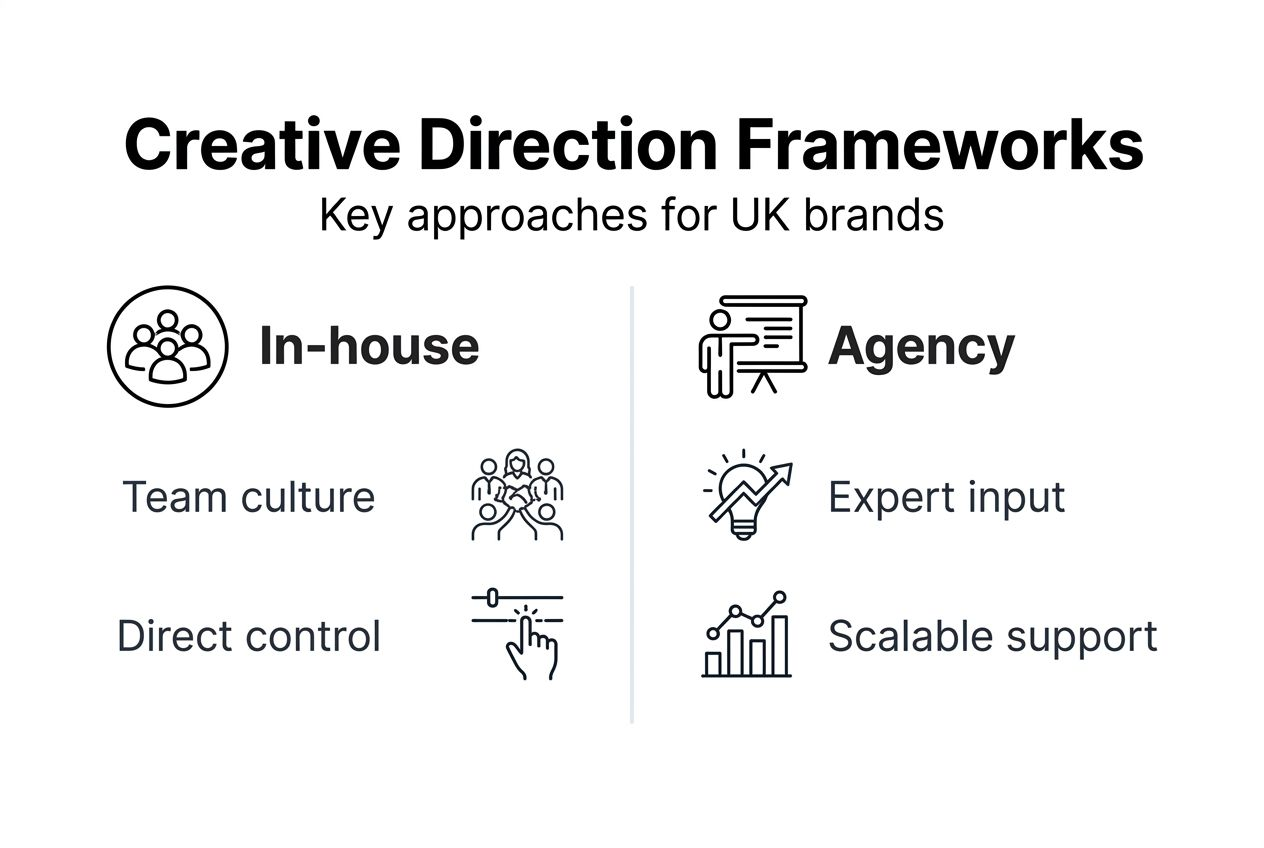
Comparing different workflow approaches helps UK businesses choose methods suited to their scale and resources:
| Approach | Best For | Key Advantage | Consideration |
|---|---|---|---|
| In-house creative team | Larger businesses with ongoing needs | Complete brand control and rapid iteration | Higher fixed costs and recruitment challenges |
| Agency partnership | Businesses seeking specialist expertise | Access to diverse skills and fresh perspectives | Requires clear briefs and communication protocols |
| Hybrid model | Mid-sized businesses balancing cost and quality | Flexibility to scale creative resources | Coordination between internal and external teams |
| Fractional creative director | Small businesses building first cohesive identity | Strategic leadership without full-time overhead | Limited availability for day-to-day decisions |
Pro Tip: Start with a comprehensive creative brief that articulates your brand values, audience insights, and success metrics. This document becomes the reference point for all creative decisions, keeping teams aligned even as projects multiply.
Maintaining branding consistency requires both initial creative direction and ongoing governance. Establish clear approval workflows, regular brand audits, and accessible guidelines that empower teams to make brand-aligned decisions independently. This structural approach prevents the creative drift that dilutes brand impact over time.
Case studies from UK business
Real-world examples demonstrate how strategic creative direction drives measurable business outcomes for UK companies. Recent 2025 and 2026 rebrands illustrate the tangible benefits of cohesive creative leadership across different sectors and company sizes.
British Airways undertook a comprehensive brand refresh in 2025, reunifying its visual identity after years of fragmented campaign aesthetics. The airline’s creative direction emphasised heritage and modern British design, resulting in improved brand perception scores and stronger customer loyalty among UK travellers. Similarly, Tesco Mobile’s 2025 rebrand leveraged creative direction to differentiate from parent company Tesco whilst maintaining brand equity, successfully attracting younger demographics through cohesive digital and physical touchpoints.
Smaller UK businesses demonstrate equally compelling results:
- A London-based independent watchmaker raised 20% more in crowdfunding after rebranding with focused creative direction, transforming scattered product photography and messaging into a cohesive luxury narrative.
- A Manchester legal tech startup increased enterprise client acquisition by 35% following a rebrand that aligned visual identity with their strategic positioning as innovative yet trustworthy.
- A Bristol sustainable fashion brand doubled social media engagement within six months by implementing creative direction that unified their environmental values across all customer touchpoints.
These UK business rebrand examples share common elements: clear strategic vision, consistent execution across channels, and creative leadership that balanced brand evolution with recognition. The businesses that achieved strongest results treated creative direction as an ongoing discipline rather than a one-time project, establishing visual branding workflows that maintained coherence as they scaled.
The investment in creative direction paid dividends beyond immediate aesthetics. Companies reported improved internal alignment, with teams making faster decisions guided by clear brand frameworks. Customer feedback consistently highlighted increased brand memorability and trust, translating to higher conversion rates and customer lifetime value. For UK business owners evaluating whether creative direction warrants strategic investment, these case studies provide compelling evidence of commercial return.
Implementing creative direction in your business
Transforming creative direction from concept to practice requires deliberate steps that embed strategic creative thinking into your business operations. Implementing creative direction requires leadership skills, strategic mindset, and attention to detail to align with business objectives and maintain brand consistency across every customer interaction.
Follow this sequence to establish effective creative direction:
- Articulate brand foundations: Document your core values, unique selling propositions, target audience insights, and competitive positioning that creative work must communicate.
- Audit existing creative assets: Review current logos, websites, marketing materials, and customer touchpoints to identify inconsistencies and opportunities for alignment.
- Develop creative strategy: Define the visual and verbal approach that best expresses your brand foundations, including mood boards, tone of voice guidelines, and conceptual direction.
- Create brand guidelines: Produce comprehensive documentation covering logo usage, colour systems, typography, imagery style, messaging frameworks, and application examples.
- Establish approval workflows: Implement processes ensuring all creative output receives review against brand guidelines before publication, preventing erosion of creative direction.
- Train internal teams: Educate everyone who touches brand communications about creative direction principles and how to apply guidelines in their work.
- Monitor and refine: Regularly assess brand consistency across channels, gathering customer feedback and business metrics to evolve creative direction strategically.
Leadership commitment determines success. Business owners must champion creative direction as a strategic priority, allocating resources and empowering teams to maintain standards. This cultural shift often proves more challenging than the technical aspects of implementation.
Pro Tip: Begin with a single high-impact project like a website redesign or major campaign to pilot your creative direction approach. Use this focused initiative to establish workflows and guidelines you can then scale across other brand touchpoints.
For UK businesses without in-house creative expertise, partnering with specialists who understand your market provides valuable guidance. A comprehensive branding strategy guide helps structure your thinking, whilst expert creative direction ensures implementation reflects both your vision and proven best practices. The key is moving from sporadic design decisions to systematic brand building that compounds over time.
Enhance your brand with expert creative direction
Transforming your brand identity through strategic creative direction requires both vision and execution expertise. At Kukoo Creative, we’ve spent over a decade partnering with UK business owners to create cohesive brand experiences that build recognition and drive growth.

Our team guides you through every stage of creative direction, from initial brand strategy to final implementation. We develop visual identities, messaging frameworks, and brand guidelines that unite your business communications across all channels. Whether you need a complete rebrand or systematic refinement of existing assets, our approach ensures every creative decision reinforces your business objectives.
Explore our portfolio to see how we’ve helped businesses like yours establish distinctive brand identities. Ready to start? Complete our logo design brief to begin the conversation, or review our comprehensive branding strategy guide to understand how creative direction fits within your broader business goals. Your brand deserves the strategic creative leadership that turns good design into business growth.
Frequently asked questions about creative direction
What is the difference between creative direction and art direction?
Creative direction provides the overarching strategic vision that guides all brand communications, whilst art direction focuses on visual execution within specific projects. Creative directors lead teams and ensure consistency across channels, whereas art directors manage the aesthetic details of individual campaigns or assets.
When should a UK business hire a creative director?
Consider hiring or engaging a creative director when your business struggles with brand consistency across channels, launches new products requiring cohesive positioning, or reaches a scale where multiple teams create customer-facing content. Even small businesses benefit from fractional or consultative creative leadership during rebrands or strategic pivots.
How does creative direction improve customer engagement?
Creative direction creates emotionally resonant brand experiences by ensuring visual and verbal consistency that builds recognition and trust. Customers engage more deeply with brands they perceive as cohesive and authentic, resulting in higher conversion rates, increased loyalty, and greater social sharing of brand content.
Can I measure the success of creative direction?
Yes, through both qualitative and quantitative metrics. Track brand recognition surveys, customer perception studies, engagement rates across channels, conversion metrics, and revenue growth. Compare performance before and after implementing creative direction, and conduct regular brand audits to ensure ongoing consistency.
What are common mistakes when implementing creative direction?
Businesses often fail by treating creative direction as a one-time project rather than ongoing discipline, creating overly restrictive guidelines that stifle creativity, neglecting to train teams on brand standards, or lacking leadership commitment to maintain consistency. Success requires balancing strategic frameworks with creative flexibility and sustained organisational focus.