
TL;DR:
- Multi-page websites improve SEO, user experience, and scalability for UK businesses.
- They create multiple entry points, targeting specific keywords and customer needs effectively.
- Properly designed multi-page sites support long-term growth and maintain clarity amidst complexity.
Many UK business owners assume that keeping their website simple means keeping it small. One page, one scroll, job done. But that assumption can quietly bottleneck your growth in ways you might not notice until a competitor overtakes you in search results or a potential customer clicks away because they could not find what they needed. This guide explains exactly what multi-page websites are, why their structure matters, and the tangible benefits they offer to UK businesses ready to build a credible, scalable online presence. Whether you are a sole trader or a growing SME, understanding your options puts you firmly in control.
Table of Contents
- Defining multi-page websites: structure and purpose
- Advantages of multi-page websites for UK businesses
- When does a multi-page site outperform single-page design?
- Multi-page websites in action: building for growth and flexibility
- Why clarity beats complexity: a business-first approach to web structure
- Get expert help with multi-page websites and branding
- Frequently asked questions
Key Takeaways
| Point | Details |
|---|---|
| Stronger business presence | Multi-page websites showcase more content and build trust with customers. |
| Better for SEO and growth | Having more pages helps your site rank for more keywords and adapt as you scale. |
| Performance affects results | Well-optimised multi-page sites can convert 25% more visitors than slow competitors. |
| Choose clarity over clutter | Focus on clear navigation and user experience, not just adding more pages. |
Defining multi-page websites: structure and purpose
A multi-page website is an online platform made up of several interconnected pages, each serving a distinct purpose. Think of it as your digital premises. Just as your physical business might have a reception, a meeting room, and a product display area, your website has a home page, an about page, service pages, and a contact page. Each room has a job to do.
The structure typically follows a clear hierarchy:
- Home page: Your first impression and primary gateway
- About page: Your story, team, and values
- Services or products pages: Dedicated, targeted content for each offering
- Blog or resources: Long-form content that builds authority
- Contact page: Conversion-focused and easy to find
- Legal pages: Privacy policy, terms and conditions
This hierarchy is supported by consistent navigation menus, logical URL structures (for example, yoursite.co.uk/services/branding), and internal linking. These elements are not just cosmetic. They help search engines crawl and understand your site, and they help visitors find what they need quickly.

Contrast this with a single-page site, where everything lives on one scrollable canvas. Single-page sites load faster on mobile and feel slick for simple use cases, but they struggle with complex user experiences, in-depth analytics, and long-term scaling. When your business grows or diversifies, a single-page site often becomes a constraint rather than an asset.
Here is a quick comparison to illustrate:
| Feature | Multi-page website | Single-page website |
|---|---|---|
| SEO potential | High, multiple keyword targets | Limited, one page to optimise |
| Analytics granularity | Per-page data available | Limited behaviour insights |
| Scalability | Add pages as you grow | Redesign often required |
| User navigation | Clear, menu-driven | Scroll-based only |
| Content depth | Unlimited per topic | Constrained by single view |
Thinking carefully about organising website pages from the outset saves considerable rework down the line and sets your business up for measurable online success.
Advantages of multi-page websites for UK businesses
Once you understand the structure, the business case becomes compelling. Multi-page websites are not just about having more content online. They are about creating multiple entry points for customers, multiple opportunities to rank in search, and a clear pathway for every type of visitor.
SEO and visibility
Each page on your site can target a specific keyword or topic. A plumber in Leeds, for instance, can have separate pages for emergency call-outs, boiler servicing, and bathroom fitting. Each page attracts different search intent and draws in different customers. That targeted approach is simply not possible on a single-page site.
Conversion and performance
E-commerce conversion benchmarks show average rates of 2 to 3 percent, but strategic optimisation of multi-page sites yields uplifts of 25 percent or more. That is the difference between a website that ticks a box and one that actively earns revenue. Meanwhile, optimised multi-page sites achieve load times under 2.5 seconds and conversion improvements of up to 61 percent, while slow sites lose 40 to 50 percent of potential conversions.
Pro Tip: Use your navigation menu strategically. Limit top-level items to five or six clear categories. Overwhelming visitors with choices leads to decision fatigue and drop-off.
Scalability and growth
Multi-page sites support website scalability naturally. You can add new service pages, regional landing pages, case studies, or a blog without restructuring the entire site. This flexibility directly supports scalable branding as your business evolves.
Key advantages at a glance:
- Stronger organic search visibility across multiple keywords
- Clearer user journeys aligned to specific customer needs
- More granular analytics to track what works
- Room to expand without a full rebuild
- Higher credibility with visitors who want detailed information
When does a multi-page site outperform single-page design?
Not every business needs the same approach. The key is matching your website architecture to your actual business model and ambitions.
Scenarios where multi-page wins
- You offer multiple services or product categories
- You want to rank for several different search terms
- Your customers need to research before buying
- You plan to grow, expand regionally, or add new offerings
- You require detailed analytics on specific user journeys
Scenarios where single-page might suffice
- You are promoting a single event or product launch
- You are a freelancer with one core offering and a portfolio
- You need a fast, temporary landing page for a campaign
For most established UK businesses, professional web design means investing in multi-page architecture from the start. The mistake we see repeatedly is businesses launching with a single-page site to save time, then finding themselves locked out of SEO opportunities when they need them most.
“Multi-page websites are superior for complex UX, analytics, and long-term scaling in business contexts.”
In competitive UK sectors such as accountancy, legal services, construction, and retail, your website is often the first and most important point of comparison. A thin, single-page site signals a small operation. A well-structured multi-page site signals credibility and substance.
UK compliance considerations also favour multi-page architecture. Cookie consent, privacy policies, and terms and conditions each need their own dedicated space. Trying to cram these into a single-page experience creates clutter and potential legal risk. Clear website design tips consistently point to dedicated legal pages as both a best practice and a trust signal.
Multi-page websites in action: building for growth and flexibility
Knowing you need a multi-page website is one thing. Building and evolving it confidently is another. Here is a practical roadmap many UK business owners find useful:
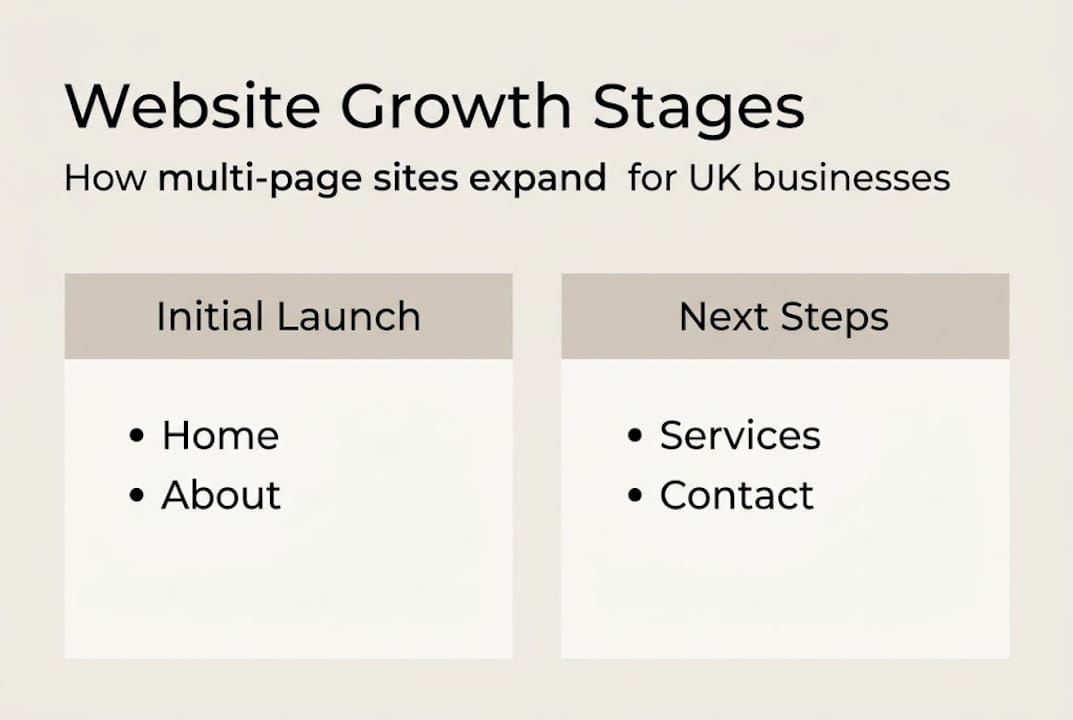
- Define your core pages first. Start with home, about, services (or products), and contact. These four form your foundation.
- Map your customer journey. Ask where a first-time visitor lands and what steps you want them to take next. Design your navigation around those paths.
- Plan for expansion. Even if you do not have a blog today, leave room for one. Structure your URLs logically so adding new sections never requires a full rebuild.
- Add depth incrementally. Launch with your core pages and add testimonials, case studies, FAQs, and regional pages as your business grows.
- Review and refine regularly. Analytics will show you which pages attract visitors and where people leave. Act on that data.
Pro Tip: Keep your navigation structure consistent as your site grows. If you reorganise menus every six months, returning visitors get lost and trust erodes. Decide on your main categories early and protect them.
The payoff of this disciplined approach is significant. Scalable design for growth means your website investment compounds over time rather than depreciating. And with e-commerce traffic scaling directly in proportion to the number of well-optimised pages, every new page you add is another door for customers to walk through.
| Growth stage | Recommended pages to add |
|---|---|
| Launch | Home, About, Services, Contact |
| 6 months | Testimonials, Blog, FAQ |
| 12 months | Regional landing pages, Case studies |
| 24 months | Resource hub, Careers, Partner pages |
Why clarity beats complexity: a business-first approach to web structure
Here is something we see constantly, and it is worth saying plainly. More pages do not automatically mean a better website. We have worked with UK business owners who launched 40-page sites crammed with duplicate content, confusing sub-menus, and pages that had not been updated in three years. The result was not a thriving online presence. It was a maze that frustrated visitors and sent them straight to a competitor.
The uncomfortable truth is that a poorly structured multi-page site can perform worse than a clean, focused single-page one. What matters is clarity of purpose on every page. If a visitor cannot immediately understand what a page is for and what to do next, that page is working against you.
We always encourage our clients to review their sites against real user behaviour, not just a wishlist of features. Look at your analytics. If a page gets traffic but no conversions, it needs work. If a page is buried in your navigation and rarely visited, question whether it should exist at all.
Following sharp website success tips means building fewer, better pages rather than many mediocre ones. Clarity is your competitive advantage. Protect it as your site grows.
Get expert help with multi-page websites and branding
If this guide has helped you see the real value of a well-structured multi-page website, you are already thinking like a business owner who takes their online presence seriously. That is a fantastic start.
At Kukoo Creative, we have spent over a decade helping UK business owners build websites and brands that genuinely work. From planning your page structure to crafting a design that earns trust on every screen, we are here to support you every step of the way. Browse our web design portfolio to see what is possible, explore our web design process guide to understand how we work, or discover how branding impact shapes the way customers perceive you. Let us build something extraordinary together.
Frequently asked questions
Is a multi-page website better for SEO than a single-page site?
Yes, multi-page websites generally perform better for SEO because they allow targeting of a wider range of keywords and content topics. Optimised multi-page sites also achieve stronger conversion rates when pages load within 2.5 seconds.
How many pages should a business website have?
Most UK business sites benefit from at least five to seven pages, including home, about, services, contact, and testimonials or a blog. You can expand from there as your business grows.
Does having more pages slow down my website?
Not necessarily. Well-optimised multi-page sites can load quickly and convert significantly better than slow, cluttered single-page alternatives, with performance improvements of up to 61 percent possible through proper optimisation.
Are multi-page websites harder to maintain for small businesses?
With modern content management tools, managing a multi-page website is straightforward and scalable, especially when the site is structured clearly and logically from the very beginning.