
TL;DR:
- Scalable design enables small businesses to adapt branding assets as they grow without costly overhauls.
- Implementing flexible systems reduces long-term costs and ensures consistent brand recognition across platforms.
- Starting with modular assets and clear guidelines helps small businesses support expansion and market agility.
Nearly 69% of UK SME employers are now adopting scalable technology to manage sales and operations, yet most still treat design as a one-off task. That disconnect is quietly bottlenecking growth for thousands of ambitious small businesses across the UK. Your logo, website, and brand materials are not just visual decoration. They are living assets that must evolve alongside your business. This guide cuts through the confusion, explains what scalable design actually means, and shows you how to use it as a genuine growth lever rather than a box to tick once and forget.
Table of Contents
- What is scalable design and why does it matter?
- Key benefits of scalable design for UK small businesses
- Common challenges in implementing scalable design
- How to choose scalable design for your business
- Why scalable design is the real competitive edge for UK small businesses
- Take your brand further with scalable design expertise
- Frequently asked questions
Key Takeaways
| Point | Details |
|---|---|
| Design for growth | Scalable design ensures your brand evolves seamlessly as your business expands. |
| Save time and money | Starting with scalable assets reduces future redesign costs and operational delays. |
| Flexible brand consistency | Consistent, adaptable branding builds customer trust across all touchpoints. |
| Take practical steps | Small changes, like modular assets and smart partnerships, make scalability achievable. |
What is scalable design and why does it matter?
Scalable design is a modular, adaptable approach to creating brand and digital assets that can grow with your business without requiring a complete overhaul every time you expand. Think of it as building your brand on a flexible framework rather than a rigid template. When your business adds a new service, enters a new market, or launches a fresh product line, scalable design means your visual identity stretches and adapts rather than cracks under the pressure.
Static design, by contrast, limits you. A logo created in isolation, a website built without future growth in mind, or brand materials that only work in one format will eventually become obstacles. You end up spending money on redesigns that could have been avoided entirely.
There are a few common misconceptions worth addressing here:
- Design is a one-time investment. Many business owners commission a logo and assume the job is done. In reality, your brand needs to evolve as your audience and offerings change.
- Scalable design is only for large companies. Small businesses benefit most from getting this right early, before bad habits become expensive problems.
- Consistency means rigidity. Scalable design actually creates consistency through flexibility, using systems and guidelines rather than fixed, inflexible files.
“Your brand is not what you say it is. It is what your customers experience every time they encounter you, across every platform and touchpoint.”
The link between design and business scalability is direct. Scalable branding gives you the confidence to launch new offerings without starting from scratch each time. Similarly, understanding website scalability facts shows how your digital presence must keep pace with your ambitions.
With 69% of UK SMEs adopting scalable technology for sales and management, it makes little sense to leave design behind as a static afterthought.
Pro Tip: When briefing a designer or agency, always ask how your assets will adapt as your business grows. Planning for flexibility from the start saves significant time and resources later.
Key benefits of scalable design for UK small businesses
Having established what scalable design is, let us look at the direct benefits it offers to businesses like yours.
- Brand consistency across every platform. When your visual identity follows a clear system, customers recognise you instantly, whether they find you on Instagram, your website, or a printed flyer. Consistency builds trust, and trust builds sales.
- Lower long-term costs. Scalable design templates and brand guidelines reduce the need for expensive, repeated redesigns. You invest once in a solid system and iterate from there.
- Faster launches. When you add a new service or open a new location, scalable assets mean your marketing materials are ready in a fraction of the time.
- Future-proofing your brand. Markets shift, technology evolves, and customer expectations change. A scalable design system keeps you agile without constant reinvention.
The benefits of professional branding extend well beyond aesthetics. A credible, consistent brand signals stability to customers and partners alike.
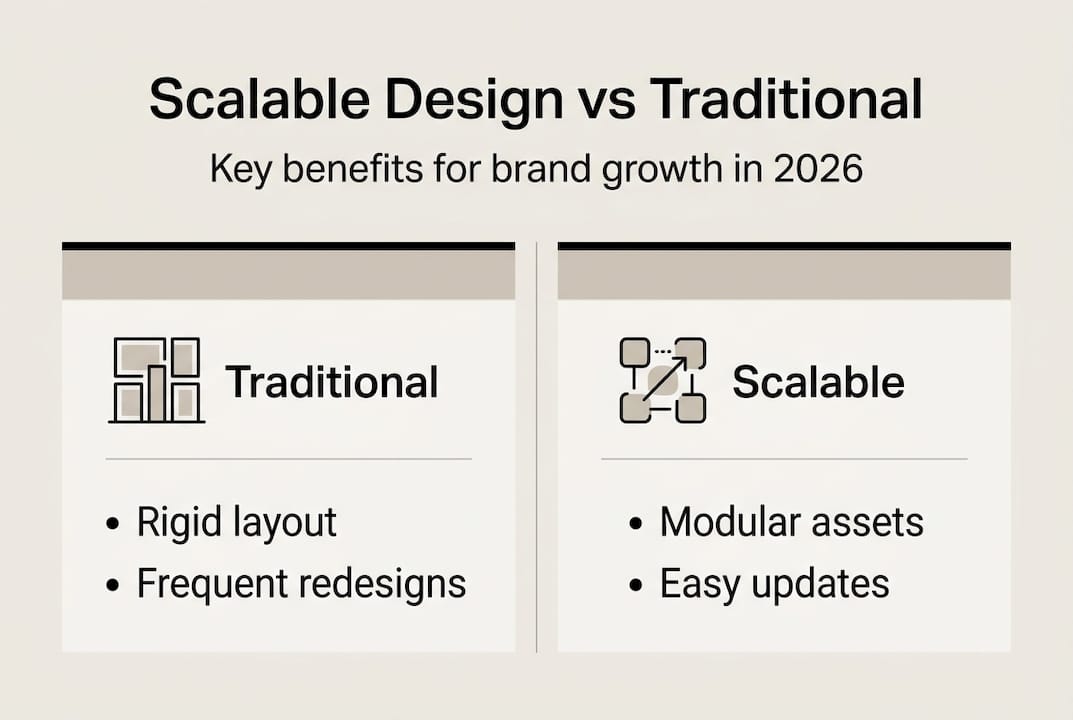
| Feature | Traditional design | Scalable design |
|---|---|---|
| Adaptability | Low, requires full redesign | High, modular and flexible |
| Long-term cost | High, repeated spend | Lower, reusable systems |
| Brand consistency | Inconsistent across channels | Consistent at every touchpoint |
| Launch speed | Slow, bespoke each time | Fast, templates ready to use |
| Growth readiness | Reactive | Proactive |
The data is encouraging. Despite the obstacles UK SMEs face, scalability adoption is rising across technology and operations. Design should be part of that same forward-thinking mindset.

Common challenges in implementing scalable design
Appreciating the value of scalable design highlights some key challenges in actually making the change. Knowing what stands in the way helps you plan around it.
The most common obstacles UK small business owners face include:
- Budget constraints. When cash flow is tight, investing in a design system can feel like a luxury. But the cost of repeated ad hoc redesigns often far exceeds the upfront investment in a scalable approach.
- Lack of internal expertise. Most small businesses do not have an in-house designer who understands flexible design systems. This makes choosing the right external partner critical.
- Cultural resistance. Change feels risky, especially when your current branding feels familiar. Many business owners stick with what they know, even when it is holding them back.
- Competing priorities. Taxation remains the top challenge for SME employers in the UK, which means design often falls down the priority list when financial pressures mount.
| Approach | Ad hoc design | Scalable design |
|---|---|---|
| Planning | Reactive, case by case | Strategic, system-led |
| Cost pattern | Unpredictable spikes | Steady, planned investment |
| Brand output | Inconsistent | Cohesive and repeatable |
| Team dependency | Relies on one person | Documented for any team member |
Understanding website scalability for growth can help you see how a scalable digital presence reduces these pressures over time. Pairing that with smart marketing strategies for growth means your design and marketing work together rather than pulling in opposite directions. It is also worth noting that accessible design success plays a role here, as inclusive design principles naturally support scalable, flexible systems.
Pro Tip: You do not need to overhaul everything at once. Start small by creating modular brand assets, a flexible logo suite, a colour palette, and a typography guide. Build from there and iterate as your business grows.
How to choose scalable design for your business
With challenges addressed, it is time to turn theory into action by thinking practically about adopting scalable design.
Before you choose any design solution or partner, ask yourself these key questions:
- Where do you want your business to be in three years?
- How many platforms or channels do you currently use, and how many might you add?
- Do you have brand guidelines, or does every piece of marketing look slightly different?
- How often do you launch new products, services, or campaigns?
Your answers will shape the level of scalability you need right now. A business with one product and one sales channel needs a different system from one planning to expand into multiple locations.
Here is a practical step-by-step process for choosing scalable design solutions:
- Audit your current assets. List every place your brand appears: website, social media, print, packaging, email. Note where inconsistencies exist.
- Define your growth goals. Be specific. Are you adding services, targeting new regions, or moving into e-commerce? Your design system must support those moves.
- Brief potential design partners clearly. Share your growth plans, not just your current needs. The right partner will design with your future in mind.
- Look for systems, not just deliverables. A scalable design partner provides guidelines, templates, and reusable assets, not just a finished logo file.
- Plan for iteration. Your brand will evolve. Build review points into your plan so your design keeps pace with your business.
When evaluating design partners or platforms, look for:
- Experience working with growing small businesses
- A portfolio that shows brand consistency across multiple formats
- Clear documentation and brand guideline delivery
- Willingness to explain how assets will adapt over time
- Transparent pricing with no hidden redesign costs
As the Longitudinal Small Business Survey confirms, scalable design supports growth across multiple business functions, from customer acquisition to operational efficiency. Learning how to approach presenting design concepts can also help you communicate your vision clearly when working with a creative partner.
Why scalable design is the real competitive edge for UK small businesses
Here is a perspective that most design conversations miss entirely. Scalable design is not a technique reserved for businesses that have already made it. It is the very thing that helps smaller firms break into larger markets in the first place.
Contrary to popular belief, design should not be finalised and filed away. It should evolve continuously as your brand matures, your audience grows, and your market shifts. The businesses we have seen outpace their competitors are not always the ones with the biggest budgets. They are the ones that treat design as a strategic investment rather than a cost centre.
When you build your brand on scalable branding insights, you are not just making things look good. You are building the agility to respond quickly, launch confidently, and stay credible at every stage of growth. Decision-makers who see design as core to business agility, rather than just the look and feel, are the ones who build thriving, lasting brands.
Take your brand further with scalable design expertise
You now understand why scalable design matters and how to approach it with confidence. The next step is putting that knowledge into practice with the right support behind you.
At Kukoo Creative, we have spent over a decade helping UK small businesses build brand recognition for small businesses through flexible, future-proof design systems. From logo design to complete brand frameworks, we create assets that grow with you rather than holding you back. If you are ready to build a brand that scales as confidently as your ambitions, explore what business branding explained looks like when it is done with your growth firmly in mind. Let us build your success story together.
Frequently asked questions
What makes a design scalable?
A scalable design uses modular assets and clear guidelines that adapt with business growth, maintaining effective and consistent branding across all platforms without requiring a full redesign each time.
How does scalable design save costs?
Scalable systems reduce the need for costly redesigns as you add products or channels, saving significant time and money over the long term by reusing flexible templates and guidelines.
Do all small businesses need scalable design?
Any small business aiming for growth or operating across multiple sales channels benefits from scalable design. Consistent branding aids growth at every stage, making it a worthwhile investment regardless of your current size.
How do I start making my brand design scalable?
Begin by auditing your existing brand assets, identifying inconsistencies, and consulting a design professional who can create flexible templates and clear brand guidelines to build from.