
Over 80 percent of british consumers now research businesses online before making a purchase decision. For Leeds business owners, an effective web design process can mean the difference between attracting local customers or losing them to the competition. Understanding your website’s purpose, knowing exactly who you want to reach, and shaping each design choice around those insights leads to stronger customer engagement and a more memorable online presence.
Table of Contents
- Step 1: Identify Brand Objectives And Audience Needs
- Step 2: Define Website Structure And Visual Strategy
- Step 3: Develop And Refine Responsive Web Layouts
- Step 4: Test Usability And Optimise Performance
- Step 5: Launch Site And Monitor User Engagement
Quick Summary
| Key Insight | Explanation |
|---|---|
| 1. Identify Brand Goals | Clearly define what your website must achieve for your business objectives in Leeds. |
| 2. Understand Your Audience | Create detailed customer personas to address their needs and enhance user experience. |
| 3. Plan Website Structure | Develop a logical content hierarchy for intuitive navigation and improved user engagement. |
| 4. Prioritise Responsive Design | Ensure your site functions flawlessly across all devices for wider accessibility. |
| 5. Regularly Review Performance | Continuously analyse user engagement to refine and optimise your website based on real feedback. |
Step 1: Identify brand objectives and audience needs
Successfully designing a website for your Leeds business starts with understanding precisely who you are designing for and what you want to achieve. Your brand objectives and target audience form the strategic foundation that will guide every visual and functional decision throughout the web design process.
To begin, map out your core business goals by asking critical questions about your brand. What specific outcomes do you want your website to deliver? Are you seeking to generate more local enquiries, showcase your portfolio, or provide online purchasing capabilities? Understanding your audience’s motivations and needs becomes paramount in translating these objectives into an effective digital strategy. Start by creating detailed customer personas that capture demographic details, professional backgrounds, online behaviours, and specific pain points relevant to your Leeds market.
Research goes beyond basic demographics. Conduct surveys, analyse website analytics, and review customer feedback to build a nuanced picture of your audience. The goal is creating a website experience that feels personally tailored and addresses your customers’ precise requirements. By aligning your brand objectives with audience insights, you transform your website from a generic online presence into a powerful business asset.
Insider Tip: Create a simple spreadsheet tracking your target audience’s key characteristics, challenges, and digital preferences to maintain clarity throughout your web design journey.
Here is a summary of essential factors for understanding your target audience and brand objectives:
| Factor | Description | Business Benefit |
|---|---|---|
| Demographics | Age, location, gender, and interests | Refines messaging and visual appeal |
| Behavioural Patterns | Online habits, typical device usage | Improves UX and site navigation |
| Key Pain Points | Main challenges faced by customers | Shapes solutions and content focus |
| Strategic Objectives | Desired outcomes from web presence | Aligns digital strategy to goals |
Step 2: Define website structure and visual strategy
Defining your website’s structure and visual strategy transforms your digital presence from a basic online placeholder to a powerful business communication tool. This crucial step determines how potential customers will interact with and perceive your brand through digital channels.

Website structure organises content in a logical hierarchy that supports both user experience and search engine visibility. Begin by creating a clear content map that outlines your key pages navigation menu and how information will flow between different sections. Consider your audience’s journey think about how they will move through your site to find relevant information or complete specific actions. Your menu should be intuitive reflecting the most important aspects of your business and making it simple for visitors to find what they need.
Visual strategy requires careful consideration of your brand identity colour palette typography and imagery. Select design elements that communicate your business personality while maintaining professional appeal. Aim for a clean responsive design that works seamlessly across mobile and desktop platforms. Remember that your visual choices should not just look attractive but also support your core business objectives and enhance user engagement.
Top Tip: Create wireframe sketches of your proposed website layout to test navigation flow and user experience before investing in full design development.
Step 3: Develop and refine responsive web layouts
Responsive web design transforms your website into a flexible digital platform that adapts seamlessly across different devices and screen sizes. This critical step ensures your Leeds business presents a professional and accessible online presence that works perfectly whether viewed on a mobile phone, tablet, or desktop computer.
Building a responsive layout requires strategic planning and technical precision. Start by implementing a flexible grid system that allows content to resize and reposition intelligently. Use percentage based widths instead of fixed pixel measurements, which enables your design to stretch and contract naturally. Focus on creating a mobile first approach where your core content and functionality work brilliantly on smaller screens before scaling up to larger displays. Prioritise intuitive navigation and readable typography that maintains clarity across all device types.
Technical implementation involves using CSS media queries to define how your layout should respond at different breakpoints. Test your design rigorously across multiple devices and browsers to ensure consistent performance. Pay attention to touch friendly elements for mobile users larger tap targets easier scrolling and simplified menus that work equally well with mouse or finger interactions. Remember that a truly responsive design is not just about visual flexibility but about creating an optimal user experience regardless of how someone accesses your website.
Expert Advice: Use browser developer tools to simulate different device screens and thoroughly test your responsive design before final implementation.
Step 4: Test usability and optimise performance
Evaluating and refining your website’s user experience represents the critical final stage in ensuring your digital platform truly serves your Leeds business objectives. This step transforms your design from a theoretical concept into a functional tool that genuinely connects with potential customers.
Website usability testing helps identify how easily users navigate and complete tasks across different devices and interaction points. Begin by recruiting a diverse group of test participants who represent your target audience. Create specific scenarios that mirror real world interactions potential customers might have with your website. Ask participants to complete key tasks like finding contact information booking a service or making an enquiry while you observe their navigation patterns and note any points of confusion or friction.
Performance optimisation goes beyond visual design into technical refinement. Analyse website loading speeds across different devices measure interaction times and identify any technical barriers that might frustrate users. Use tools like Google PageSpeed Insights to evaluate your site performance and implement recommended improvements. Pay close attention to mobile responsiveness image compression and script minimisation. Remember that even a one second delay in page loading can significantly reduce user engagement and potentially impact your search engine rankings.
Expert Tip: Schedule regular quarterly usability testing sessions to continuously adapt and improve your website based on real user feedback and changing digital behaviours.
Step 5: Launch site and monitor user engagement
Launching your website marks the culmination of your strategic design process and the beginning of your digital journey. This pivotal moment transforms your carefully crafted website from a development project into a live platform that represents your Leeds business to the world.
A comprehensive website launch checklist ensures smooth deployment and initial performance tracking. Before going live, conduct a final comprehensive review of all pages, checking for broken links, ensuring mobile responsiveness, and verifying that contact forms and interactive elements function correctly. Set up key analytics tools like Google Analytics to track user behaviour from the moment your site goes live. Focus on critical metrics such as page views, session duration, bounce rates, and conversion pathways that reveal how visitors interact with your digital platform.
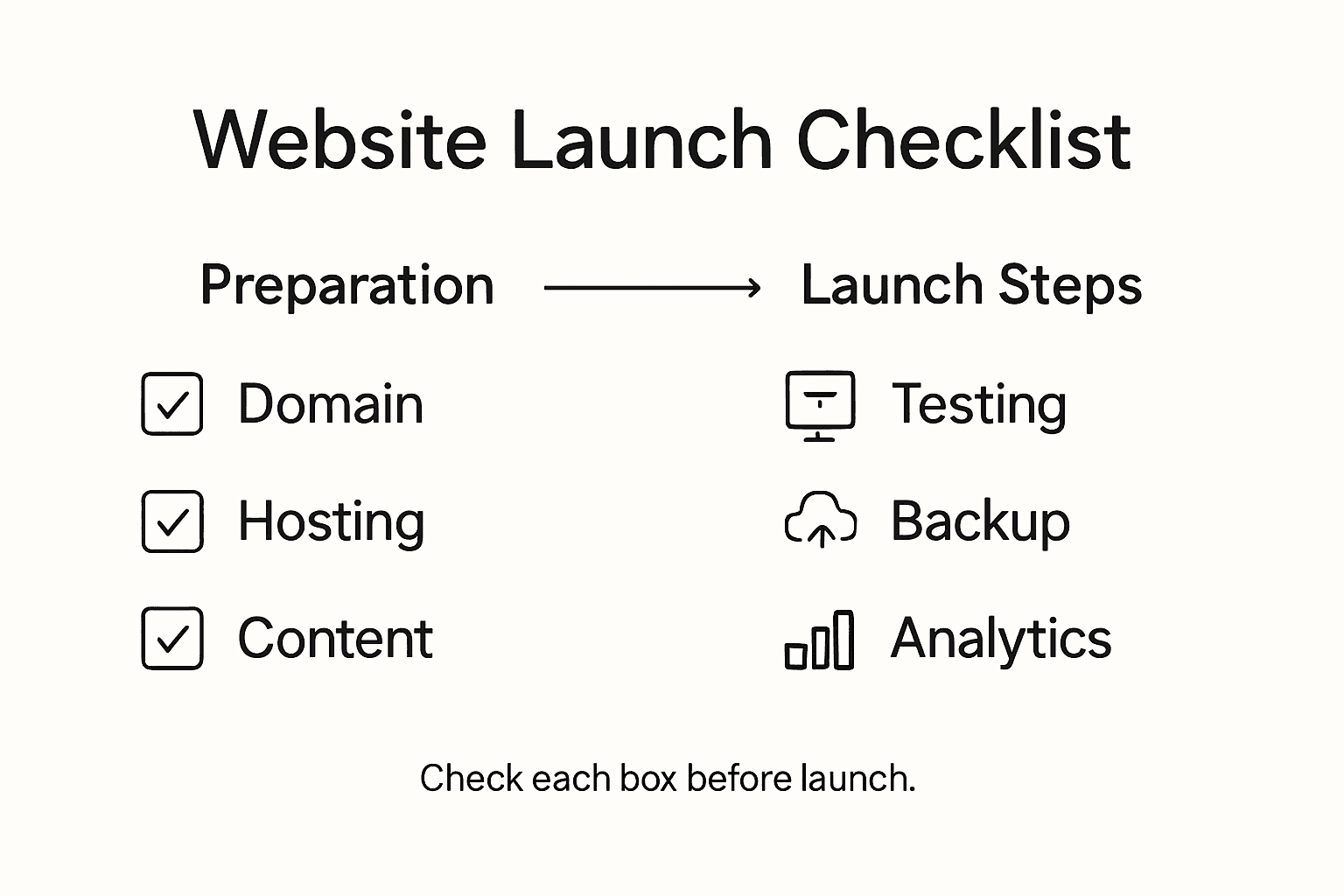
Engagement monitoring is an ongoing process that requires consistent attention. Review your website analytics monthly to understand user patterns and identify potential improvements. Pay close attention to which pages attract the most traffic, where users spend the most time, and at what points they might be leaving your site. Use these insights to continuously refine your content, navigation, and overall user experience. Remember that your website is a dynamic tool that should evolve based on real user interactions and changing business objectives.
Expert Tip: Create a quarterly review calendar to systematically analyse your website performance and implement data driven improvements.
Below is a comparison table outlining website launch metrics and their significance:
| Metric | What It Measures | Why It Matters |
|---|---|---|
| Page Views | Number of visits per page | Indicates popular content areas |
| Session Duration | Average time spent | Reveals engagement and content quality |
| Bounce Rate | Early exit percentage | Flags pain points or navigation issues |
| Conversion Pathways | User journey to goals | Tracks sales, enquiries, or bookings |
Elevate Your Leeds Business with Expert Web Design Support
Embarking on the web design journey outlined in the “Web Design Process Guide for Leeds Business Owners” can feel overwhelming. From pinpointing your brand objectives and defining a responsive website structure to testing usability and launching, each stage demands precision and a clear understanding of your audience’s needs. Common challenges include translating business goals into compelling visual strategies and ensuring seamless mobile responsiveness that truly engages visitors. At kukoocreative-com.stackstaging.com/, we understand these pain points and specialise in crafting impactful digital experiences tailored to your unique business aspirations.
Our team has partnered with Leeds business owners for over a decade to deliver captivating logos and websites that not only build brand recognition but also connect you directly with your target market. We combine strategic insight with technical excellence to help you overcome hurdles like optimising user experience and tracking meaningful engagement metrics. You can learn more about our comprehensive design services at kukoocreative-com.stackstaging.com/ and see how we bring your digital vision to life by visiting our landing page.
Ready to transform your online presence with a responsive website that truly reflects your brand’s objectives and meets your customers’ needs?
Take the next step today by partnering with experts who know how to convert these web design concepts into results. Discover how we can help you create a powerful, engaging website that drives real business growth. Visit kukoocreative-com.stackstaging.com/ and start shaping your digital future now.
Frequently Asked Questions
What are the key objectives to consider when designing a website for my Leeds business?
Establishing clear objectives is essential for your website. Identify what outcomes you want to achieve, such as generating local enquiries or showcasing your portfolio. Create a list of specific goals to guide your web design decisions.
How can I understand my target audience for effective web design?
To understand your target audience, create detailed customer personas capturing their demographics, behaviours, and pain points. Conduct surveys and analyse website analytics to build a nuanced picture of their needs. This insight will help tailor your website to resonate with potential customers.
What is the best way to structure my website’s navigation?
A clear and intuitive website structure is crucial for user experience. Map out the content hierarchy and create a navigation menu reflecting the most important aspects of your business. Test your proposed layout through wireframe sketches to ensure easy navigation for visitors.
How do I create a responsive design that works on all devices?
Implement a flexible grid system that allows your website layout to adapt to various screen sizes. Prioritise mobile usability first, ensuring core content and functionalities are optimal on smaller screens. Regularly test your design across multiple devices and browsers to ensure consistency.
What should I do to test usability before launching my website?
Usability testing involves observing real users navigating your site to identify any challenges they face. Recruit a diverse group to complete specific tasks and note any confusion or friction points. Use this feedback to make necessary adjustments before your site goes live.
How can I monitor user engagement after my website is launched?
Set up analytics tools to track user behaviour once your site is live. Focus on metrics such as page views, session duration, and bounce rates to understand how visitors interact with your content. Regularly review this data and make improvements based on user interactions to enhance the overall experience.