
A website redesign can transform your business, but without proper planning, it risks running late and exceeding budget. 51% of redesign projects launch late and 63% go over budget, costing UK businesses valuable time and resources. This guide walks you through a structured approach to planning your redesign, helping you avoid common pitfalls while positioning your site to achieve up to 35% improvements in conversion rates.
Table of Contents
- Prerequisites and Tools Needed Before You Start
- Setting Clear Business Goals and Success Metrics
- Planning Timeline and Budget Considerations
- SEO Considerations and Preservation Strategies
- Stakeholder Collaboration and Project Management
- Common Mistakes and How to Avoid Them
- Expected Results and Outcomes with Success Benchmarks
- Discover Expert Website Redesign Services to Elevate Your UK Business
Key Takeaways
| Point | Details |
|---|---|
| Set Clear Goals | Define specific conversion targets and KPIs before starting to guide every design decision. |
| Plan for Contingency | Budget an extra 20-30% and schedule buffer time to handle unexpected challenges smoothly. |
| Protect Your SEO | Conduct thorough audits and create redirect maps to preserve rankings and traffic during transition. |
| Engage Stakeholders Early | Involve marketing, IT, and design teams from day one to reduce delays and misalignment. |
| Test Extensively | Validate across devices and browsers before launch to catch issues that could harm user experience. |
Prerequisites and Tools Needed Before You Start
Before diving into redesign planning, you need the right foundation. Access to performance data is non-negotiable. Set up Google Analytics and Google Search Console if you haven’t already. These tools reveal how visitors currently interact with your site and where improvements matter most. PageSpeed Insights shows technical issues slowing your site down.
Understanding core web vitals and SEO health is critical before redesign begins. Without baseline metrics, you cannot measure success or justify investment. Familiarise yourself with SEO fundamentals like keyword targeting, meta descriptions, and mobile optimisation. Knowing basic user experience principles helps you evaluate design proposals intelligently.
Gather your team early. Marketing, sales, IT, and leadership all have stakes in the outcome. Early stakeholder input defines project scope and prevents costly mid-project changes. Secure budget approval including contingency funds before planning begins. Nothing derails projects faster than funding gaps halfway through.
Consider these essential prerequisites:
- Analytics access and historical performance data for benchmarking
- SEO audit tools to identify technical issues and content gaps
- Stakeholder availability for regular reviews and decision-making
- Approved budget with 20-30% contingency for unexpected needs
- Basic wireframing or design brief documenting current pain points
If your brand identity needs refreshing alongside your website, explore our logo redesign guide and branding strategy guide. Aligning visual identity with digital presence creates stronger market impact. Our web design process guide details how professional teams coordinate these moving parts.
Setting Clear Business Goals and Success Metrics
Vague aspirations like “modernise the website” doom projects to scope creep and disappointment. Set specific goals such as increasing conversions by 10% or improving average session duration by 20% within six months of launch. Specific targets drive design decisions and help teams prioritise features.
Follow this process to define meaningful objectives:
- Review current performance metrics to establish realistic improvement targets
- Identify your top three business priorities like lead generation or e-commerce sales
- Translate business priorities into website-specific goals with numeric targets
- Select 5-7 KPIs that directly measure progress toward those goals
- Document how you will track and report these metrics monthly post-launch
Your KPIs might include conversion rate, bounce rate, average session duration, pages per session, organic traffic volume, page load speed, and mobile usability scores. Each metric should connect clearly to a business outcome. If you cannot explain why a metric matters to revenue or customer satisfaction, drop it.

Ensure website goals align with broader business strategy. If your company aims to expand into new regions, your redesign should emphasise local SEO and regional content. If customer retention drives growth, focus on personalised user journeys and account management features.
Pro Tip: Create a one-page goal document that every team member can reference. Include target numbers, measurement methods, and the business reason behind each goal. This keeps everyone focused when design debates arise.
Communicate goals clearly with all stakeholders. Marketing needs to understand how the redesign supports campaign performance. Sales should see how improved lead capture forms help their pipeline. IT must know which integrations matter most. Our brand launch guide and branding tips for small businesses show how strategic alignment across teams amplifies results.
Planning Timeline and Budget Considerations
Realistic scheduling and budgeting prevent the overruns plaguing most redesigns. Budget for additional 20-30% contingency over initial cost estimates; redesign cycles occur every 2-3 years for full overhauls, with smaller updates in between. This rhythm balances staying current without constant disruption.
Break your timeline into distinct phases:
- Discovery and audit: 2-4 weeks to analyse current site and define requirements
- Design: 4-6 weeks for mockups, revisions, and stakeholder approval
- Development: 6-10 weeks to build, integrate systems, and populate content
- Testing: 2-3 weeks for quality assurance, device testing, and bug fixes
- Launch and monitoring: 1-2 weeks for deployment and immediate post-launch adjustments
These estimates assume a typical small to medium business site with 20-50 pages and moderate complexity. Add time for custom features, complex integrations, or extensive content creation. Schedule explicit stakeholder review points at the end of each phase. Waiting for feedback delays progress and frustrates teams.
Budget beyond design and development costs. Factor in content writing, photography, SEO consulting, project management, hosting upgrades, and ongoing maintenance. The 20-30% contingency covers scope additions, extra revision rounds, or technical challenges discovered mid-project.
Pro Tip: Build a phased launch approach into your timeline. Launch core pages first, then add advanced features in subsequent releases. This reduces initial complexity and gets improvements live faster.
Aim for delivery within 10% of planned budget and timeline. Larger variances signal planning problems or scope creep. Regular status updates and transparent communication help catch issues early. Our visual branding workflow demonstrates how structured processes keep creative projects on track.
SEO Considerations and Preservation Strategies
Without clear SEO planning, redesigns often cause declines in organic traffic and rankings that take months to recover. Protecting your hard-won search visibility requires deliberate technical measures throughout the redesign process.
Start with a comprehensive SEO audit identifying your top-performing pages, valuable backlinks, and current keyword rankings. Document every URL on your existing site, noting which pages drive traffic and conversions. This inventory becomes your preservation checklist.
Follow these steps to safeguard SEO during redesign:
- Map old URLs to new ones, planning 301 redirects for any URL changes
- Preserve existing high-performing content, improving rather than replacing it
- Maintain meta titles, descriptions, and header tags for top-ranking pages
- Optimise new site architecture for crawlability and logical information hierarchy
- Ensure mobile responsiveness and fast page load speeds meet Core Web Vitals standards
- Submit updated XML sitemap to search engines immediately after launch
- Monitor rankings and traffic closely for three months post-launch
Coordinate closely between design, development, and SEO teams. Designers must understand how image optimisation affects speed. Developers need to implement proper heading structures and schema markup. Everyone should prioritise mobile experience since most UK traffic comes from smartphones.
Compare your options carefully:
| Approach | Timeline | SEO Risk | Cost | Best For |
|---|---|---|---|---|
| Full Redesign | 4-6 months | Moderate to High | £8,000-£25,000+ | Complete visual refresh and major functionality changes |
| Partial Refresh | 6-10 weeks | Low to Moderate | £3,000-£10,000 | Updating design while keeping core structure and content |
| Iterative Updates | Ongoing | Very Low | £500-£2,000/month | Continuous improvement without disruption |
Full redesigns deliver dramatic transformation but carry higher risk. Partial refreshes update look and feel while minimising technical disruption. Iterative approaches spread changes over time, reducing risk but extending timeline for visible improvements.
Our SEO in branding guide explains how search visibility integrates with brand strategy. Our responsive design guide details mobile optimisation techniques that protect rankings while improving user experience.
Stakeholder Collaboration and Project Management
Early and continuous stakeholder engagement reduces risk of delays and budget issues by ensuring alignment before problems escalate. Website redesigns affect every department, so involving key players from the start prevents misalignment and rework.
Identify your core project team early. Typically this includes a project sponsor from leadership, marketing lead, IT manager, content creator, and either an internal web lead or external agency partner. Each person needs a clearly defined role and decision-making authority within their domain.
Establish communication protocols at project kickoff:
- Weekly status meetings with core team to review progress and resolve blockers
- Bi-weekly updates to broader stakeholder group showing visual progress
- Dedicated Slack channel or project management tool for daily questions
- Clear escalation path for decisions requiring leadership approval
- Documented feedback and revision process with defined turnaround times
Use project management tools like Asana, Monday, or Trello to maintain transparency. Everyone should see current tasks, upcoming milestones, and who owns each deliverable. This visibility reduces duplicate work and helps team members support each other.
Schedule explicit feedback windows with fixed deadlines. Open-ended review periods lead to delayed responses and cascading timeline impacts. Give stakeholders one week to provide consolidated feedback after each major deliverable. Appoint one person to gather and synthesise all input before sharing with the design team.
Facilitate cross-functional collaboration throughout the project. Marketing insights inform content strategy. Sales feedback shapes lead capture forms. Customer service identifies common user pain points. IT ensures backend systems integrate smoothly. Our branding consistency workflow shows how coordinated teams maintain quality across touchpoints.
Common Mistakes and How to Avoid Them
Learning from others’ failures saves time and money. Over 50% of redesign failures neglect SEO audits and migration planning, causing traffic loss that damages business performance for months. Avoid these pitfalls with proactive planning.
The most damaging mistakes include:
- Starting without specific, measurable goals that guide design decisions and priority trade-offs
- Skipping comprehensive SEO audits and redirect planning before changing URLs or site structure
- Poor stakeholder communication leading to surprise feedback late in development
- Insufficient testing across devices, browsers, and user scenarios before launch
- No contingency budget or timeline buffer to handle inevitable surprises
- Ignoring existing analytics data when making design and content decisions
- Launching without proper staff training on new CMS or website features
Set concrete objectives at project start. Vague goals like “improve user experience” provide no basis for evaluating design proposals. Specific targets like “reduce checkout abandonment by 15%” focus the team and enable data-driven decisions.
Plan your SEO strategy before touching site architecture. Audit current performance, map redirects, and preserve valuable content. Treating SEO as an afterthought guarantees traffic losses that undermine redesign ROI.
Maintain frequent communication with all stakeholders. Surprises late in development cost far more to fix than early course corrections. Regular updates and structured feedback processes keep everyone aligned.
Test extensively before launch. Check functionality on iPhone, Android, desktop, and tablet. Validate forms, shopping carts, and integrations under realistic conditions. User testing reveals confusion that designers miss because they know the site too well.
Include 20-30% contingency in both budget and timeline. Unexpected challenges always emerge. Contingency funds let you address them without compromising quality or delaying launch. Our web design process guide details quality assurance steps that catch issues early.
Expected Results and Outcomes with Success Benchmarks
Knowing realistic outcomes helps you evaluate success and demonstrate ROI to stakeholders. Redesigns can yield up to 35% increase in conversions and 10-20% revenue growth when executed strategically with clear goals and proper planning.
Typical improvements within 6-12 months post-launch include conversion rate increases of 10-35%, depending on how outdated your previous site was. Average session duration often improves by 20% or more as better navigation and content keep visitors engaged. Bounce rates typically decrease 15-25% when page speed and mobile experience improve.
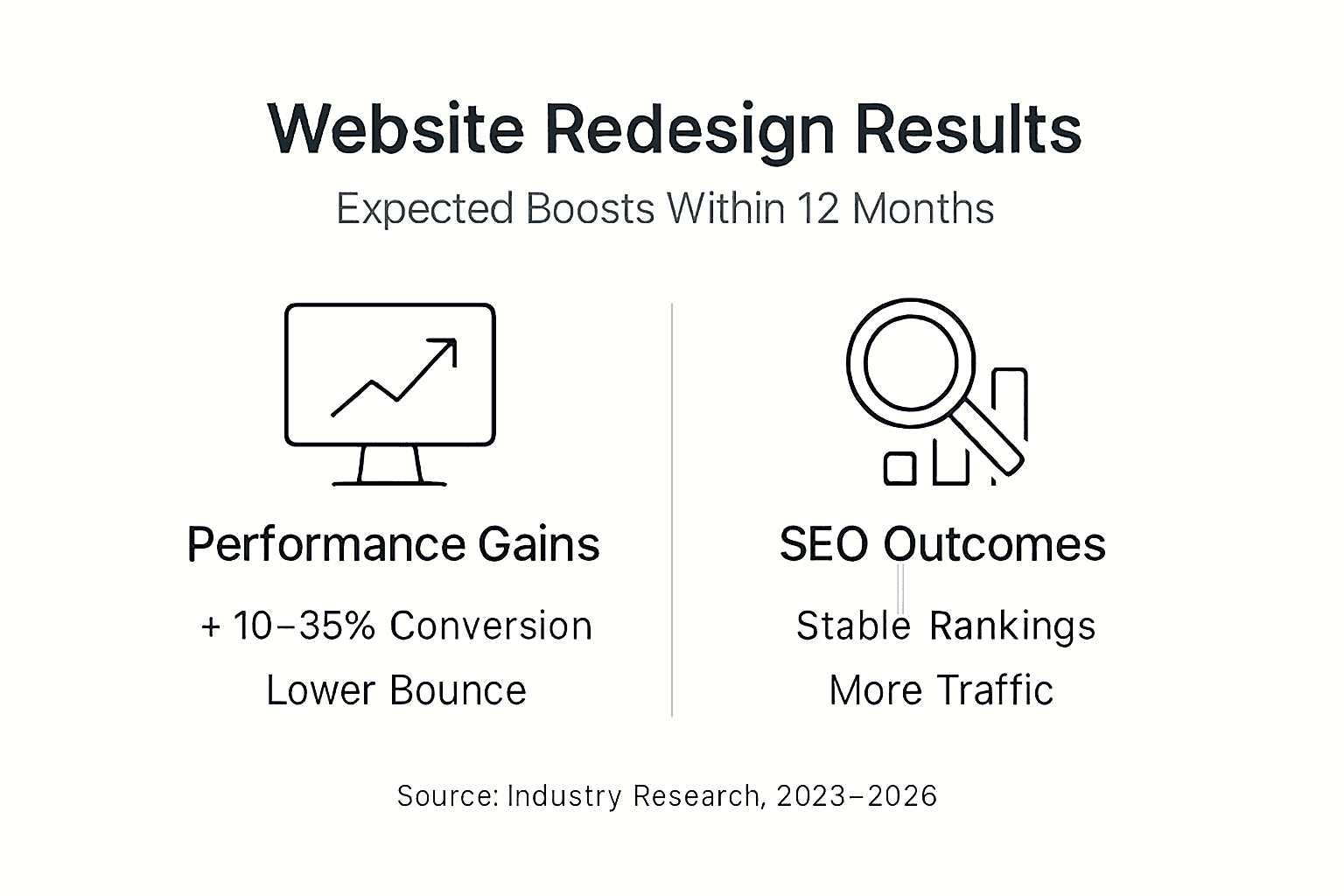
SEO rankings can be preserved or even improved within three months of launch if you follow proper migration procedures. Some temporary fluctuation is normal as search engines recrawl your site, but well-executed redesigns stabilise quickly.
Project delivery metrics matter too. Completing within 10% of original timeline and budget indicates good planning and management. Larger variances suggest scope creep or inadequate initial assessment.
| Metric | Baseline | 3-Month Target | 6-Month Target | 12-Month Target |
|---|---|---|---|---|
| Conversion Rate | 2.1% | 2.5% | 2.8% | 3.2% |
| Avg Session Duration | 1:45 | 2:00 | 2:15 | 2:30 |
| Bounce Rate | 58% | 52% | 48% | 45% |
| Organic Traffic | 5,200/mo | 5,000/mo | 5,500/mo | 6,200/mo |
| Page Load Speed | 4.2s | 2.8s | 2.5s | 2.3s |
These benchmarks provide realistic expectations based on industry data. Your specific results depend on starting conditions, budget, and how well you execute the strategies outlined in this guide. Track these metrics monthly and adjust tactics based on performance trends.
Remember that redesign benefits compound over time. Initial improvements continue growing as you optimise based on user behaviour data and search engine feedback. Our user experience enhancement guide explores how visual design choices drive measurable performance gains.
Discover Expert Website Redesign Services to Elevate Your UK Business
Planning a successful redesign requires expertise across strategy, design, development, and SEO. For over a decade, we’ve partnered with UK small and medium businesses to create websites that build brand recognition and drive measurable results.
Our proven process aligns your business goals with user needs and technical best practices. We handle everything from initial audits through post-launch optimisation, ensuring your redesign delivers the conversion improvements and user experience enhancements you expect. Explore our professional web design services tailored specifically for UK businesses like yours. Review our web design process guide to understand how we avoid common pitfalls while staying on time and budget. See real results in our design portfolio showcasing successful redesigns for businesses across the UK.
Frequently Asked Questions
How long does a typical website redesign take for a small to medium UK business?
Most redesigns require 3-6 months from initial planning through launch, depending on scope and complexity. Phased approaches may extend this timeline but improve quality control and allow for iterative feedback. Simple refreshes with minimal functionality changes can complete in 6-10 weeks.
What budgets should UK businesses allocate for a full website redesign in 2026?
Budgets vary widely based on site complexity, but plan for £8,000-£25,000 for a full redesign of a typical small to medium business site. Always include 20-30% contingency beyond initial estimates to handle unexpected requirements or scope additions that emerge during development.
How can I ensure my website redesign doesn’t harm my existing SEO rankings?
Conduct a thorough SEO audit before starting, create a comprehensive 301 redirect map for any URL changes, and maintain your existing high-performing content and metadata. Work with developers who understand technical SEO and prioritise mobile optimisation and page speed from the start.
Should I do a full redesign or a partial refresh of my business website?
Choose a full redesign when you need major functionality changes, complete visual transformation, or outdated technology that limits growth. Opt for a partial refresh if your site structure works well but needs visual updates and minor improvements. Consider your budget, timeline, and how urgently you need changes live.