
TL;DR:
- Customer journey maps visually capture customer interactions, emotions, and pain points across touchpoints.
- They promote organizational alignment by providing a shared understanding and evidence-based decision-making.
A customer journey map is a visual representation of every interaction a customer has with your business, capturing their actions, emotions, and pain points across each touchpoint. The term “customer journey map” is widely used, though the recognised industry standard is customer experience mapping, a structured method championed by organisations like the Nielsen Norman Group. Understanding why customer journey maps work is the first step to using them well. They do not just improve customer experience. They create organisational alignment, sharpen resource prioritisation, and give UK business owners a credible basis for strategic decisions.
Why customer journey maps are essential for business strategy
Customer journey maps give every department a shared view of reality. Without one, your marketing team, sales team, and support team each hold a different mental model of the customer. That fragmentation leads to conflicting priorities and wasted effort. Cross-departmental alignment is consistently cited as the prime benefit of mapping, sitting above customer experience improvements in practical value.

The maps also replace guesswork with evidence. Prioritisation without maps tends to follow the loudest voice in the room rather than data. A well-built map identifies which touchpoints carry the highest leverage for retention and growth. That shifts decision-making from opinion to observation, which is exactly what UK marketing professionals need when budgets are tight and accountability is high.
The importance of customer journey mapping extends to brand perception too. Every touchpoint either builds or erodes trust. Mapping makes those moments visible before they become problems.
What are the essential components of a customer journey map?
An effective customer journey map contains five core components: actor, scenario, journey phases, actions and emotions, and improvement opportunities with assigned ownership. Each element serves a distinct purpose in making the map usable rather than decorative.
| Component | Role in the map |
|---|---|
| Actor (persona) | Defines whose journey is being mapped, grounded in real customer data |
| Scenario and goal | Sets the context and what the customer is trying to achieve |
| Journey phases | Breaks the experience into stages such as awareness, consideration, and onboarding |
| Actions, mindset, and emotions | Captures what customers do, think, and feel at each stage |
| Opportunities with ownership | Identifies improvements and assigns a named person responsible for each |
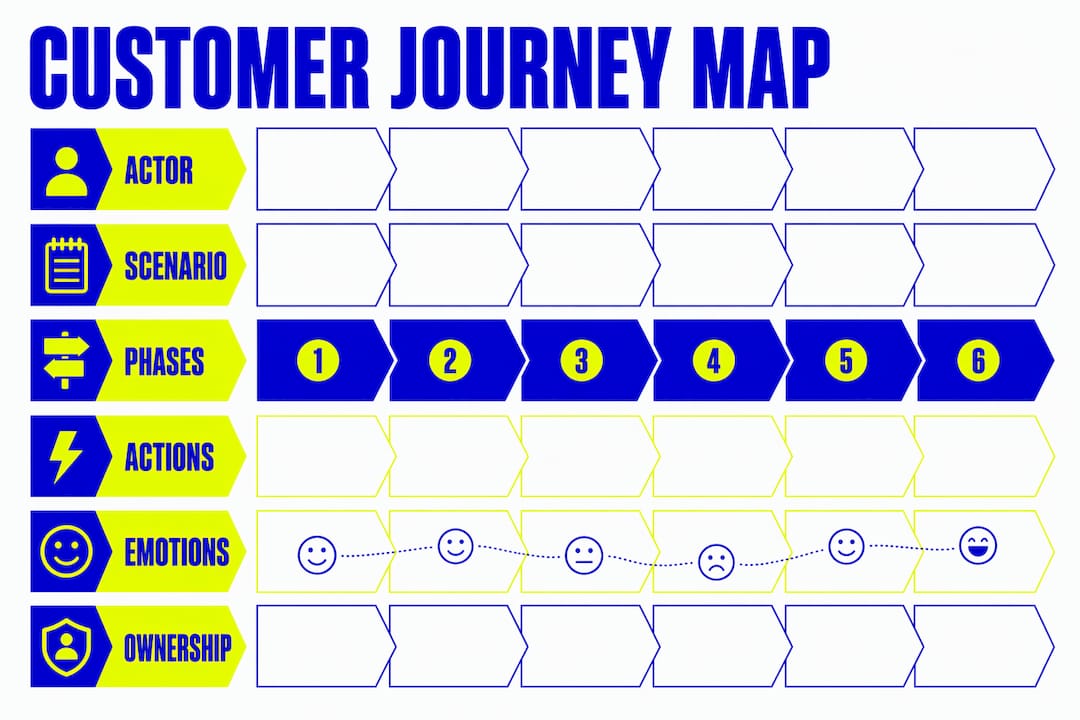
The ownership column is the one most teams skip. Assigning explicit ownership for every identified opportunity prevents insights from becoming orphaned. A map without owners is a document. A map with owners is a plan.
Real customer data must drive every row of that table. Maps built on assumptions rather than interviews, surveys, or behavioural data produce what practitioners call “mapping fiction.” The resulting insights feel plausible but do not reflect actual customer behaviour.
Pro Tip: Run at least five customer interviews before building your first map. Five conversations will surface patterns that no amount of internal brainstorming can replicate.
How do journey maps improve organisational alignment?
Mapping creates a single source of truth that every team can reference. Marketing, sales, product, and support teams stop arguing about whose version of the customer is correct. They work from the same evidence. That shared understanding is the greatest organisational benefit a business can extract from the exercise.
The practical benefits of this alignment are significant:
- Reduced duplication. Teams stop solving the same customer problem independently without knowing it.
- Faster decisions. When a friction point is visible on a shared map, the conversation moves from “is this a problem?” to “who fixes it and when?”
- Clearer resource allocation. Maps identify high-leverage touchpoints so budget goes where it produces the most impact.
- Better handoffs. Sales to onboarding, onboarding to support. Each transition becomes a designed moment rather than an accidental gap.
- Stronger customer retention. Teams that understand the full customer lifecycle make decisions that protect long-term relationships, not just short-term conversions.
The web design process at Kukoocreative reflects this principle directly. Aligning client goals with design decisions at every stage prevents costly revisions and builds confidence on both sides.
Pro Tip: Present your journey map in a shared workspace your whole team can access and annotate. A map locked in a PDF on someone’s desktop will never drive change.
What practical outcomes do journey maps produce for UK businesses?
The most compelling business case for customer experience mapping is churn prevention. 52% of customers will switch brands after a single poor interaction. Journey maps make those high-risk moments visible before customers leave. That is a significant commercial advantage for any UK business competing on customer experience.
Onboarding is one of the clearest examples. 40% of trial users drop off during onboarding, but standard analytics only show where the drop-off happens. A journey map reveals why. It captures the emotional shift from excitement to confusion that precedes the exit. That insight is what client onboarding guides consistently identify as the difference between a retained customer and a lost one.
Journey maps also shift the focus of growth strategy. Rather than pouring budget into acquisition, businesses start investing in retention and advocacy. The outcomes from that shift follow a logical sequence:
- Identify the friction points causing drop-off or dissatisfaction.
- Assign ownership of each friction point to a specific team or individual.
- Prioritise fixes by impact on retention, not by ease of implementation.
- Measure the change in customer behaviour after each improvement.
- Update the map to reflect the new experience and repeat the cycle.
UK businesses in service industries benefit particularly from step five. Customer expectations shift quickly. A map that reflects last year’s experience will mislead this year’s decisions.
Journey maps also improve customer retention in luxury and premium service sectors, where a single friction point can end a relationship that took years to build. The emotional detail captured in a well-built map is precisely what premium service providers need to protect those relationships.
What are the common pitfalls in customer journey mapping?
Most mapping projects fail not because the method is flawed but because teams make predictable mistakes. Knowing these pitfalls in advance saves considerable time and effort.
- Mapping fiction. Building a map based on what you assume customers experience rather than what they actually report. Real qualitative data is non-negotiable for a map that produces valid insights.
- The wall art trap. Creating a beautifully designed map that gets pinned up, admired, and never updated. Maps must be living documents reviewed regularly as customer behaviour and technology evolve.
- No ownership. Identifying opportunities without naming who is responsible for acting on them. Orphaned insights produce no change.
- Mapping the wrong actor. Building a map for an idealised customer rather than a specific, research-backed persona. One map cannot represent every customer segment.
- Ignoring emotions. Treating the map as a process diagram rather than an emotional record. The emotional layer is what separates a journey map from a simple flowchart.
Each pitfall has a straightforward remedy. Use real interview data. Schedule quarterly map reviews. Name an owner for every opportunity. Build separate maps for distinct personas. And always include an emotions row, even if it feels uncomfortable to acknowledge where your business frustrates people.
Key takeaways
Customer journey maps are the most direct method for turning fragmented customer data into shared organisational understanding and concrete retention improvements.
| Point | Details |
|---|---|
| Alignment is the primary benefit | Maps give marketing, sales, and support a single shared view of the customer experience. |
| Five components make maps effective | Actor, scenario, phases, emotions, and owned opportunities are all required for a usable map. |
| Real data prevents mapping fiction | Base every map on customer interviews and behavioural data, not internal assumptions. |
| Ownership drives change | Every identified opportunity needs a named person responsible for acting on it. |
| Maps must be living documents | Review and update maps regularly to reflect changing customer behaviour and expectations. |
The alignment advantage: a perspective from Kukoo
The businesses I see getting the most value from journey mapping are not the ones with the most polished maps. They are the ones where the map has caused an argument. A good map surfaces uncomfortable truths. It shows that the onboarding experience your product team is proud of is the exact moment customers start losing confidence. That conversation is worth more than any workshop.
The scope of mapping has also changed considerably. Modern mapping goes well beyond tidying up a single user flow. It now addresses how businesses scale ideas through internal capabilities, technology, and cultural nuances to meet unmet customer needs. For UK businesses in 2026, that means treating the map as a strategic tool, not a design exercise.
My honest observation is that most UK small businesses skip mapping entirely because it sounds like a large-company activity. It is not. Rapid mapping can be completed in less than a day and still produce insights that change how you prioritise your next quarter. The barrier is lower than most people think. The return is higher than most people expect.
The brands that build lasting customer relationships treat their journey maps the way a good accountant treats a balance sheet. They look at it regularly, update it honestly, and make decisions based on what it tells them.
— Kukoo
How Kukoocreative helps UK businesses build credible brand experiences
Understanding your customer’s experience is only half the picture. The other half is making sure every visual and digital touchpoint reflects a brand worth trusting. At Kukoocreative, we have spent over a decade helping UK business owners create brand identities that connect with the right people at every stage of the customer journey.

From logo design to full web builds, our work is grounded in understanding how customers perceive and respond to your brand. If your journey mapping has revealed gaps in how your brand looks or communicates, our visual branding workflow is built to close them. Take a look at our services for UK businesses and see how we can help you build something your customers genuinely trust.
FAQ
What is a customer journey map?
A customer journey map is a visual document that captures a customer’s actions, emotions, and pain points across every interaction with a business. It typically includes five components: actor, scenario, journey phases, emotions, and improvement opportunities.
Why use journey maps in marketing?
Journey maps show marketers which touchpoints influence customer decisions most, replacing subjective prioritisation with evidence. They also reveal where messaging fails to match customer expectations or emotional state.
How do you create a customer journey map?
Start by defining a specific customer persona, then gather real data through interviews or surveys. Map the phases of their experience, record their actions and emotions at each stage, and assign ownership to every identified improvement opportunity.
How often should a journey map be updated?
Journey maps should be reviewed at least quarterly. Customer behaviour, technology, and expectations change regularly, and a static map quickly becomes misleading rather than useful.
Can small UK businesses benefit from journey mapping?
Rapid mapping can be completed in less than a day and still produce commercially valuable insights. The method scales to any business size and is particularly useful for identifying retention risks before they affect revenue.