
TL;DR:
- Iconography is a dynamic visual language that identifies symbols and communicates ideas without words. It involves recognizing subjects, understanding their conventional meanings, and interpreting their cultural and historical significance, which evolves over time. Applying this knowledge deliberately enhances clarity in art, design, and branding while avoiding cultural misappropriation.
Iconography is one of those terms that designers and art students encounter constantly, yet its full meaning often gets flattened into something far simpler than it actually is. Ask most people what is iconography and they will say it is about symbols. That is partially true. But reducing it to a symbol dictionary misses the point entirely. Iconography is a living visual language, shaped by culture, history, and context, that lets artists and designers communicate ideas without a single word. This guide unpacks the iconography definition properly, shows you real examples, and explains how to use this knowledge in your own creative practice.
Table of Contents
- Key takeaways
- What is iconography in art and design?
- Iconography vs iconology: Panofsky’s framework
- Iconography examples in classical and modern contexts
- How iconography changes over time
- How to interpret and apply iconography in your work
- My honest take on learning iconography
- Bring iconography into your brand design
- FAQ
Key takeaways
| Point | Details |
|---|---|
| Iconography is descriptive | It identifies and classifies what is shown in an image, not why it matters. |
| Iconology goes deeper | Iconology interprets the cultural and historical significance behind the symbols. |
| Symbols shift over time | Iconographic meaning is not fixed; it changes with cultural and political context. |
| Attributes act as visual subtitles | In religious and classical art, objects and figures carry codified meanings that replace written explanation. |
| Designers benefit directly | Understanding iconography helps you make deliberate symbol choices that communicate with precision. |
What is iconography in art and design?
The word itself comes from the Greek eikon (image) and graphein (to write or describe). Literally, it means “writing with images.” That etymology tells you something important: iconography is not passive observation. It is a system of communication.
The National Gallery, London explains that iconography originally referred to depicting likeness, but the meaning evolved to mean studying the content of images in art, distinct from analysing style or technique. That shift matters. Iconography asks: what is actually being shown here, and what does it conventionally mean?
At its core, the iconography definition covers:
- Identification of subjects. Recognising figures, objects, scenes, and settings within an artwork or design.
- Classification of symbols. Understanding the conventional meaning of specific visual elements within a given tradition or cultural system.
- Communication of ideas. Using recognised imagery to convey narratives, values, or beliefs without written explanation.
- Visual vocabulary building. Developing fluency in the shared symbolic language of a period, culture, or medium.
Iconography in art is distinct from analysing brushwork, colour palette, or compositional technique. Those fall under formal analysis. Iconography is concerned purely with meaning carried by the imagery itself. As a graphic designer, you are already practising iconography every time you choose a symbol, icon, or visual motif for a brand. The question is whether you are doing it consciously or by accident.
There is one related term worth separating out early: iconology. The two are often confused but they operate at different levels of analysis. Iconography describes. Iconology interprets. More on that distinction shortly.
Iconography vs iconology: Panofsky’s framework
No conversation about the meaning of iconography is complete without Erwin Panofsky. The German art historian gave us one of the most practical analytical frameworks in art history: three levels of interpretation that move from surface observation to deep cultural meaning.
Here is how those three levels work in practice:
- Pre-iconographical description. You observe what is literally there. A man seated on a throne. A woman holding a lily. A lamb on a hilltop. No interpretation yet.
- Iconographical analysis. You identify what those elements conventionally signify. The seated man is a king. The lily symbolises purity and is associated with the Virgin Mary. The lamb represents Christ. This is iconography proper.
- Iconological interpretation. You ask why these symbols were combined, what the work says about the culture, religion, or politics of its time, and what deeper human truths it encodes. This is iconology.
Panofsky’s three-level framework makes the distinction clean: iconography answers “what is shown?” while iconology asks “why does it matter?” Both are necessary for full understanding, but they serve different purposes.
Here is a quick comparison to keep them straight:
| Feature | Iconography | Iconology |
|---|---|---|
| Primary question | What is shown? | Why does it matter? |
| Type of analysis | Descriptive | Interpretive |
| Focus | Symbols and subjects | Cultural and psychological meaning |
| Level of depth | Surface to mid-level | Deep contextual analysis |
| Typical use | Identifying figures, attributes, scenes | Understanding belief systems, ideology |
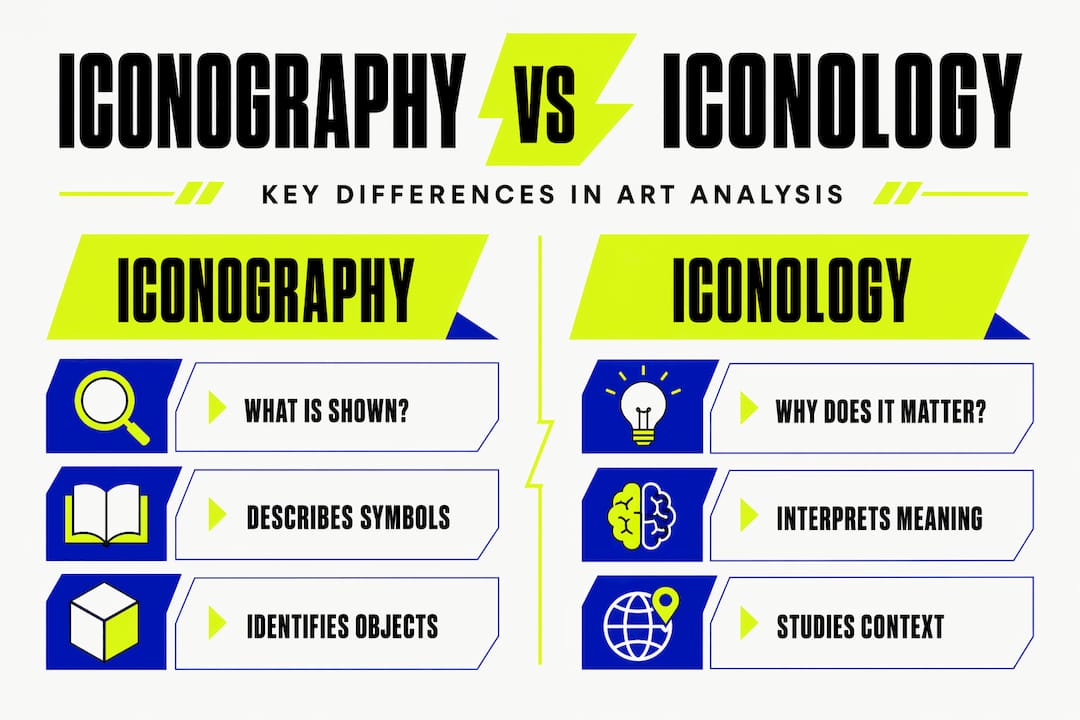
Iconology studies historical, social, and psychological associations behind images to unravel deeper meanings. Iconography gives you the vocabulary. Iconology helps you read the full sentence.
Pro Tip: When analysing any artwork or design, work through Panofsky’s three levels in sequence. Rushing to iconological interpretation without first completing the iconographical analysis is where misreading happens most often.
Iconography examples in classical and modern contexts
This is where the concept becomes concrete, and frankly, far more interesting.
Religious art and the attribute system
In mediaeval and Renaissance religious art, most viewers could not read. The Church needed images to communicate stories, and it developed a codified visual system to do exactly that. Attributes in religious art act as visual subtitles, allowing viewers to identify saints and understand narratives without a single word of text.
Here are some of the best known examples:
- Saint Sebastian is identified by arrows piercing his body, referencing his martyrdom.
- Saint Lawrence carries a gridiron, the instrument of his death.
- Saint Peter holds two keys, symbolising the keys to the Kingdom of Heaven.
- The Virgin Mary is often depicted in blue, associated with heaven and purity.
- The dove above a figure signals the presence of the Holy Spirit.
Once you learn this visual grammar, you can walk into any cathedral or gallery and read the imagery with confidence. That is iconography knowledge in direct, practical use.
Renaissance art and layered meaning
Renaissance painters were not simply decorating churches and palaces. They were encoding philosophy. Botticelli’s works used symbolic gestures and figures to convey Neoplatonic ideas, weaving together classical mythology and Christian theology in ways that would have been immediately legible to an educated Renaissance audience but remain puzzling to viewers who lack the iconographic context.
Pro Tip: Before studying a Renaissance painting in depth, research the Neoplatonic and Humanist ideas circulating at the time of its creation. The iconography only makes full sense against that intellectual backdrop.
Modern graphic design
The importance of iconography does not stop at the gallery door. Every road sign, app icon, and corporate logo uses iconographic logic. A padlock icon means security. A magnifying glass means search. A house icon means home. These are not arbitrary choices. They draw on decades of accumulated visual convention that audiences have learnt to read instantly. Iconography informs visual branding and storytelling in ways that go far beyond aesthetic preference. If you want to see this at work in real logos, the hidden meanings in famous logos are a perfect case study.

How iconography changes over time
Here is what most introductory articles miss: iconographic meaning is not fixed. It shifts. It gets claimed, contested, and reinterpreted by different groups for different purposes.
Erwin Panofsky emphasised evaluating iconography relative to the environment of its creation. That advice exists precisely because the same image can mean radically different things in different hands and different contexts.
A striking real-world example is Andrei Rublev’s The Trinity, painted in the early 15th century. When housed in a museum, it functioned as a historical artefact, studied for its extraordinary technique and its place in Russian art history. When Rublev’s Trinity was transferred to church custody, its function transformed. It became a living religious object again, with all the devotional meaning that carries. The iconographic content never changed. The cultural context around it did, and that changed everything.
For designers and art students, this has direct practical consequences:
- A symbol that works in one culture may carry negative meaning in another. The white colour associated with purity in Western contexts signals mourning in parts of East Asia.
- Political appropriation can shift a symbol’s meaning dramatically. Visual elements adopted by particular movements carry those associations forward, sometimes permanently.
- Historical distance changes readability. The more distant a symbol’s origin, the more cultural knowledge a viewer needs to read it accurately.
- Custodianship matters. Who owns and displays an image shapes how it is read and what it communicates.
This is why iconography acts as a bridge connecting visual imagery with meaning deeply rooted in specific cultural or religious contexts. The meaning lives not in the image alone but in the relationship between the image and its audience.
How to interpret and apply iconography in your work
Knowing what iconography is theoretically becomes genuinely useful when you can apply it in practice. Here is how to build that skill deliberately.
Start with observation, not interpretation. Follow Panofsky’s first level. Before you ask what something means, describe exactly what you see. Train yourself to separate observation from assumption.
Research the cultural and historical context. Learning key symbols in Christian, Olympian gods, and Buddhist iconography opens access to centuries of visual communication. Pick one tradition and go deep before going broad.
Build a personal symbol reference. When you encounter an unfamiliar symbol or attribute, record it. Over time, you will develop your own iconographic vocabulary that informs your design decisions.
Apply iconographic thinking to design briefs. When you are developing a logo or visual identity, ask what symbols are already culturally associated with your client’s sector, values, and audience. You can find practical guidance on this in Kukoocreative’s visual branding workflow.
Avoid misappropriation. This is the most common pitfall. Borrowing visual symbols from a cultural or religious tradition without understanding their significance can cause serious offence. The research stage is not optional.
Test your iconography with real audiences. Symbol recognition is not universal. What reads clearly to you may be opaque or carry unintended meaning for your actual audience. User testing catches these gaps before they become problems.
My honest take on learning iconography
I remember the first time I looked at a Flemish altarpiece and could actually read it. Not just see it. Before understanding iconography, I saw a technically impressive painting. After, I saw a carefully constructed argument about theology, patronage, and cultural identity. That shift is hard to describe, but it changes you as both a designer and a viewer.
What I have found over the years is that most designers treat iconography as a lookup table. They learn that a dove means peace, a lion means strength, and they leave it there. That approach produces safe, predictable work. It misses the real opportunity.
The more interesting application is understanding why those associations formed and what they say about the cultures that created them. When you work at that level, your design decisions become far more considered. You are not just borrowing a symbol. You are inheriting a conversation that has been going on for centuries.
My contrarian view: you should actively resist fluency that comes too easily. The moment iconography feels like a solved problem, you stop questioning it. The best designers I have encountered treat every symbol as a question worth asking again, particularly when working across cultures or for audiences very different from themselves. Iconography rewards curiosity far more than it rewards memorisation.
— Kukoo
Bring iconography into your brand design
Understanding the meaning of iconography is one thing. Putting it to work in your own brand identity is where it gets exciting.
At Kukoocreative, we have spent over a decade designing logos and visual identities that use symbolic thinking deliberately. Every mark we create carries intention. If you are ready to build a visual identity where every element earns its place, start with our logo design brief to see how we approach the process. You can also read more about how logo design shapes brand perception in ways most businesses never consider. And if you want proof before you commit, our design portfolio shows exactly how iconographic thinking translates into real, credible brand work.
FAQ
What is iconography in simple terms?
Iconography is the study and use of visual symbols and imagery to communicate meaning within a particular cultural or historical context. It identifies what is shown in an artwork or design and what those visual elements conventionally represent.
What is the difference between iconography and iconology?
Iconography describes and classifies visual symbols, answering “what is shown?” Iconology interprets the deeper cultural and psychological meaning behind those symbols, answering “why does it matter?” Both are part of Panofsky’s three-level framework for art analysis.
Why is iconography important for graphic designers?
Understanding iconography helps designers make deliberate symbol choices that communicate clearly and avoid unintended cultural misreadings. Symbols carry inherited meanings, and knowing those meanings lets you use visual language with precision and confidence.
How do I start interpreting iconography in artworks?
Begin with straightforward observation, describing what you literally see before applying any interpretation. Then identify the cultural tradition the work belongs to and research the conventional meanings of the symbols present. Panofsky’s three levels provide a reliable structure for this process.
Can iconographic meaning change over time?
Yes. Iconographic meaning is not fixed. Political, social, and cultural shifts can transform how the same symbol is read and used, as demonstrated by the changing significance of Rublev’s The Trinity when its custodianship moved from museum to church.