
TL;DR:
- Visual consistency builds brand recognition, trust, and can increase revenue by up to 33%.
- Maintaining core visual elements across all touchpoints is essential for effective branding.
- Balance coherence with creative flexibility to prevent brand blindness and stay engaging.
Visual inconsistency is quietly costing UK small businesses more than they realise. When your logo looks different on your van than it does on your website, or your social posts use a completely different colour palette to your packaging, customers notice. They may not say anything, but that nagging sense of disorganisation erodes trust fast. Inconsistent branding costs UK small businesses real revenue and real credibility. The good news? Visual consistency is not the exclusive preserve of big-budget brands. This guide walks you through exactly what it means, why it matters, and how to build it into your business starting today.
Table of Contents
- What visual consistency means for your brand
- The business case: Measurable gains from consistency
- How to achieve visual consistency: A step-by-step framework
- Balancing consistency and creativity: Avoiding brand blindness
- A modern take: Why small brands should embrace guided flexibility
- Take your visual consistency to the next level
- Frequently asked questions
Key Takeaways
| Point | Details |
|---|---|
| Recognition builds trust | Visual consistency helps customers instantly recognise and trust your brand. |
| Boost to revenue | Consistent brands can achieve up to 33% more revenue growth than inconsistent ones. |
| Practical steps matter | Simple guidelines and regular audits empower even small teams to maintain consistency. |
| Balance with creativity | Staying flexible within your guidelines prevents boredom and strengthens your brand’s relevance. |
What visual consistency means for your brand
Visual consistency is the practice of presenting your brand with the same recognisable look and feel across every single touchpoint a customer encounters. Think of it as the visual language your business speaks. When that language is coherent, people understand you immediately. When it is fractured, they hesitate.
At its core, visual consistency covers five key elements:
- Logo usage: The same version, proportions, and spacing applied correctly every time
- Colour palette: A defined set of primary and secondary colours used without deviation
- Typography: Consistent typefaces and font weights across all materials
- Imagery style: Photos and illustrations that share a similar mood, tone, and treatment
- Layout rules: Consistent spacing, alignment, and compositional principles
These elements work together to create what designers call a cohesive visual identity. Each time a customer sees your brand, their brain registers familiarity. That familiarity builds credibility. And credibility builds the kind of trust that turns browsers into buyers.
“Visual consistency builds brand recognition and trust by creating familiarity across touchpoints, leading to higher mental availability and customer preference.”
For small UK businesses, this is particularly powerful. You are competing against larger brands with bigger advertising budgets. Consistency is your equaliser. When your brand feels polished and reliable, customers assume your products or services are too.
Here is a quick overview of the key touchpoints where consistency in branding must show up:
| Touchpoint | What to keep consistent |
|---|---|
| Website | Colours, fonts, logo placement, imagery style |
| Social media | Profile images, post templates, tone of visuals |
| Packaging | Colour, logo version, label typography |
| Signage | Logo proportions, brand colours, font usage |
| Fleet and uniforms | Logo placement, colour accuracy |
| Email and print | Letterhead, footer styles, brand colours |
The benefits of getting this right are significant:
- Stronger brand recognition across channels
- Greater customer trust and perceived professionalism
- Higher memorability after fewer exposures
- Reduced confusion when customers switch between platforms
- A more confident, unified team who know how to represent the brand
Visual consistency is not about being boring. It is about being reliably brilliant every single time.
The business case: Measurable gains from consistency
If you have ever wondered whether investing time and effort into visual consistency is genuinely worth it, the numbers make a compelling argument.
Consistent brands achieve 23 to 33% higher revenue growth compared to inconsistent ones, with SMEs seeing up to 33% more benefit from proper brand guidelines. That is not a marginal improvement. For a business turning over £200,000 per year, that could represent an additional £46,000 to £66,000 in revenue simply from presenting your brand more cohesively.

The cognitive science behind this is equally striking. Consistent branding reduces cognitive load by 40%, enables 10x faster recognition, and generates 2.3x higher trust among customers. In plain terms: when your brand looks the same everywhere, customers spend less mental energy figuring out who you are, and more energy deciding to buy from you.
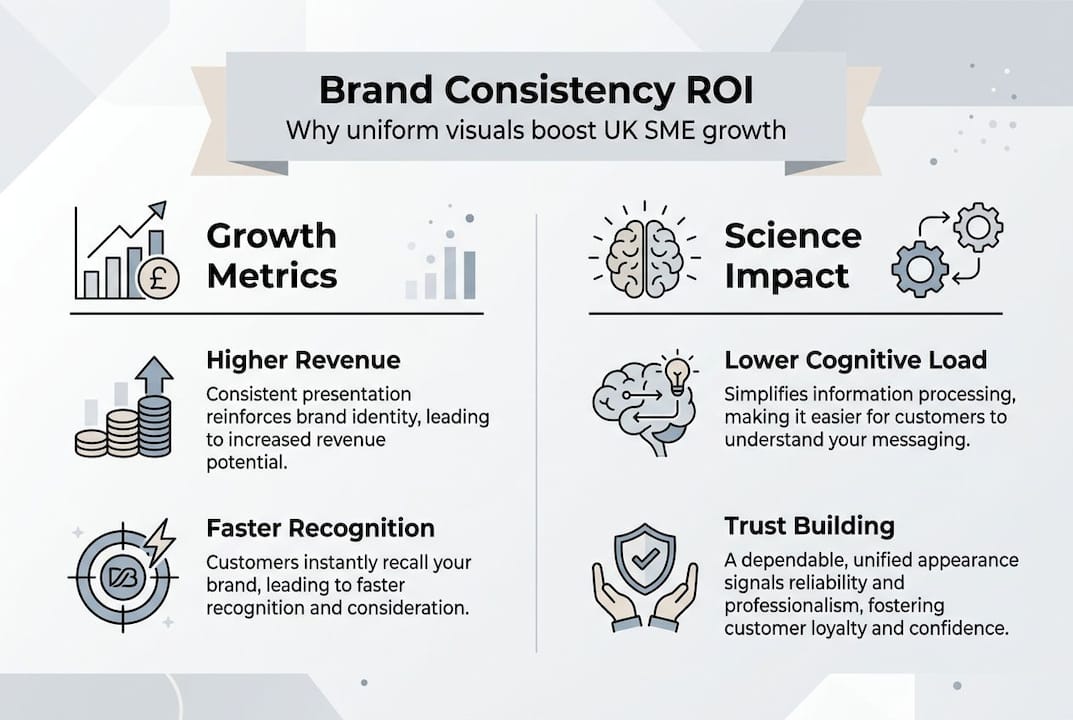
Here is how consistent and inconsistent brands compare across the metrics that matter most:
| Metric | Consistent brand | Inconsistent brand |
|---|---|---|
| Brand recall | High, achieved faster | Low, requires repeated exposure |
| Customer trust | 2.3x higher | Significantly lower |
| Conversion rate | Stronger, more predictable | Erratic, harder to improve |
| Revenue growth | Up to 33% higher | Flat or declining |
| Marketing efficiency | Lower cost per impression | Higher spend for same result |
The practical outcomes for your business look like this:
- Higher recall: Customers remember you after fewer interactions, reducing the number of touchpoints needed before a sale
- Repeat buyers: Familiarity breeds loyalty. Consistent brands feel safe to return to
- Easier sales conversations: When your brand already communicates professionalism, your team spends less time building credibility from scratch
- Lower marketing costs: A recognisable brand needs less spend to stay top of mind
- Faster trust: New customers feel confident sooner, shortening the decision cycle
What does 10x faster recognition actually look like in the real world? Imagine a customer scrolling through Instagram. They pause on your post before they even read the caption because the colours and image style are instantly familiar. That is the power of a consistent visual branding workflow in action.
Pro Tip: Run a quick consistency audit before anything else. Pull up your website, your most recent social posts, and a piece of print collateral side by side. If they look like they belong to three different businesses, you have found your starting point. You can find inspiration in real-world visual branding examples to benchmark where you want to be.
How to achieve visual consistency: A step-by-step framework
Knowing why consistency matters is one thing. Building it into your day-to-day operations is another. Here is a practical framework any small UK business can follow, regardless of team size or budget.
-
Define your core visual elements. Start with the non-negotiables: your logo (and its approved variations), your primary and secondary colour palette with exact hex codes, your chosen typefaces, and your image style guidelines. Do not leave these open to interpretation.
-
Document the rules in a living brand guide. A static PDF that lives forgotten on a hard drive helps no one. Comprehensive brand guidelines should cover logo usage, colours, typography, imagery style, and layout rules, and they should be hosted somewhere your whole team can access and update easily. Tools like Notion, Canva Brand Kit, or Google Sites work brilliantly for this.
-
Centralise your brand assets. Create a single, shared folder or digital asset management system where every approved logo file, colour swatch, font file, and template lives. No more hunting through old emails or using outdated logo versions.
-
Review every active platform. Go through your website, social profiles, email signatures, printed materials, and any physical signage. Update anything that does not match your defined guidelines. This is your branding consistency workflow in practice.
-
Train your team. Even a five-minute walkthrough of your brand guide with a new team member or freelancer can prevent months of inconsistency. Make it part of your onboarding process. Your brand guideline should be easy enough for a non-designer to follow.
-
Audit quarterly. Brands evolve. New platforms emerge. Team members change. A quarterly review ensures your visual identity stays coherent as your business grows. Build it into your calendar like any other business review.
Pro Tip: Do not try to fix everything at once. Start with your top three customer touchpoints, typically your website, your most active social platform, and your email signature. Get those consistent first, then work outward. You can explore practical brand asset creation approaches to make this process faster.
Even a small team of two or three people can maintain strong visual consistency with the right systems. The key is documentation and accessibility, not a large design budget.
Balancing consistency and creativity: Avoiding brand blindness
Here is something most branding articles will not tell you: too much visual uniformity can actually work against you. It is called brand blindness, and it happens when your audience becomes so accustomed to seeing the same visuals that they stop registering them altogether.
Total uniformity risks brand blindness; coherence over strict consistency is the smarter approach, adapting for context while keeping core values intact.
Brand coherence is the goal, not brand rigidity. Coherence means your audience always recognises you, even when your visuals adapt to suit a campaign, a season, or a specific platform. Rigidity means applying the same template to every piece of content regardless of context, which quickly becomes wallpaper.
Watch out for these signs of brand blindness in your own business:
- Engagement on your social posts has dropped despite consistent posting
- Customers struggle to recall specific campaigns or promotions
- Your team is producing content that feels mechanical or uninspired
- Your visuals look identical across wildly different contexts (a Christmas campaign using the same imagery as a product launch)
- Feedback from customers suggests your brand feels predictable or stale
The solution is to build creative adaptation zones into your brand system. Think of it this way: your core visual elements, logo, colours, and primary typeface, are fixed. Everything else has room to breathe.
“Strong brands maintain a recognisable core while allowing their visual expression to evolve with context, audience, and platform. Flexibility is not a weakness; it is a sign of a mature brand.”
Pro Tip: Use the 90/10 rule. Keep 90% of your visual identity consistent across all touchpoints, and allow 10% creative adaptation for campaigns, seasonal content, or platform-specific formats. This keeps your brand fresh without losing recognition. Explore how leading visual branding agency examples handle this balance for inspiration.
For small UK businesses, this flexibility is especially valuable. You might need to adapt your visuals for a local market event, a limited-edition product, or a social media trend. The 90/10 rule gives you permission to do that without undermining the brand equity you have worked hard to build.
A modern take: Why small brands should embrace guided flexibility
We have worked with hundreds of UK small business owners over the past decade, and we have noticed a pattern. The ones who obsess over pixel-perfect consistency often end up paralysed. Every piece of content becomes a committee decision. Every social post requires sign-off. The brand becomes a bottleneck rather than a growth engine.
The smartest approach is not rigid uniformity. It is guided flexibility. That means giving your team, your freelancers, and your future self a clear set of core visual rules alongside defined zones where creativity is actively encouraged.
In today’s fast-moving digital landscape, UK SMEs need brand systems that can keep pace. New social platforms emerge. AI-generated content is becoming part of the mix. Seasonal campaigns demand fresh visuals. A brand system built on rigid templates will crack under that pressure.
What works is a living brand guide paired with a culture of creative confidence. Document the non-negotiables. Free up everything else. The businesses we see thriving are those who treat their visual identity as a framework, not a straitjacket. Explore visual branding workflow approaches that build this kind of flexibility into your process from the start.
Take your visual consistency to the next level
You now have the knowledge to build a visual identity that works hard for your business every single day. But knowing and doing are two different things. That is where we come in.
At Kukoo Creative, we have spent over a decade helping UK small business owners like you create brand systems that are consistent, credible, and genuinely compelling. Whether you need a full brand overhaul or a focused visual branding workflow to tighten up what you already have, we are here to help. Explore our brand recognition resources or book a consultation with our team today. Let us build something extraordinary together.
Frequently asked questions
What are the first steps to improve visual consistency for my SME?
Start by documenting your logo, colours, and font rules, then centralise all brand assets in one shared location. A quick review of your website and social media will show you where the gaps are. Brand guidelines covering logo, colours, typography, and imagery style are your foundation.
Can too much visual uniformity hurt my brand?
Yes. Excessive uniformity risks brand blindness, making your content invisible to your own audience. Aim for coherence with room for contextual creativity rather than rigid sameness.
How does colour consistency impact recognition?
Colour consistency can improve brand recognition by 80%, and most customers need between five and seven impressions before a brand is reliably recalled. Getting your colours right and keeping them consistent is one of the highest-impact actions you can take.
What is the ROI of investing in visual consistency for small UK businesses?
UK SMEs can realistically achieve 23 to 33% revenue growth and 3.5x more visibility by establishing strong visual consistency. For most small businesses, that return far outweighs the initial investment in brand guidelines and asset management.