
Standing out in a crowded Leeds market is tough when every competitor seems to blend together. Strong brand recognition is not just about a striking logo or an attractive website. It is about creating a consistent identity using visual elements like logos, typography, and colour palettes that truly communicate who you are. This guide shows how defining your unique brand identity and applying it with intention can help local businesses become instantly recognisable and trusted.
Table of Contents
- Step 1: Define Your Unique Brand Identity
- Step 2: Select Consistent Visual Elements
- Step 3: Design A Professional Logo And Materials
- Step 4: Apply Brand Assets To Your Website
- Step 5: Review And Refine Asset Consistency
Quick Summary
| Key Insight | Explanation |
|---|---|
| 1. Define your brand identity | Understand what makes your business unique through values and mission. |
| 2. Choose consistent visual elements | Apply cohesive logos, colours, and fonts across all platforms. |
| 3. Design a professional logo | Create a simple, versatile logo that reflects your brand identity. |
| 4. Apply brand assets to your website | Ensure your site mirrors your brand identity for consistency and trust. |
| 5. Regularly review brand consistency | Audit all materials to maintain uniformity and address discrepancies. |
Step 1: Define your unique brand identity
Before you design a logo or build a website, you need to understand who your business really is. Defining your brand identity means clarifying what makes you different from every other business owner in Leeds. This is the foundation that everything else builds upon, and without it, your design choices will feel scattered and unconvincing.
Start by asking yourself what your business stands for. Think about the problems you solve, the customers you serve, and why those customers should trust you over someone else. Your brand identity includes visual elements like logos, typography, and colour palettes, but it goes much deeper than that. It also encompasses your communication style, your business values, and how you want customers to feel when they interact with your company. If you run a digital marketing agency in Leeds, your identity might centre on innovation and local expertise. If you offer accountancy services, trustworthiness and reliability should be at the heart of everything you do.
Think about your brand personality next. Are you formal or approachable? Traditional or cutting-edge? This personality shapes every decision you make, from the fonts you choose to the tone of voice you use on your website. You need to define the relationship you want with your customers. Do you want to be seen as a friendly local expert who understands the specific challenges facing Leeds businesses, or as a premium service provider? This clarity helps you stay consistent across every touchpoint. Without it, you might end up with a professional logo that contradicts your casual website copy, or a modern design that confuses customers about what your business actually offers.
Write down your core values and mission. What does your business exist to do? Why does it matter? A local bakery in Leeds might centre on using traditional recipes and supporting community events. A web design studio might prioritise creating websites that actually convert visitors into customers. These aren’t just nice-to-have statements, they directly influence your visual identity, your messaging, and the types of customers you attract.
Pro tip: Create a simple one-page brand identity document that answers who you are, what problems you solve, who your ideal customer is, and what makes you different. Keep this document close as you move through design decisions, and refer back to it whenever you’re unsure if a choice aligns with your brand.
Step 2: Select consistent visual elements
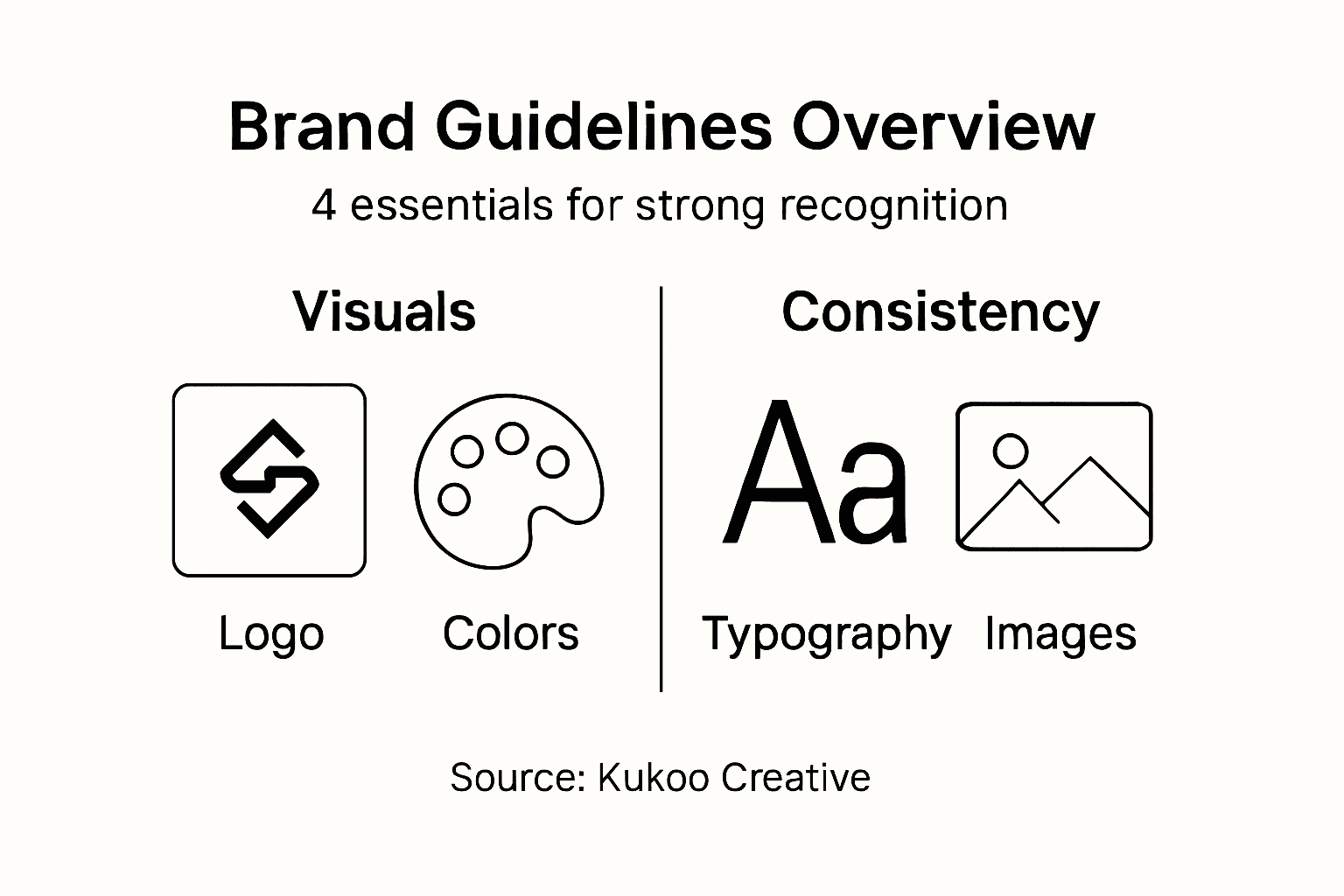
Now that you understand your brand identity, it’s time to translate those values into visual elements that customers will recognise instantly. Selecting consistent visual elements means choosing the logos, colours, typefaces, and imagery that will appear across every platform where your business shows up, from your website to your business cards to your social media profiles.
Start with your colour palette. Colours trigger emotional responses, and different combinations communicate different messages. If you run a financial advisory business in Leeds, deep blues and greys might convey stability and professionalism. If you own a creative agency or design studio, you might choose bolder, more vibrant colours that signal innovation and energy. The key is choosing a primary colour that represents your brand, then selecting two or three complementary colours that work together. These colours should appear consistently everywhere. Your website header uses the same blue as your logo. Your email templates use the same colour scheme. Your printed materials match your digital presence. This consistency builds recognition over time. Customers start to associate that specific shade of green with your coffee shop, or that particular orange with your fitness studio.

Next, consider your typography. Fonts are surprisingly powerful. A elegant serif typeface feels different from a modern sans-serif, even if the words are identical. Your brand likely needs two typefaces at most, one for headings and one for body text. These typefaces should work well together and feel appropriate for your industry. A law firm would choose different fonts than a children’s entertainment company. Once you’ve selected your typefaces, use them consistently across your website, marketing materials, and signage. When customers see your brand consistently using the same fonts, it reinforces recognition and makes your business feel professional and intentional.
Your logo is your visual anchor. Logos, colour palettes, typography, and imagery work together to manage your brand identity and reinforce recognition across all communication. A strong logo doesn’t need to be complicated. It needs to be distinctive, scalable, and work in different sizes and formats, from your website favicon to a billboard. Your logo should reflect your brand personality and values. Once you’ve invested in a good logo, protect its usage. Establish guidelines about how it can be sized, coloured, and positioned. Using it consistently makes it more memorable.
Imagery matters too. If your website features photographs, choose images that match your brand personality. A boutique luxury brand might use high-end, carefully styled photography. A friendly local service might use more candid, approachable images of real customers and team members. Stock photos are convenient, but they can make your brand feel generic if every competitor uses the same images. Consider investing in original photography or illustrations that reflect your unique brand.
Here’s a quick overview of how different visual brand elements influence customer perception:
| Brand Element | Typical Use | Customer Impact |
|---|---|---|
| Logo | Website, materials | Recognition, trust |
| Colour palette | All platforms | Emotional response, recall |
| Typography | Digital and print copy | Professionalism, clarity |
| Imagery | Website, marketing assets | Brand personality, appeal |
This summary helps clarify which brand assets deliver specific benefits for your business presence.
Pro tip: Create a simple brand guidelines document that specifies your exact colour codes (both RGB and hex), your approved typefaces, logo usage rules, and imagery style. Share this with anyone creating content for your business, whether that’s a designer, web developer, or social media manager. Consistency grows naturally when everyone knows what to follow.
Step 3: Design a professional logo and materials
With your brand identity and visual elements defined, it’s time to create the physical and digital materials that represent your business. This step involves designing a professional logo and the supporting materials that customers will interact with, from your website to your business cards to your email signatures. A professional logo design communicates competence and builds trust, whilst cohesive supporting materials reinforce your brand message at every customer touchpoint.
Start with your logo design. Your logo is the cornerstone of your brand identity, and it needs to work across multiple contexts. A logo that looks great on your website might need to appear on a tiny business card, a large storefront sign, and in black and white on a fax cover sheet. This is why simplicity matters. The most memorable logos are often the simplest. Think about iconic logos you recognise instantly. They use clean lines, limited colours, and straightforward shapes. Your logo should be scalable, meaning it remains clear whether it’s printed at five centimetres or five metres wide. Avoid overly complex details that disappear when your logo shrinks. If you’re working with a professional designer, they understand these constraints and can guide your choices.
Beyond your logo, you need supporting materials that extend your brand consistently. Professional brand materials including logo files, fonts, and templates sustain a cohesive brand presence across all your communications. These materials become your brand toolkit. Your logo needs to exist in multiple formats. You need a full colour version for most uses, a black and white version for situations where colour isn’t available, and a simplified version that works at small sizes. If you work with a designer or design agency in Leeds, they should provide you with a comprehensive package including all these variations. You’ll also need your logo in different file formats, SVG files for digital use, PNG files with transparent backgrounds, and PDF files for print materials.
Next, extend your branding to your digital and print collateral. Your business stationery, including letterheads, business cards, and envelopes, should all use your logo, colours, and typography consistently. Your email templates should match your website design. Your presentation templates should feel like they belong to your brand. Your website is often the first impression potential customers have of your business, and it absolutely must reflect your visual identity. Every element, from the header to the footer, should use your brand colours, fonts, and imagery. Your social media profiles need consistent branding too. Your profile picture should be your logo or a branded image. Your cover photo should use your brand colours. Your bio should reflect your brand voice.
Consider creating a digital brand guide for yourself and anyone else who might create content for your business. This document should specify your logo usage rules, your approved colour codes in both RGB and hex format, your typefaces and how they should be used, your imagery style, and any other guidelines that ensure consistency. When you outsource work, whether to a web developer, copywriter, or social media manager, sharing this guide means they understand your brand standards and can maintain consistency without constant back and forth conversations.
Pro tip: Invest in professional logo design rather than relying on DIY tools or templates. A custom logo designed specifically for your business is infinitely more valuable than a generic template that your competitors might also be using. The professional designer understands how your logo will function across different media and creates something truly distinctive to your brand.
Step 4: Apply brand assets to your website
Your website is often the first place potential customers encounter your brand. This is where your visual identity needs to shine most consistently. Applying your brand assets to your website means integrating your logo, colours, typography, and imagery throughout every page so that visitors immediately recognise your business and feel confident in what they see. When your website reflects your brand assets coherently, it builds trust and makes your business appear established and professional.
Start with your website header and navigation. Your logo should appear prominently, usually in the top left corner, and clicking it should take visitors back to your home page. This is a standard convention that users expect. Your primary brand colours should dominate your header, creating an immediate visual anchor that signals professionalism. The navigation menu should use your approved typeface and maintain consistent spacing and styling. When visitors scroll down your page, they should feel like they’re exploring the same brand, not jumping between different websites. Your colour palette should remain consistent. Your buttons should use your primary brand colour. Your headings should use your branded typeface. Your images should reflect your brand’s visual style and imagery guidelines.
Applying visual assets like logos, colour palettes, and templates consistently across your website enhances user experience and reinforces your reputation online. Consider how your footer communicates your brand too. Many businesses overlook the footer, but it’s real estate you own. Your footer should include your logo again, your brand colours, and perhaps imagery that echoes your brand personality. This creates a sense of completion as visitors reach the bottom of your page. Your footer is also where contact information, social media links, and legal pages live, so make sure these reflect your brand standards as well.
Your website’s interior pages need the same attention. Blog posts, service pages, and case study pages should all follow your brand guidelines. The same typefaces should appear consistently. The same colour palette should be used for highlights, buttons, and links. If you use icons or illustrations, they should match your brand’s visual style. Nothing undermines brand recognition faster than inconsistency. A visitor who sees your professional branded homepage but then encounters a blog post with different fonts, colours, and imagery feels confused about what your business actually is.
Don’t forget about interactive elements. Form fields, buttons, dropdown menus, and other interactive components should all use your brand colours and typefaces. When a visitor hovers over a button, the colour change should feel intentional and branded, not generic. Your website should have a consistent visual language where every element reinforces your brand identity. This consistency extends to responsive design too. Your website needs to look branded on desktop computers, tablets, and mobile phones. Your logo should scale appropriately. Your colours should display correctly on all devices. Your typography should remain readable at smaller sizes.
If you’re updating an existing website, audit what’s already there. Does your current design use your brand colours consistently? Are your typefaces aligned with your brand guidelines? Does your imagery match your brand personality? You might discover that your website has drifted from your intended brand identity. This happens easily when multiple people make updates over time without referencing a brand guide. A comprehensive audit helps you identify what needs to be refreshed. You don’t necessarily need to redesign your entire website. Sometimes strategic updates to key pages create significant impact. Update your homepage to showcase your brand prominently. Refresh your colour scheme. Replace generic stock photos with branded imagery that reflects your business.
Pro tip: Create a website style guide that documents exactly how your brand assets should appear online. Specify your logo placement and minimum size, your colour codes for all UI elements, your typefaces and their usage, and your imagery guidelines. Share this with anyone who updates your website, from your web developer to team members adding blog content, so your brand remains consistent as your site evolves.
Step 5: Review and refine asset consistency
Creating brand assets is not a one-time task you complete and then forget about. Your brand identity needs regular review to ensure everything still works together cohesively and that your business hasn’t drifted away from its intended visual message. Reviewing and refining asset consistency means auditing how your brand appears across all touchpoints and making adjustments when things have become misaligned. This ongoing process keeps your brand recognition strong and ensures new materials meet your standards.
Begin by conducting a comprehensive brand audit. Look at your website, social media profiles, business cards, email templates, presentation decks, printed materials, and any other customer-facing content. Take screenshots and photographs of everything. Does your logo appear the same everywhere, or have different versions crept in? Are your brand colours consistent, or have they drifted slightly due to different printing methods or display settings? Do your typefaces match your guidelines, or have team members substituted different fonts when creating documents? You might be surprised how much inconsistency builds up over time without intentional oversight. When multiple people create content for your business without a clear reference guide, variations happen naturally. Effective brand management requires consistent communication of brand elements across all touchpoints. This consistency is what builds recognition. A customer who sees your brand presented differently on your Instagram profile than on your website may question whether they’re actually looking at the same business.
As you conduct your audit, document what you find. Create a simple spreadsheet listing each touchpoint and noting whether it adheres to your brand guidelines. Your website homepage uses correct colours and logos, so mark that as compliant. Your email signature uses an outdated logo, so note that as needing updating. Your printed brochures use the right typefaces, so that’s compliant. This documentation helps you prioritise what needs fixing first. Some inconsistencies matter more than others. Your website and social media profiles are high visibility, so prioritise those. Your internal presentations matter less from a customer recognition perspective, but they still reinforce brand culture internally. Once you’ve completed your audit, create an action plan. What needs updating immediately? What can you update gradually as materials naturally reach the end of their life cycle? A brochure that will be reprinted in three months can be updated then. A website that customers see daily should be updated now.
Use this table to compare the main methods for auditing brand consistency across your assets:
| Audit Method | Strengths | Limitations |
|---|---|---|
| Manual review | Custom detail, flexible | Time-consuming, subjective |
| Spreadsheet tracking | Organised, easy updates | Requires ongoing effort |
| Automated tools | Quick, scalable | May miss subtle issues |
Selecting the right approach helps maintain cohesive branding across every customer touchpoint.
Use your audit findings to refine your brand guidelines. Perhaps your original colour palette doesn’t print consistently across different materials, and you need to adjust your specifications. Perhaps your typefaces don’t render well on mobile devices, and you need alternatives for digital use. Perhaps your logo needs a simplified version that works better at very small sizes. Brand guidelines aren’t static documents. They evolve as you learn what works and what doesn’t in real world applications. After you’ve made updates, store your refined guidelines somewhere your entire team can access them. A shared document or brand management platform ensures everyone works from the same current version.
Make review and refinement a regular habit. Schedule quarterly brand audits where you check a different set of materials. This prevents large inconsistencies from building up. When you’re about to launch new marketing materials, new team members, or new customer communication channels, review your brand guidelines first. Ask yourself whether your existing assets work for this new context, or whether you need new variations. A marketing campaign that works beautifully on Instagram might need adjustment for LinkedIn or email. Your logo placement that works on a website header might need rethinking on a business envelope. Thoughtful review before launch prevents you from creating materials that look out of brand and having to remake them later.
Pro tip: Set a quarterly calendar reminder to review your brand assets across different touchpoints. During each review, pick three or four customer-facing materials and assess whether they match your current brand guidelines. Document any inconsistencies and create a simple action list. This prevents brand drift from building up gradually and keeps your recognition strong over time.
Strengthen Your Brand Identity with Expert Design Support
Building brand assets that truly reflect your business personality and values can feel overwhelming. You might be struggling with creating a consistent logo, choosing colours that resonate emotionally, or aligning your typography across platforms. These challenges can lead to brand inconsistency that confuses potential customers and weakens trust. The article highlights the importance of a cohesive visual identity – from your colour palette to your website design – ensuring your business stands out in Leeds and beyond.
At KUKOO Creative, we understand these pain points and specialise in helping business owners like you create impactful brands that build strong recognition. Our decade of experience means we craft custom logos, select perfect colour schemes and implement consistent typography that reflects your unique mission and values. Are you ready to move from uncertainty to confidence with your brand assets?
Explore how our tailored design services can transform your visual identity today. Visit KUKOO Creative to discover professional logo design and cohesive branding solutions. Don’t let inconsistency hold your business back – take the next step now and partner with experts who ensure your brand speaks clearly and memorably across every touchpoint.
Frequently Asked Questions
How can I define my brand identity effectively?
To define your brand identity, clarify what makes your business unique. Write down your core values, mission, and the specific problems you solve for your customers. Create a simple one-page document summarising this information to guide your brand decisions.
What visual elements should I choose for my brand assets?
Select consistent visual elements like your logo, colour palette, and typography that align with your brand identity. Choose a primary colour that represents your brand and two or three complementary colours, then ensure these elements appear consistently across all platforms.
How do I create a professional logo for my brand?
Design a professional logo by ensuring it is simple, distinctive, and scalable. Work with a designer who can provide multiple formats of your logo and define guidelines for its usage to maintain consistency across different applications.
What steps should I take to apply brand assets to my website?
To apply brand assets to your website, integrate your logo, colours, typography, and imagery consistently across all pages. Ensure elements like your header, navigation, and footer follow your brand guidelines to build trust and recognition.
How can I conduct a brand audit for consistency?
Conduct a brand audit by reviewing all customer-facing materials, such as your website, social media profiles, and printed items. Document any inconsistencies you find and create an action plan to address these issues, prioritising high-visibility materials first.
How often should I review my brand assets?
Schedule regular reviews of your brand assets at least once every quarter. During each review, assess a few customer-facing materials for alignment with your current brand guidelines and make adjustments to maintain strong recognition.