
TL;DR:
- Scalable design creates flexible, growth-ready branding systems for small businesses.
- It reduces rework costs and maintains brand consistency across all platforms.
- Implementing scalable assets and systems provides UK businesses with freedom and confidence to grow.
Most small business owners treat design as a one-off task. You get a logo made, pick some colours, and move on. But that approach quietly bottlenecks your growth. Every time you launch a new product, enter a new market, or update your website, you’re back to square one. Scalable design changes that entirely. It gives your brand a flexible framework that grows with you, stays consistent across every platform, and saves you from expensive rework. This guide walks you through exactly what scalable design means, how to build it, and how to embed it into your daily operations as a UK small business owner.
Table of Contents
- Demystifying scalable design: Core concepts for small businesses
- Building a scalable brand foundation: Essential assets and systems
- Expanding with confidence: Integrating scalable design into daily operations
- Pitfalls and misconceptions: What scalable design is not (and how to avoid rework)
- Why scalable design unlocks freedom for UK small businesses
- How to take your brand further with scalable design experts
- Frequently asked questions
Key Takeaways
| Point | Details |
|---|---|
| Definition clarity | Scalable design is a flexible framework that keeps your branding consistent and effective as your business grows. |
| Start with essentials | A modular logo kit, colour palette, and style guide are the foundation for any scalable brand. |
| Integrate and automate | Pairing visual design with process automation unlocks sustainable growth and operational efficiency. |
| Avoid common pitfalls | Don’t over-engineer early or neglect stress-testing your design assets at every scale. |
| Real-world impact | Proper scalable design boosts engagement and reduces costly redesigns as your business expands. |
Demystifying scalable design: Core concepts for small businesses
Let’s get clear on exactly what scalable design means for small businesses like yours.
Scalability in design refers to creating flexible design frameworks, particularly in branding and visual identity, that adapt and grow with a small business without losing consistency or brand recognition. It is not about having a fancy logo. It is about building a system.
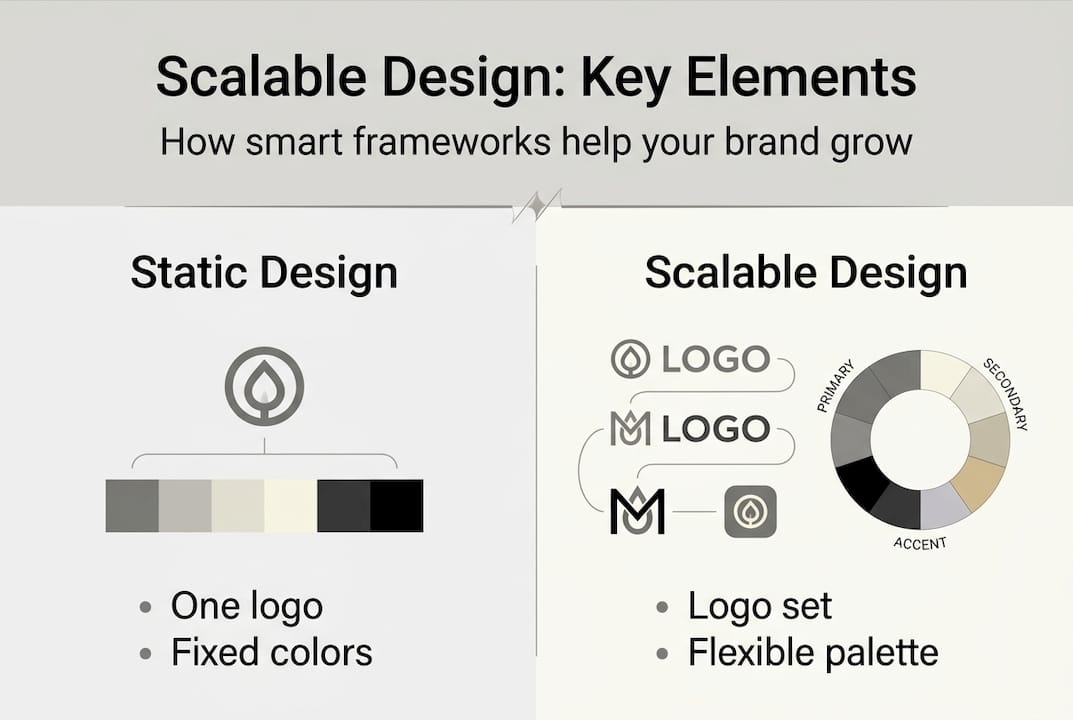
Think of it like a wardrobe. A static design is a single outfit. A scalable design is a wardrobe with interchangeable pieces that always look coordinated, whatever the occasion. That distinction matters enormously when your business starts expanding.
Here is how scalable and static design compare in practice:
| Feature | Static design | Scalable design |
|---|---|---|
| Logo flexibility | One fixed version | Multiple adaptable formats |
| Brand guidelines | Absent or informal | Documented and detailed |
| Asset reuse | Low, frequent rework | High, consistent across media |
| Growth readiness | Requires redesign | Adapts without starting over |
| Cost over time | Increases with each change | Decreases as systems mature |
The real consequences of static design are painful. Businesses that outgrow their branding often face full rebrands costing thousands of pounds, lost recognition with existing customers, and months of disruption. These are not rare horror stories. They are common outcomes for businesses that did not plan ahead.
The key elements of a scalable brand include:
- A modular logo system with versions for different sizes and contexts
- A documented colour palette with primary, secondary, and neutral tones
- Typography rules covering headings, body text, and digital use
- A style guide that anyone on your team can follow
- Adaptable asset templates for social media, print, and web
The payoff is measurable. Consistent, scalable branding leads to approximately 12% better mobile engagement, which matters enormously when most of your customers are browsing on their phones. Brands built on scalable systems are also far better positioned for lasting brand growth because they are not constantly reacting. They are built to lead.
Building a scalable brand foundation: Essential assets and systems
Now that the core concepts are clear, how can you put scalable design into practice for your small business brand?
Building a scalable foundation starts with getting the basics right. Key methodologies include a strong brand foundation covering your logo, colours, and fonts, supported by documented design systems, modular components, optical sizing, and standardised processes for consistency.
Here is a practical step-by-step approach:
- Commission a professional logo system. Working with a professional logo designer ensures your logo is delivered in vector formats that scale without quality loss.
- Define your colour palette. Choose two to three primary colours and two to three supporting tones. Document their HEX, RGB, and CMYK values.
- Set your typography rules. Pick one or two typefaces. Define sizes for headings, subheadings, and body copy across digital and print.
- Build your style guide. This document is your brand bible. It tells anyone producing content exactly how to represent your brand.
- Create asset templates. Design reusable templates for social media posts, email headers, brochures, and presentations.
A modular logo kit is particularly powerful. Here is how a four-tier kit works:
| Logo tier | Use case | Format |
|---|---|---|
| Primary logo | Main branding, website header | SVG, PNG |
| Secondary logo | Horizontal layouts, email signatures | SVG, PNG |
| Icon or mark | Favicon, app icon, social avatar | SVG, PNG |
| Wordmark | Merchandise, signage, print | SVG, EPS |
Optical sizing is worth understanding too. A logo that looks sharp at full size can become unreadable at 32 pixels. Always test your assets at the smallest sizes you will actually use them. A branding consistency workflow helps you keep all of this organised as your team grows.

For digital asset storage, use a shared cloud folder with clearly labelled subfolders. Name files consistently so anyone can find the right version instantly.
Pro Tip: Test every logo and brand asset at both thumbnail size and billboard scale before signing off. Catching issues early is far cheaper than reprinting 500 brochures or rebuilding a website header. Use our branding checklist to make sure nothing gets missed.
Expanding with confidence: Integrating scalable design into daily operations
Once you have your scalable foundations in place, the next step is day-to-day integration to really unlock growth.
Having great brand assets sitting in a folder achieves nothing if your team is not using them consistently. Scalable design only works when it is woven into your operations. Start by auditing every touchpoint where your brand appears:
- Social media profile images and post templates
- Email signatures and newsletter headers
- Business cards and printed materials
- Website banners and landing pages
- Proposals, invoices, and presentations
- Signage and packaging
For each of these, create a template that pulls directly from your style guide. Tools like Canva allow you to upload your brand colours, fonts, and logos and lock them into templates your team can use without going off-brand. Export logos as SVG files wherever possible. Modular SVG logos improve web load speed and visibility, which directly supports your SEO and user experience.
Setting up simple SOPs (standard operating procedures) for brand rollouts makes a significant difference. An SOP does not need to be complicated. It is simply a short checklist that answers: which assets to use, where to find them, and who approves final output.
Scalable systems support 15 to 30% annual growth without constant rework, making them one of the highest-return investments a small business can make in its brand.
Pairing visual scalability with process SOPs and automation prevents bottlenecks as your brand expands. This is especially relevant when you bring on new staff, freelancers, or agencies who need to represent your brand without a lengthy briefing every time.
For visual identity creation that genuinely supports operations, the goal is to make the right choice the easy choice for everyone on your team.
Pro Tip: Use asset templates and automation tools to minimise repetitive manual work. If someone on your team is recreating a social media graphic from scratch each week, that is a sign your scalable system needs attention.
Pitfalls and misconceptions: What scalable design is not (and how to avoid rework)
Even with the best intentions, common mistakes can derail scalable design efforts. Here is how to avoid wasted time and resources.
One of the biggest misconceptions is that scalability is purely a tech issue. For small businesses, scalability is about visual and brand systems that prevent constant reworking and over-investment. It is not about which software you use. It is about the decisions you make before you open any design tool.
Another common trap is over-designing for a pitch or launch moment. Businesses sometimes invest heavily in elaborate brand assets that look stunning in a presentation but fall apart in real-world use. A logo with too many gradients or fine details will not reproduce well on embroidered workwear or a small social media icon.
Three costly mistakes to avoid:
- Skipping small-scale testing. Always check how assets look at favicon size, on mobile, and in black and white before finalising.
- Neglecting written guidelines. Without a style guide, every team member or freelancer interprets your brand differently. Inconsistency erodes trust.
- Automating before your system is ready. Rushing into automation tools before your brand framework is solid just scales the chaos faster.
Use this checklist to stress-test your brand assets before rolling them out:
- Does your logo work in black and white?
- Is your primary typeface available on all platforms your team uses?
- Can your colour palette be reproduced accurately in both print and digital?
- Do your templates lock in brand colours and fonts so they cannot be accidentally changed?
- Is there a clear approval process for new branded materials?
If you have already hit a wall with a brand that has grown inconsistent, you are not alone. Many UK small businesses reach a point where different versions of their logo are circulating, colours are slightly off across platforms, and no one is quite sure which assets are current. The fix is not always a full rebrand. Often, consolidating your assets and creating a simple style guide is enough to get back on track. Explore common scalable branding pitfalls to see where things typically go wrong and how to course-correct.
Why scalable design unlocks freedom for UK small businesses
Having mapped out the processes and pitfalls, here is a perspective from years of supporting growing UK brands.
Most conversations about scalable design focus on growth metrics and cost savings. Those matter. But the benefit we see business owners value most is something quieter: freedom.
When your brand has a solid, scalable system behind it, you stop making the same decisions repeatedly. You stop worrying whether the new social post looks right, or whether the freelancer you hired last week is representing your brand correctly. The system handles it. That mental space is genuinely valuable.
Scalable design is, in many ways, the anti-micromanagement brand strategy. It lets you step back from the detail and focus on actually running your business. Brands with scalable systems can enter new markets, launch new products, and onboard new team members without starting from scratch every time.
The businesses we have supported through lasting brand growth consistently tell us the same thing: the investment in getting the foundations right was the best decision they made. Not because it made their brand look better overnight, but because it gave them the confidence to grow without fear of falling apart.
How to take your brand further with scalable design experts
If you are ready to put these principles into practice and avoid brand headaches, here is how Kukoo Creative can help.
For over a decade, we have partnered with UK small business owners to build brands that are not just beautiful but genuinely built to grow. From logo systems and style guides to full visual branding workflow development, we create the frameworks that make your brand consistent, credible, and scalable.
Whether you are starting from scratch or untangling an inconsistent brand, we can help you build a system that works. Strong brand recognition does not happen by accident. It is the result of smart, scalable foundations. Explore our logo design essentials or get in touch to talk through your brand goals. We would love to help you build something extraordinary.
Frequently asked questions
What is the difference between scalable design and regular design?
Scalable design adapts and grows without losing consistency or recognition, whereas regular design is typically static and requires reworking each time your business expands or your needs change.
How can scalable design help my UK small business grow?
It streamlines your branding across all platforms, saves money on future design work, and supports growth through consistent visuals. Scalable design boosts mobile re-engagement by approximately 12% and supports sustainable annual growth of 15 to 30%.
What are examples of scalable design assets?
Examples include modular logo kits, adaptable templates, standardised style guides, and visual assets that work at all sizes from favicons to signage. Modular logo kits and design systems with guidelines allow assets to be used across different scales and media.
Should I invest in scalable design from the outset or later?
Starting scalable saves future redesign costs and stress. Foundational scalable assets are valuable at every growth stage, so building them early is always the smarter choice for UK small businesses.