
Many UK businesses struggle with rebranding without a clear process, leading to inconsistent messaging, wasted budgets, and missed opportunities. A structured approach ensures your brand refresh strengthens market presence and builds genuine connection with your audience. This guide provides practical stages from initial preparation through execution to verification, helping you navigate your rebrand with confidence and clarity.
Table of Contents
- Preparing For Your Rebranding Journey
- Step By Step Execution Of Your Rebrand
- Common Pitfalls And How To Avoid Them
- Measuring Success And Maintaining Your New Brand
- Explore Professional Branding Services To Support Your Rebrand
- Frequently Asked Questions
Key takeaways
| Point | Details |
|---|---|
| Preparation is essential | Assess current brand performance, set measurable goals, and research your market before making changes. |
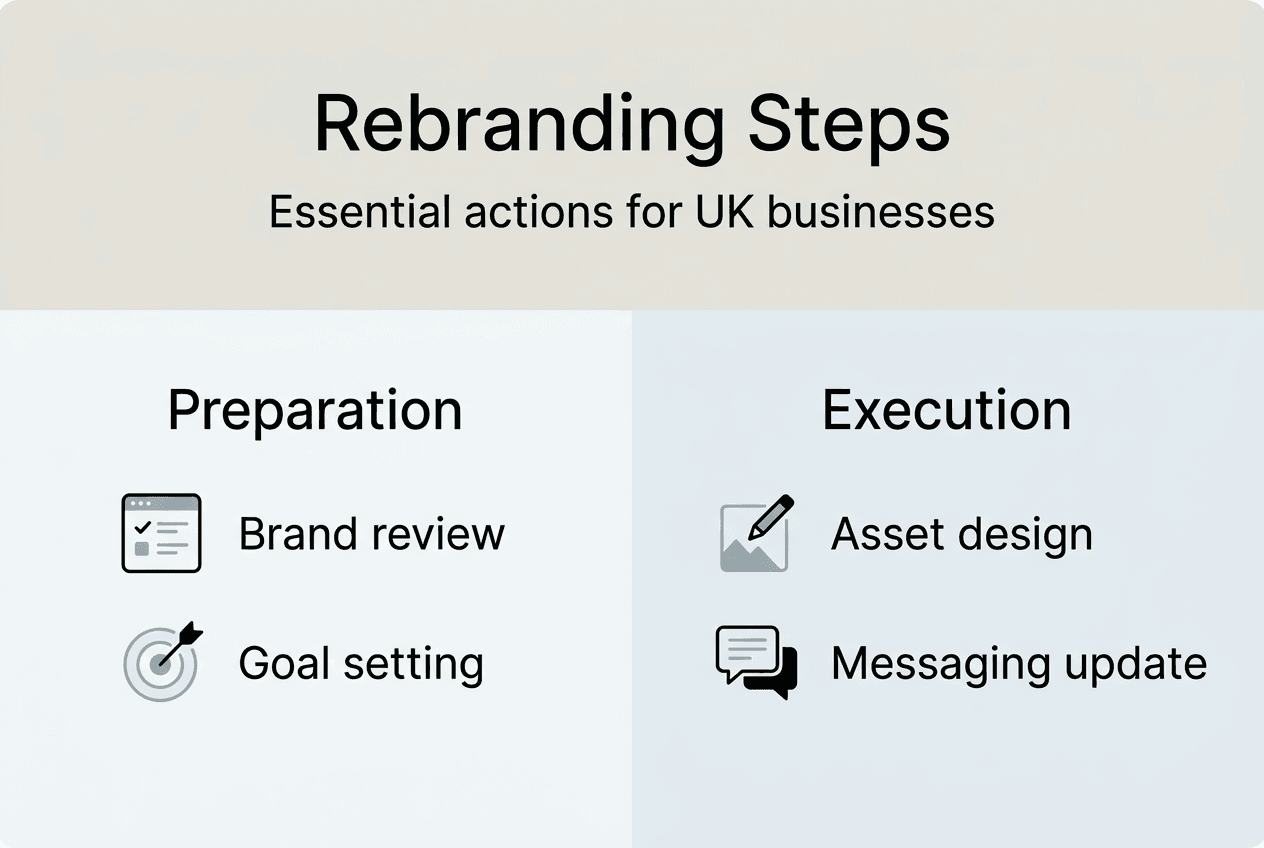
| Follow sequential steps | Execute logo redesign, visual identity updates, messaging refresh, and legal considerations in clear order. |
| Avoid common mistakes | Maintain consistency, communicate with stakeholders, and gather feedback throughout the process. |
| Measure and maintain success | Track KPIs, collect ongoing feedback, and conduct regular brand audits to sustain recognition. |
Preparing for your rebranding journey
After understanding why rebranding requires structure, this section prepares you to start with solid groundwork to increase success chances. Research and clear objectives set the stage for successful rebranding, ensuring you build on evidence rather than assumptions.
Start by evaluating your current brand performance through customer surveys, sales data, and market position analysis. Understanding how customers perceive your business today reveals gaps between your intended identity and actual reputation. This assessment highlights specific areas requiring attention, from visual elements to messaging tone.
Define clear, measurable rebranding goals aligned with business growth. Are you targeting new demographics, repositioning for premium markets, or simply modernising an outdated identity? Specific objectives might include increasing brand recognition by 30% within six months or improving customer perception scores in key areas. Vague ambitions lead to diluted efforts, whilst concrete targets guide every design and messaging decision.
Research competitors and target audience expectations in the UK market thoroughly. Analyse what resonates with your ideal customers, identify gaps your competitors leave unfilled, and explore emerging trends relevant to your sector. This intelligence informs positioning strategies that differentiate your refreshed brand effectively. Consider a step by step branding process retail success framework to organise your findings.
Assemble a capable team, whether internal staff, external agencies, or a combination. Successful rebrands require diverse skills including strategy, design, copywriting, project management, and legal expertise. Clarify roles, establish decision making processes, and ensure leadership commitment to the project timeline and budget.
Pro Tip: Use brand audits and customer surveys for data driven insights. Qualitative feedback reveals emotional connections and pain points that quantitative metrics alone miss. A visual branding workflow uk business approach can streamline this discovery phase efficiently.
Step by step execution of your rebrand
Building on preparation, this section walks you through the essential concrete steps to implement the rebrand successfully. Following an organised sequence ensures thorough rebranding and reduces costly oversights.
1. Create or update your logo with professional design guidance
Your logo serves as the visual anchor for your entire brand identity. Work with experienced designers who understand your sector and target audience, ensuring the mark communicates your values at a glance. Consider scalability across digital and print applications, colour variations for different contexts, and timeless appeal that won’t feel dated quickly. A comprehensive logo design brief ensures designers capture your vision accurately from the start.
2. Develop consistent brand assets including colours, fonts, and imagery
Expand beyond the logo to create a cohesive visual system. Select a colour palette that evokes appropriate emotions and stands out in your market, choose typography that balances readability with personality, and establish photography or illustration styles that reinforce your positioning. Document these choices in detailed brand guidelines for consistent application.

3. Refresh brand messaging to reflect new positioning and values
Craft messaging that articulates what you stand for, who you serve, and why you matter. Develop your brand voice guidelines, key messages for different audiences, and taglines that capture your essence memorably. Brand messaging guide leeds businesses principles apply across UK markets, emphasising clarity and authentic connection.
4. Consider trademark and legal updates for the new brand identity
Protect your investment by registering trademarks, updating business registrations, and ensuring compliance with relevant regulations. Consult legal professionals early to avoid conflicts with existing marks or geographical restrictions that could force costly changes later.
5. Plan internal launch for staff alignment and external launch for customers
Introduce the rebrand to employees first, explaining the rationale and their role in bringing it to life. Training sessions ensure consistent application across customer touchpoints. Then orchestrate a public launch that generates excitement whilst managing expectations. Refer to how to update business logo uk guide for practical rollout tactics.
| Action | Typical Timeline | Responsible Party |
|---|---|---|
| Logo design | 4 to 8 weeks | Design team/agency |
| Visual identity system | 3 to 6 weeks | Design team |
| Messaging development | 3 to 5 weeks | Marketing/copywriters |
| Legal review | 2 to 4 weeks | Legal counsel |
| Internal rollout | 2 to 3 weeks | HR/management |
| External launch | 1 to 2 weeks | Marketing team |
Pro Tip: Avoid rushing logo updates; test designs with focus groups representing your target audience. Their honest reactions reveal whether your visual identity communicates as intended or creates unintended associations that could undermine your goals.
Common pitfalls and how to avoid them
After detailing steps, this section warns against errors that can undermine rebranding efforts and offers solutions to avoid them. Many rebrands fail due to inconsistent application and poor stakeholder engagement, wasting significant investment and confusing audiences.
Avoid these frequent mistakes:
- Skipping stakeholder communication: Failing to involve employees, customers, and partners creates resistance and missed opportunities for buy in. Share the vision early, explain the benefits, and address concerns transparently.
- Neglecting brand consistency: Applying the new identity inconsistently across channels dilutes recognition and credibility. Establish a branding consistency workflow small business framework that ensures every touchpoint reflects your updated brand accurately.
- Ignoring customer feedback: Launching without testing concepts risks alienating your existing audience. Gather reactions through surveys, focus groups, and soft launches to refine messaging and visuals before full rollout.
- Insufficient staff training: Employees represent your brand daily through customer interactions, yet many rebrands overlook internal education. Comprehensive training on new guidelines, messaging, and customer experience standards prevents mixed signals.
Consistent application across platforms matters enormously. When customers encounter different logos, colour schemes, or messages depending on where they interact with you, confusion erodes trust. Create thorough brand guidelines covering every application from social media to signage, then audit regularly to catch deviations quickly.
Consistency is crucial to building lasting brand recognition. Audiences need repeated exposure to cohesive visual and verbal cues before your identity becomes memorable and trustworthy.
Address concerns proactively by acknowledging that change requires adjustment periods. Communicate the rationale behind decisions, demonstrate how the rebrand benefits customers specifically, and show patience as recognition builds over time.
Measuring success and maintaining your new brand
Closing the execution focused content by moving from action steps to how to confirm and sustain rebranding success. Verification and maintenance are essential to ensure rebranding delivers intended business growth and recognition.
Define KPIs for brand awareness, engagement, and sales impact before launch, establishing baselines for comparison. Track metrics including website traffic, social media engagement rates, customer acquisition costs, and conversion rates. Monitor brand sentiment through social listening tools, review platforms, and direct customer feedback channels.
Steps for tracking and maintaining brand health:
1. Establish measurement framework immediately post launch
Set up tracking systems for quantitative metrics and feedback collection mechanisms for qualitative insights. Create dashboards that visualise progress against your defined objectives, making it easy to identify trends and anomalies quickly.
2. Collect customer and employee feedback regularly
Schedule quarterly surveys to gauge perception changes over time. Ask specific questions about brand recall, emotional associations, and perceived differentiation from competitors. Employee feedback reveals internal adoption challenges and customer facing issues requiring attention.
3. Update brand guidelines and train new staff continuously
Your brand guidelines document should evolve as you discover what works and encounter new applications. Incorporate new hires into brand training programmes immediately, ensuring consistent representation regardless of team changes. A branding consistency workflow small business system automates much of this process.
4. Use digital analytics to track recognisable brand touchpoints
Analyse which channels drive the strongest brand recognition and engagement. Assess whether visual elements perform consistently across devices and contexts, adjusting where necessary to optimise impact.
5. Schedule regular brand audits
Conduct comprehensive reviews every six to twelve months, examining all customer touchpoints for consistency and effectiveness. These audits identify drift from guidelines, reveal opportunities for refinement, and ensure your brand remains relevant as markets evolve.
Maintaining momentum requires ongoing commitment rather than treating rebranding as a one time project. Brands that succeed long term integrate identity management into regular business operations, making consistency and evolution natural parts of company culture. Refer to how to launch a brand uk business guide for sustainable launch strategies that support lasting recognition.
Explore professional branding services to support your rebrand
After learning how to rebrand independently, readers are invited to consider professional support for a smoother process and stronger results. Rebranding demands significant expertise across strategy, design, and implementation, and partnering with experienced professionals can accelerate success whilst reducing risks.
Kukoo Creative offers expert branding services for small businesses tailored for UK businesses seeking impactful brand refreshes. Our professional logo design and visual identity creation ensures your rebrand resonates with your target audience and builds lasting recognition. We support each stage from initial concept through final implementation, applying the structured approach outlined in this guide.
Our decade of experience partnering with business owners like you means we understand the challenges you face and the outcomes you need. From crafting distinctive logos that capture your essence to developing comprehensive visual systems that maintain consistency, we simplify your rebrand whilst improving results. Discover how logo design will make or break your brand and explore our approach to visual identity creation for UK business owners that connects you with the people who matter most.
Frequently asked questions
What is the first step in rebranding a business?
The first step involves assessing your current brand performance through customer feedback, market position analysis, and competitor research. This assessment and goal setting lay the groundwork for aligning your refreshed brand with genuine market opportunities and business vision.
How long does a rebranding process typically take?
Rebranding timelines vary from several weeks to many months depending on scope and complexity. Smaller refreshes focusing primarily on visual updates might complete in two to three months, whilst comprehensive repositioning including extensive research, messaging overhauls, and phased rollouts often require six months or longer. Adequate time ensures proper research, design iteration, stakeholder approval, and coordinated implementation.
How can I ensure my new brand resonates with my customers?
Customer insights prove crucial for tailoring messaging and visuals that connect authentically with your audience. Conduct research before finalising designs, test concepts with representative customer groups, and gather feedback during soft launches. This evidence based approach revealed in brand messaging guide leeds businesses reduces risks of poor reception and builds confidence your rebrand will strengthen customer relationships.
Should I rebrand everything at once or phase the rollout?
Phased rollouts often work better for established businesses with extensive existing materials and customer touchpoints. This approach allows you to manage costs, test responses, and refine elements before full deployment. However, ensure core visual identity remains consistent throughout the transition to avoid confusing mixed signals that dilute recognition.