
Every Leeds business owner understands the challenge of making your brand stand out and truly connect with local customers. Knowing who you are speaking to and how to reach them is vital for building lasting recognition. By focusing on systematically researching your audience and mapping out the competition, you can develop messaging that resonates and gives your business a decisive edge in the Leeds market.
Table of Contents
- Step 1: Assess Your Target Audience And Competition
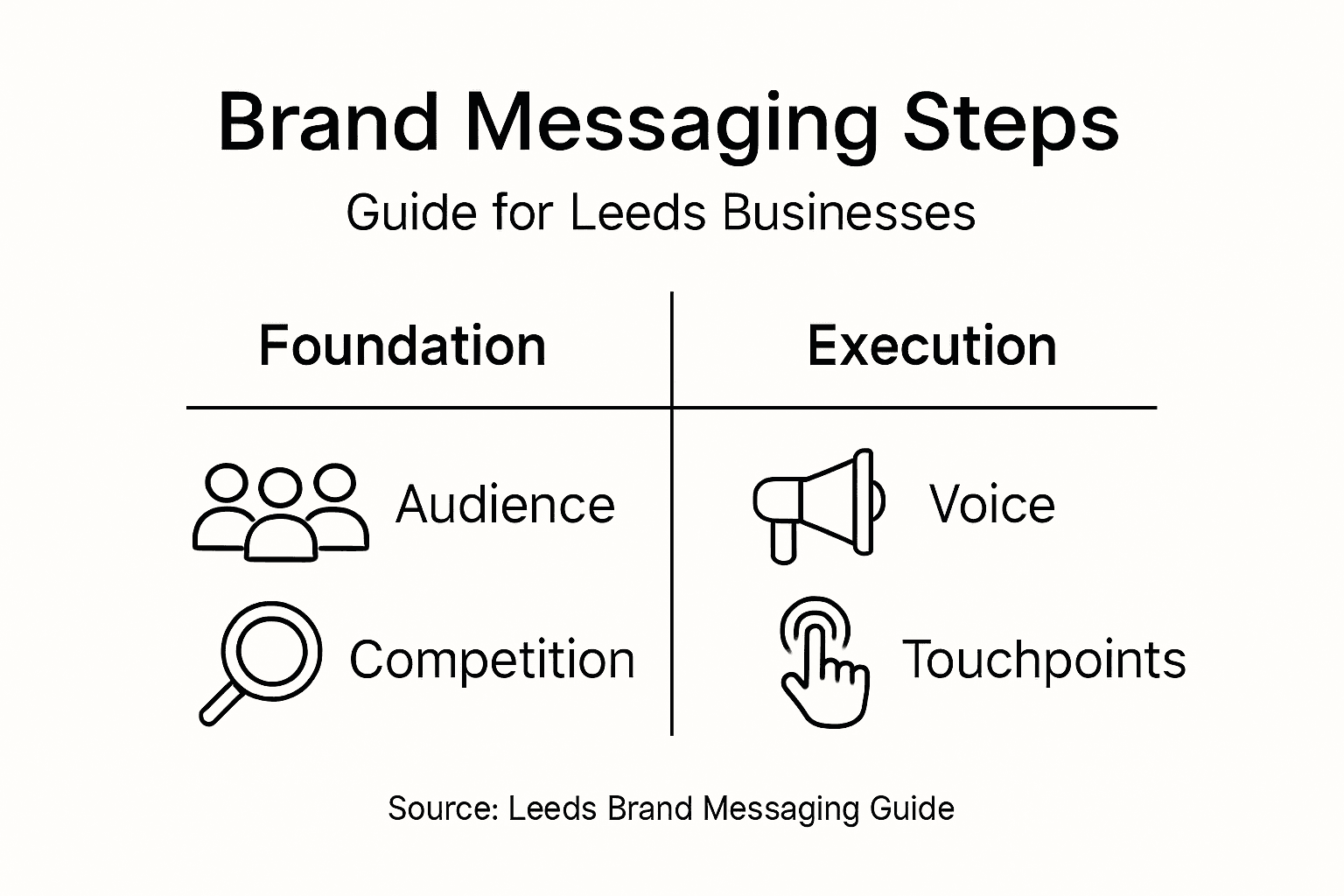
- Step 2: Define Your Brand’S Unique Voice And Promise
- Step 3: Craft Clear And Compelling Brand Messages
- Step 4: Apply Your Messaging Across All Brand Touchpoints
- Step 5: Evaluate Messaging Impact And Gather Feedback
Quick Summary
| Key Message | Explanation |
|---|---|
| 1. Understand your audience’s characteristics | Gather demographic information to segment your target market and identify their needs effectively. |
| 2. Conduct a thorough competitive analysis | Identify competitors and their strengths to discover gaps in messaging that your brand could fill. |
| 3. Define your unique brand voice | Create a distinctive narrative and tone that reflects your core values and resonates with your audience. |
| 4. Ensure consistent messaging across platforms | Maintain uniformity in communication style and visual elements across all brand touchpoints to build recognition. |
| 5. Regularly evaluate and refine your messaging | Collect feedback and assess the effectiveness of your messaging to adapt and improve it continuously. |
Step 1: Assess your target audience and competition
To develop a powerful brand message that resonates with Leeds businesses, you must first understand who you’re speaking to and what landscape you’re operating within. This section walks you through systematically researching your audience and analysing your competitive environment.
Begin by gathering comprehensive demographic information about your potential customers. Audience segmentation strategies can help you break down your target market into meaningful groups. Consider these key characteristics:
- Age range
- Income levels
- Professional sectors
- Geographic location within Leeds
- Specific business challenges
- Purchasing behaviours
Next, conduct a thorough competitive analysis. National Archives guidance recommends identifying competing businesses that might be attracting your potential customers. Map out their strengths, messaging approaches, and potential gaps you could exploit.
To effectively research, utilise multiple information sources like industry reports, LinkedIn insights, local business networks, and direct customer interviews. Your goal is to build a nuanced understanding of both your audience’s needs and the competitive landscape.
Here is a comparison of common audience research methods and their business advantages:
| Research Method | Description | Business Advantage |
|---|---|---|
| Industry reports | Market analysis from experts | Reveals trends and benchmarks |
| LinkedIn analytics | Professional insights data | Identifies networking potential |
| Local business forums | Community-driven information | Highlights local challenges |
| Customer interviews | Direct client feedback | Uncovers unique motivations |
The most successful brands don’t just communicate – they connect by understanding precisely who they’re talking to.
Pro tip: Create a detailed customer persona document that captures not just demographics, but the emotional motivations and professional aspirations of your ideal client.

Step 2: Define your brand’s unique voice and promise
Defining your brand’s unique voice and promise is about creating a clear, compelling narrative that sets you apart in the competitive Leeds business landscape. This crucial step transforms your business from a generic service provider to a distinctive, memorable brand that resonates with your target audience.
Start by identifying core values and key differentiators that make your business unique. Consider what truly distinguishes you from competitors in brand development for UK businesses. This isn’t just about what you do, but how and why you do it. Develop a concise brand positioning statement that encapsulates:
- Your primary service or product
- The key benefits you provide
- Your unique approach or methodology
- The specific problems you solve for clients
Next, craft a brand voice that reflects your business personality. This involves choosing a communication style that feels authentic and appealing to your target audience. Are you professional and authoritative? Friendly and approachable? Creative and innovative? Your voice should be consistent across all communication channels, from your website to social media and client interactions.
Your brand voice is the personality that transforms your business from a mere service into a memorable experience.
To ensure your brand promise is compelling, articulate how you deliver unique value that goes beyond standard industry offerings. Align your messaging with your audience’s deepest needs and aspirations, creating an emotional connection that transcends transactional relationships.
Pro tip: Conduct a brief workshop with your team to brainstorm and distil your brand’s most distinctive qualities, ensuring everyone can articulate your unique value proposition consistently.
Step 3: Craft clear and compelling brand messages
Crafting clear and compelling brand messages is about distilling your business’s essence into powerful, memorable communication that instantly connects with your target audience. This step transforms your brand’s core values and unique positioning into language that resonates and inspires action.
Begin by developing messaging frameworks that reflect your brand’s personality. In branding strategies for UK businesses, consistency is key. Your messaging should include:
- A distinctive brand tagline
- Key value propositions
- Emotional trigger points
- Problem-solving statements
- Unique differentiation language
Focus on creating concise, impactful communication that speaks directly to your audience’s needs and aspirations. Each message should answer three critical questions: Who are we? What do we do? Why does it matter? Avoid industry jargon and complex language. Instead, aim for clarity, authenticity, and emotional engagement.
Great brand messaging doesn’t just inform – it creates an instant, meaningful connection with your audience.
Test your messaging across different platforms and channels. Ensure your tone remains consistent whether you’re communicating through social media, website content, print materials, or direct client interactions. Adapt your language while maintaining your core brand voice and promise.
Pro tip: Create a brand messaging document that acts as a reference guide, ensuring every team member can communicate your brand’s essence consistently and authentically.
Step 4: Apply your messaging across all brand touchpoints
Applying your brand messaging consistently across every interaction point is crucial for building recognition and trust with your target audience. This step ensures your brand speaks with a unified voice, regardless of where or how customers encounter your business.
Start by creating a comprehensive brand communication blueprint that outlines your messaging strategy for branding consistency in local businesses. Your blueprint should map out how your brand voice and key messages will be implemented across various channels:
- Website content
- Social media platforms
- Print marketing materials
- Email communications
- Customer service interactions
- Digital advertising
- Presentation decks
Ensure absolute consistency in visual and verbal branding. This means aligning your colour palette, typography, tone of voice, and key messaging across every single touchpoint. Even subtle variations can dilute your brand’s impact and confuse potential customers.
Consistency transforms disconnected communications into a powerful, recognisable brand narrative.
Regularly audit your brand communications to maintain alignment. Schedule periodic reviews to check that all materials – from your website to your business cards – reflect your core messaging and visual identity. Train your team to understand and embody your brand voice in every interaction.
Pro tip: Create a brand style guide that serves as a living document, providing clear, practical guidance for everyone representing your business.
Step 5: Evaluate messaging impact and gather feedback
Evaluating your brand messaging’s effectiveness requires a strategic approach that goes beyond surface-level metrics. This crucial step helps you understand how your communication resonates with your target audience and identifies opportunities for refinement.
Develop a comprehensive feedback collection strategy through UK business communication techniques. Your evaluation methods should include multiple touchpoints:
- Customer surveys
- Direct client interviews
- Website analytics
- Social media engagement metrics
- Sales conversion tracking
- Net Promoter Score (NPS) measurements
- Qualitative feedback sessions
Quantitative and qualitative data provide a holistic view of your messaging impact. Track numerical metrics like engagement rates and conversion percentages, but also pay close attention to the nuanced language customers use when describing their perception of your brand.
The following table summarises ways to evaluate brand messaging impact using both data types:
| Data Type | Example Metric | Insight Provided |
|---|---|---|
| Quantitative | Engagement rates | Measures visibility and reach |
| Quantitative | Conversion rates | Tracks lead-to-client journey |
| Qualitative | Customer testimonials | Reveals emotional response |
| Qualitative | Interview feedback | Identifies subtle perception gaps |
Meaningful feedback transforms good messaging into exceptional brand communication.
Implement a systematic review process that allows for continuous improvement. Schedule quarterly messaging audits where you compare current performance against your initial brand communication objectives. Be prepared to make incremental adjustments that keep your messaging fresh, relevant, and compelling.
Pro tip: Create a dedicated feedback dashboard that centralises insights from different sources, making it easier to spot trends and make data-driven messaging refinements.
Elevate Your Leeds Business With a Powerful Brand Message
Building a strong brand message that truly connects with your Leeds audience can feel overwhelming. This Brand Messaging Guide for Leeds Businesses highlights the challenge of defining a unique voice that resonates and the importance of consistent communication across all touchpoints. Many business owners struggle with transforming complex values into clear messages that inspire trust and loyalty. Key goals include crafting authentic emotional connections and delivering a consistent experience that stands out from competitors.
At KUKOO Creative we specialise in making these exact challenges simpler for you. With over a decade of experience partnering with UK business owners we create impactful designs from logos to websites that build brand recognition and authentically connect you with your ideal clients. We understand how vital a cohesive brand voice and visual identity are to compelling messaging. Our tailored solutions bring your unique brand promise to life through thoughtful design and clear communication.
Discover how we can help you apply your brand messaging flawlessly across every channel. Explore our expert design services and start transforming your business narrative today.
Secure your unique position in the Leeds market. The sooner you clarify and communicate your brand message, the stronger your connection with customers. Visit KUKOO Creative now and let’s craft a brand that truly speaks to who you are.
Frequently Asked Questions
How can I assess my audience for effective brand messaging?
To assess your audience, gather demographic information such as age, income levels, and business challenges. Conduct audience segmentation to create meaningful groups and consider using methods like customer interviews to gain deep insights into their needs.
What are the key elements of defining my brand’s unique voice?
Defining your brand’s unique voice involves identifying your core values, key differentiators, and communication style. Aim for a voice that reflects your business personality and resonates with your target audience across all communication channels.
How do I craft clear brand messages that connect with customers?
Craft clear brand messages by developing a messaging framework that includes a tagline, value propositions, and problem-solving statements. Ensure your communication is concise and answers critical questions like ‘Who are we?’ and ‘Why does it matter?’.
What strategies can I use to apply my messaging across all brand touchpoints?
Apply your messaging by creating a brand communication blueprint that outlines how to implement your key messages across various channels such as your website and social media. Ensure consistency in both visual and verbal branding to strengthen recognition with your audience.
How can I evaluate the effectiveness of my brand messaging?
Evaluate your brand messaging by gathering both quantitative data (like engagement rates) and qualitative feedback (such as customer testimonials). Implement regular audits to review your messaging strategies and adjust them based on insights collected, aiming for improvements within a few months.