
TL;DR:
- Marketing collateral includes all branded digital and print materials that support your sales efforts.
- Consistent and professional collateral enhances brand perception, trust, and recognition.
- Regularly update and strategically use collateral to build long-term customer relationships.
Many small business owners think marketing collateral means a pile of business cards and a few flyers tucked in a drawer. It’s a common misconception, and it quietly costs businesses real growth. The truth is, your marketing collateral shapes how every potential customer perceives your brand, often before you’ve spoken a single word to them. From your website and email templates to your brochures and social media graphics, each piece either builds confidence in your business or undermines it. This guide walks you through exactly what marketing collateral is, which types matter most, and how to use it strategically to strengthen your brand presence across the UK.
Table of Contents
- What is marketing collateral?
- Key types of marketing collateral for small businesses
- Why marketing collateral matters for your brand identity
- How to create effective marketing collateral for your small business
- A fresh perspective: why most small businesses underuse their collateral
- Ready to transform your brand? Explore marketing collateral solutions
- Frequently asked questions
Key Takeaways
| Point | Details |
|---|---|
| Collateral goes beyond print | Marketing collateral includes both print and digital assets that consistently represent your brand. |
| Boosts brand recognition | Well-crafted collateral enhances customer trust and makes your small business stand out. |
| Start with your brand story | Effective collateral always begins with a clear message and identity tailored to your audience. |
| Consistency is key | Unified style and messaging across collateral foster credibility and loyalty. |
| Update as your business grows | Your marketing collateral should evolve alongside your brand to maintain relevance and impact. |
What is marketing collateral?
Let’s start by demystifying exactly what marketing collateral includes and why it’s far more than just printed brochures.
Marketing collateral refers to any branded material, print or digital, that supports your sales and promotional efforts. It’s the full collection of content and resources your business uses to communicate with potential and existing customers. Think of it as the voice of your brand when you’re not in the room.
The term covers a surprisingly wide range of materials, including:
- Business cards and letterheads that make a professional first impression
- Brochures and flyers that explain your products or services clearly
- Email templates that maintain brand consistency in every message you send
- Social media graphics that reinforce your identity across platforms
- Presentations and pitch decks used in meetings or proposals
- Websites and landing pages that serve as your 24/7 digital shopfront
- E-books, guides, and whitepapers that demonstrate your expertise
The purpose of each piece is consistent messaging. Every time a customer interacts with your brand, whether on Instagram, in person, or via a printed leaflet, they should feel the same tone, see the same colours, and recognise the same personality. That’s the real job of marketing collateral.
“Your collateral is the physical and digital representation of your brand promise. When it’s consistent and compelling, it does the selling for you.”
Understanding business branding elements helps clarify why collateral sits at the heart of all effective marketing. Without it, your brand message becomes fragmented and customers struggle to connect with you on a meaningful level.
Key types of marketing collateral for small businesses
With the definition clear, it’s crucial to see which collateral options make sense for most small businesses.
Not all collateral is created equal. The right mix depends on your audience, your industry, and where your customers spend their time. But there are core materials that almost every UK small business should have in place.
Printed collateral remains powerful, particularly for local businesses and industries where face-to-face interaction drives sales. A well-designed business card still makes an impression at a networking event. A beautifully produced brochure left in a waiting room can convert a curious visitor into a paying client. Flyers distributed thoughtfully in your local area generate real footfall. Letterheads and compliment slips signal professionalism and attention to detail.
Digital collateral has become equally, if not more, important. Your website is the cornerstone of your digital presence. Email templates keep your communications looking polished and on-brand. Social media graphics help you show up consistently across channels. E-books and downloadable guides position you as an authority in your field and generate valuable leads.

Here’s a quick overview of how different collateral types align with common business goals:
| Collateral type | Primary goal | Best suited for |
|---|---|---|
| Business cards | First impressions, networking | All businesses |
| Brochures | Education, product overview | Service-based businesses |
| Flyers | Local promotions, events | Retail, hospitality, local services |
| Website | Visibility, credibility | All businesses |
| Email templates | Relationship building | E-commerce, service providers |
| Social media graphics | Awareness, engagement | All businesses |
| E-books / guides | Lead generation, authority | Consultants, coaches, agencies |
| Presentation decks | Pitching, proposals | B2B businesses, freelancers |
Understanding the benefits of professional branding makes it much easier to see why investing in the right collateral pays off. Businesses with strong branded materials consistently report higher trust levels and improved conversion rates compared to those using generic or inconsistent designs.
Your logo sits at the centre of all of this. It anchors every piece of collateral and acts as the visual shorthand for everything your brand stands for. The logo impact for businesses extends far beyond aesthetics. A distinctive, professionally designed logo increases recognition and communicates credibility before a single word is read.
Pro Tip: Start with the collateral your customers encounter first. For most businesses, that’s a website and a business card. Get those two right, and build outwards from there. Trying to produce everything at once often leads to rushed designs and inconsistent results.
Why marketing collateral matters for your brand identity
Now that you know the types, it’s important to connect them with your overall brand identity and customer experience.
Brand identity is not just your logo or your colour palette. It’s the sum total of how your business is perceived by the people who encounter it. Your marketing collateral is one of the most powerful tools you have to shape that perception, consistently and intentionally.
Consider two businesses offering the same service at similar price points. One has a professionally designed website, cohesive social media graphics, and a polished brochure. The other has a DIY logo, no consistent colour scheme, and printed materials that look like they were produced in a rush. Customers will almost always choose the first business, even if the second one is technically superior. That’s the power of strong collateral.
Here’s how the contrast typically plays out:
| Aspect | Strong collateral | Weak or absent collateral |
|---|---|---|
| First impression | Professional, trustworthy | Uncertain, amateurish |
| Brand recall | High, customers remember you | Low, easily forgotten |
| Customer confidence | Strong, leads to conversions | Weak, leads to hesitation |
| Perceived value | Premium, justifies pricing | Discounted, hard to command fees |
| Word-of-mouth | Customers share and recommend | Customers less likely to refer |
The benefits of cohesive branding are measurable. Businesses that maintain consistency across their materials build stronger brand recall and are more likely to be recommended by existing customers.
“Consistency isn’t about being boring. It’s about being recognisable. And recognition is the foundation of trust.”
This extends even into areas many business owners don’t immediately consider. Thoughtful collateral matters in branding in recruitment, too. If your business materials look polished and professional, you attract better candidates as well as better clients. Your collateral speaks for your business in every direction.
Key effects of strong marketing collateral on your brand:
- Credibility: Professional materials signal that you take your business seriously
- Memorability: Consistent visuals make your brand easier to recall and recognise
- Trust: Quality collateral reassures customers that you’ll deliver quality work
- Differentiation: Well-designed materials help you stand out from competitors
- Professionalism: Polished communications make every interaction feel considered
These are not abstract benefits. They translate directly into more enquiries, stronger client relationships, and better long-term growth for your business.
How to create effective marketing collateral for your small business
Once you recognise the impact of collateral, here’s how to start building and refining your own materials.
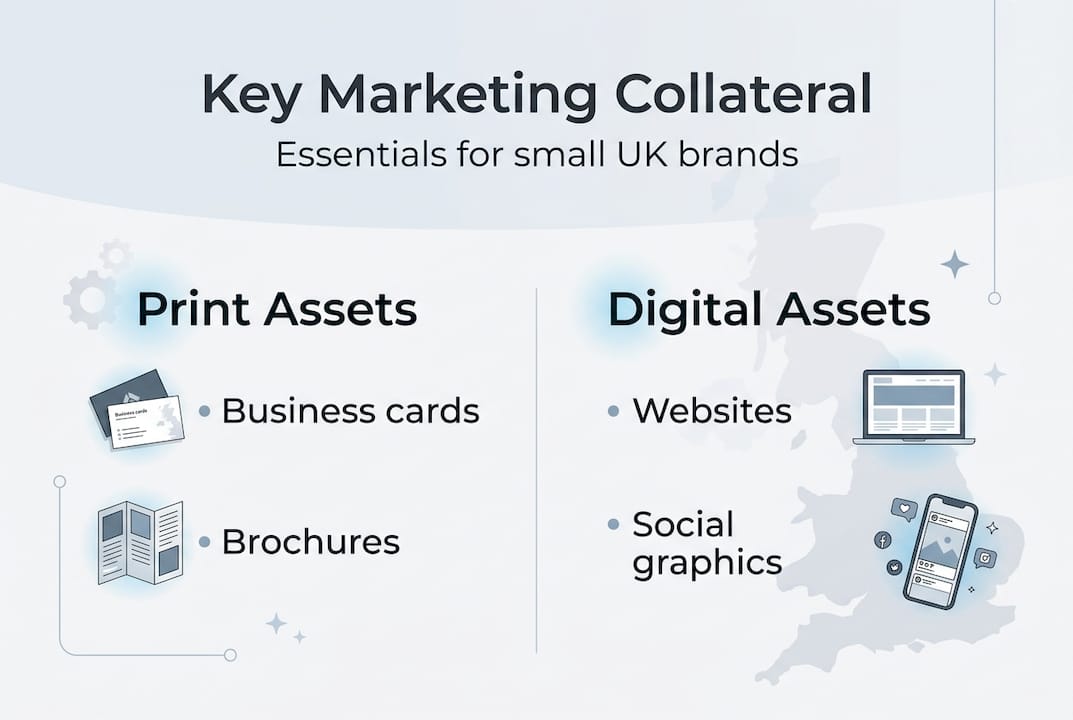
Creating effective collateral doesn’t require a massive budget or a full in-house design team. What it does require is clarity, intention, and a willingness to invest in the pieces that matter most to your specific audience and goals.
Follow these steps to build collateral that genuinely works:
-
Define your audience. Who are you trying to reach? A local trade business targeting homeowners needs very different collateral to a B2B consultant targeting corporate clients. Be specific about who your ideal customer is, where they spend their time, and what messages resonate with them.
-
Map your customer journey. Identify every touchpoint where a potential customer encounters your brand. This might include seeing a social media post, visiting your website, receiving an email, meeting you at an event, or receiving a printed leaflet. Each touchpoint is an opportunity for your collateral to work.
-
Prioritise your most impactful pieces. Not everything needs to be produced at once. Rank your collateral by impact. For most businesses, a professional website, branded email template, and a core print piece such as a business card or brochure will cover the majority of situations.
-
Establish your brand guidelines before designing anything. Your guidelines should include your logo, colour palette, typography, tone of voice, and image style. Every piece of collateral must reference these guidelines to maintain consistency.
-
Work with a professional designer. Templates and DIY tools have their place, but professional design makes a genuine difference to how your brand is perceived. Understanding how presenting design concepts works can also help you collaborate more effectively with designers, ensuring the final results genuinely reflect your vision.
-
Test before scaling. Before printing 5,000 brochures or launching a full suite of digital assets, test your materials with a small audience. Get feedback. Check that the message lands clearly and that the design feels right.
-
Review and refresh regularly. Your collateral should evolve as your business grows. Plan to review all materials at least once a year, or whenever you make significant changes to your offer, branding, or target audience.
Pro Tip: Keep digital versions of all your collateral in a shared folder that any team member can access easily. This prevents the all-too-common problem of different versions of your logo or brochure floating around and creating inconsistency.
Cost-effective production doesn’t have to mean low quality. Digital collateral has almost no print or distribution cost. Focus your budget on the pieces where quality of print or finish genuinely makes an impression, such as business cards or brochures for high-value client meetings.
A fresh perspective: why most small businesses underuse their collateral
With practical steps underway, consider this essential shift in approach for lasting impact.
Here’s something most marketing articles won’t tell you directly: the majority of small businesses treat their collateral as a box-ticking exercise. They commission a logo, print some business cards, build a basic website, and consider the job done. The materials sit in a drawer or on a server, largely forgotten. That’s a significant missed opportunity.
The businesses that genuinely transform their presence through collateral think about it completely differently. They treat each piece not as a static deliverable, but as part of an ongoing dialogue with their audience.
Think about it this way. Your brochure is not just a product sheet. It’s a conversation starter. Your email template is not just a formatting choice. It’s a relationship-building tool that arrives in someone’s inbox and either deepens trust or erodes it. Your social media graphics are not just filler content. They’re consistent visual cues that train your audience to recognise and remember you.
We’ve seen this shift in approach make a genuine difference for businesses across the UK. A small independent accountancy firm in the Midlands refreshed its entire suite of printed and digital materials with a clear, consistent identity. Within six months, the principal reported that clients were commenting unprompted on how professional the business appeared. Referrals increased. The firm attracted a higher calibre of client than before, simply because its collateral communicated competence and care at every touchpoint.
The mistake is assuming that once you’ve created your collateral, it runs on autopilot. The businesses that benefit most from their materials actively use them. They share digital assets across social media. They hand out printed materials with intention. They keep their website updated and their email templates refreshed.
The branding benefits for small business only materialise when the collateral is genuinely integrated into how you operate day-to-day. A fantastic logo sitting in a folder helps no one.
The real power of marketing collateral is cumulative. Every time a customer sees your consistent branding, it deepens recognition. Every professional touchpoint builds trust incrementally. This is not a one-time investment. It’s a long-term conversation, and every piece of collateral is a sentence in that ongoing story.
Ready to transform your brand? Explore marketing collateral solutions
Finally, if you’re ready to turn theory into practice, here’s how to get expert guidance tailored to your UK business.
At Kukoo Creative, we’ve spent over a decade helping small business owners across the UK build brands that genuinely resonate. We understand that collateral isn’t just a design exercise. It’s how you build brand recognition that lasts and turns casual browsers into loyal customers.
Whether you’re starting from scratch or refreshing existing materials, we’d love to help you create collateral that works as hard as you do. Explore our visual branding workflow to understand how we bring a brand to life, step by step. Or browse our design portfolio to see the kind of results we achieve for businesses just like yours. When you’re ready to start a project or have a chat about what your business needs, we’re here and ready to help you build something extraordinary.
Frequently asked questions
How is marketing collateral different from advertising?
Marketing collateral supports your brand and nurtures customer relationships over time, while advertising focuses on direct promotion or driving immediate sales. Collateral tends to have a longer shelf life and works across multiple stages of the customer journey.
What are examples of digital marketing collateral?
Digital collateral includes websites, email templates, e-books, social media graphics, and presentation decks designed to reinforce your brand consistently online. These materials work around the clock to communicate your value to potential customers.
Can I create effective marketing collateral on a small budget?
Yes, by focusing on your most essential pieces first and using professional design for those high-impact materials, small businesses can produce credible collateral without a large spend. Prioritise quality over quantity and build your suite gradually.
How often should I update my marketing collateral?
Review and refresh your collateral whenever you update your branding, launch new products or services, or shift your business strategy. At a minimum, an annual review ensures your materials remain current, accurate, and aligned with your goals.
Why is consistency important in marketing collateral?
Consistency ensures that every material your business produces reinforces the same brand identity, making you more memorable and trustworthy to customers. Inconsistent collateral creates confusion and undermines the credibility you’ve worked hard to build.