
TL;DR:
- Most UK SME websites underperform in Core Web Vitals, losing visitors, rankings, and revenue unnoticed.
- Routine website audits reveal critical issues like security vulnerabilities, outdated content, and poor usability, which can be fixed to boost business growth.
- A comprehensive audit covers technical SEO, accessibility, user experience, and compliance, guiding strategic improvements for lasting success.
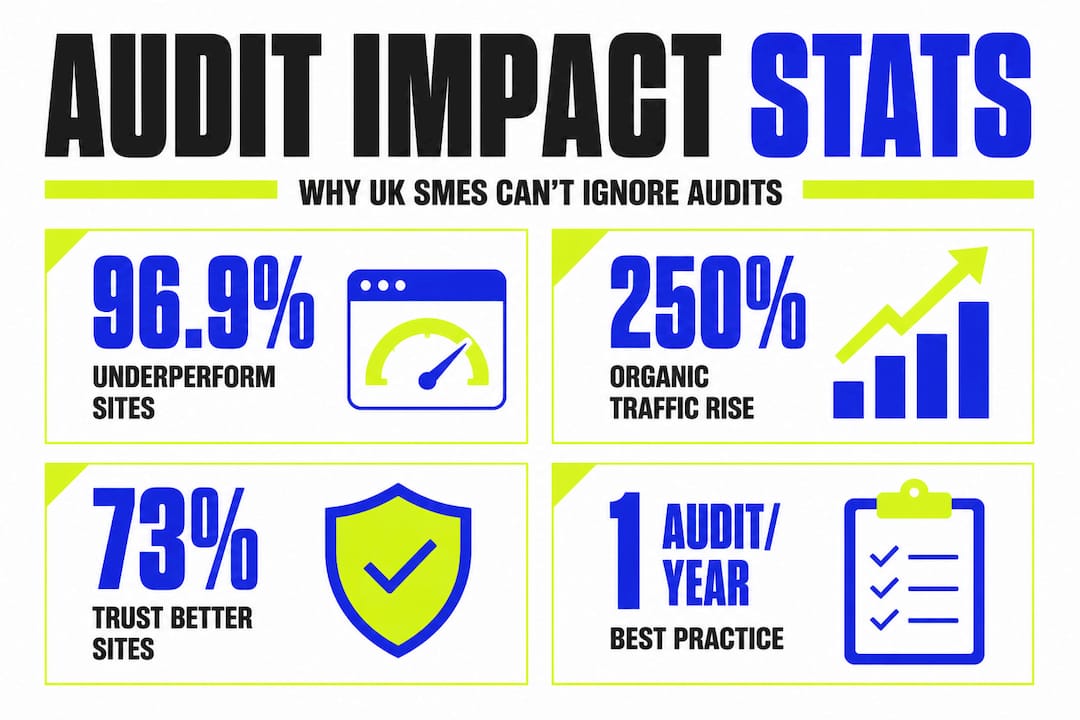
Most UK business websites are quietly underperforming, and the owners have no idea. 96.9% of small business sites fail at least one Core Web Vitals metric, meaning the majority of SME websites are losing visitors, rankings, and revenue every single day. A website is not a “set it and forget it” asset. It needs regular attention, honest assessment, and purposeful improvement. This guide explains why website audits matter so much, what they actually involve, and how they can become one of the smartest investments you make in your business this year.
Table of Contents
- The hidden costs of neglecting website audits
- What a comprehensive website audit really covers
- The business impact: visibility, trust, conversions
- DIY vs professional audits: which is right for your business?
- The uncomfortable truth about website audits: context beats checklists
- Transform your website with expert audits and strategic branding
- Frequently asked questions
Key Takeaways
| Point | Details |
|---|---|
| Most SME sites underperform | The vast majority of UK small business websites have issues hurting SEO, user trust, and conversions. |
| Audits drive measurable growth | Regular, comprehensive audits deliver significant traffic, conversion, and trust gains. |
| Beyond SEO: Full-spectrum review | Modern audits cover technical, content, UX, compliance, and ethical factors for holistic improvement. |
| DIY or professional: Context matters | Simple sites can use DIY tools, but tailored professional audits give best results for growth-focused SMEs. |
The hidden costs of neglecting website audits
Having highlighted the big gap in site performance, let’s investigate what happens when audits are not routinely done.
Most UK business owners invest time and money building a website, then move on. It feels done. But the digital landscape shifts constantly. Search engines update their algorithms. User expectations evolve. Security vulnerabilities emerge. And your competitors are not standing still either.
The numbers tell a sobering story. UK SMEs frequently overlook audits, leaving them exposed to cyber threats, missing out on meaningful analytics, and haemorrhaging potential customers through poor usability. Specifically, 85% of UK small businesses have never checked their site for cyber security issues, and 75% do not use any form of website analytics. That means three quarters of SMEs are flying blind, making decisions without any real data to support them.
Consider the financial dimension. The average UK SME spends around £3,200 building a website. Without routine audits, that investment slowly loses its value. A site that loads slowly, breaks on mobile, or contains outdated content is not just unhelpful, it actively pushes customers away. Poor web usability alone can cost you conversions you never even knew you were missing.
Here are some of the most common issues that go undetected without regular audits:
- Broken links and outdated pages that frustrate visitors and damage your search rankings
- Unpatched security vulnerabilities that expose customer data and risk regulatory penalties
- Missing or incorrect metadata that reduces your visibility on search engines
- Slow page load times that increase bounce rates significantly
- Non-compliant privacy policies that could attract fines under UK GDPR
- Poor mobile responsiveness that alienates the growing majority of mobile users
“A website audit is not an expense. It is insurance against the slow, invisible erosion of your online presence.”
The good news? Every one of these issues is fixable. But you cannot fix what you do not know about. That is precisely why audits exist, and why they should be part of your regular business routine. If you want to boost your online visibility, knowing exactly where your site falls short is the essential first step.
What a comprehensive website audit really covers
To truly solve these missed opportunities, it is crucial to know what a modern website audit involves.
Many people assume an audit means checking a few SEO boxes. In reality, a thorough audit examines far more. Modern comprehensive audits cover technical SEO, content quality, user experience, accessibility, analytics setup, answer engine optimisation (AEO), privacy, and compliance, often across 75 or more individual checks. That is a significant body of work, and each area has direct implications for your business performance.
Here is how a basic audit compares to a comprehensive one:
| Audit area | Basic audit | Comprehensive audit |
|---|---|---|
| Technical SEO | Page titles, meta descriptions | Core Web Vitals, crawlability, schema markup, indexing |
| Content quality | Word count check | Relevance, duplication, keyword gaps, readability |
| Usability | Mobile-friendly test | Full UX review, navigation, forms, CTAs |
| Accessibility | Not included | WCAG compliance, screen reader testing, colour contrast |
| AI / AEO readiness | Not included | Featured snippet optimisation, structured data, voice search |
| Compliance | Not included | UK GDPR, cookie consent, accessibility statement |
| Analytics setup | Not included | Goal tracking, conversion funnels, data accuracy |
| Security | Not included | SSL, vulnerability scan, outdated plugins |
A professional audit typically follows a structured process:
- Discovery and goal setting — Understanding your business objectives, target audience, and competitive context
- Technical crawl — Running automated tools to identify errors, broken links, slow pages, and indexing issues
- Content review — Assessing quality, relevance, and gaps across all key pages
- UX and accessibility assessment — Evaluating how real users navigate and experience your site
- Analytics and tracking audit — Confirming that data is being captured accurately and meaningfully
- Compliance and security check — Verifying legal requirements including GDPR and accessibility standards
- AEO and AI readiness review — Checking whether your content is structured to appear in AI-generated answers and featured snippets
- Prioritised action plan — Delivering a clear, ranked list of improvements with expected impact
Just as a brand audit examines how your brand is perceived and performing, a website audit examines how your digital presence is functioning. Both are essential for sustained growth.
Pro Tip: Free DIY tools like Google Search Console and PageSpeed Insights are genuinely useful starting points for small, simple sites. But if your site has more than a few hundred pages, includes ecommerce functionality, or has strategic growth goals, a professional audit will almost certainly uncover issues those tools miss. Pair your DIY efforts with local SEO tools to build a fuller picture of your local search performance.
The business impact: visibility, trust, conversions
Understanding the scope of audits clarifies why their business impact goes far beyond the technical.

Let us talk results. Website audits identify critical technical issues that affect both SEO and user experience, and fixing those issues translates into real, measurable business outcomes.
Traffic is the most obvious win. Properly optimised websites can see organic traffic increases of 250% to 500% over time when audit recommendations are implemented consistently. That is not a promise, but it reflects what is achievable when you fix what is broken and build on what works.
Conversions are equally striking. Research shows that a mere 0.1 second improvement in page load speed can lift conversion rates by 8.4% for retail sites. For an SME generating £200,000 in annual online revenue, that is an additional £16,800 from one technical fix. Fast, frictionless sites simply sell better.
Local visibility matters enormously for UK SMEs. “Near me” searches have grown by over 250% in recent years, and local SEO is now a critical battleground for small businesses. An audit will reveal whether your Google Business Profile is properly connected, whether your site uses local schema markup, and whether your content speaks to your local market. Get these right and you become far more visible to the customers who are closest and most ready to buy.
Ethical and accessible websites also build trust in a meaningful way. Research consistently shows that 73% of consumers factor in a company’s social and environmental responsibility when making purchasing decisions. An accessible, privacy-respecting website signals that you are a credible, trustworthy business. It matters to people.
| Audit action | Business outcome | Typical impact |
|---|---|---|
| Fix Core Web Vitals | Improved rankings and lower bounce rate | Significant SEO uplift |
| Improve page speed | Higher conversion rate | Up to 8.4% per 0.1 second gain |
| Add local schema markup | Better local search visibility | 250%+ growth in “near me” reach |
| Achieve WCAG accessibility | Broader audience and legal compliance | Reduces exclusion of 1 in 5 UK adults |
| Implement structured data | Featured snippet and AI answer appearances | Major increase in zero-click visibility |
| Fix GDPR compliance gaps | Legal protection and consumer trust | Avoids fines and builds brand credibility |
The SEO and branding connection is real. A well-audited website does not just rank better, it presents a more confident, more credible brand to every visitor. And if your audit reveals that a fuller overhaul is needed, knowing how to plan a website redesign properly ensures your investment delivers lasting returns.
Pro Tip: When prioritising your post-audit fixes, start with Core Web Vitals and any accessibility or compliance issues. These deliver the strongest ROI and protect you legally. Then move to content gaps and AEO optimisation for sustained growth.
DIY vs professional audits: which is right for your business?
Whether you run a microbusiness or a fast-growing SME, the right audit approach depends on your situation.
There is no single correct answer here, and we would never tell you that a professional audit is always necessary. For small sites with a handful of pages and modest goals, a disciplined DIY approach using free tools can get you a long way. Google Search Console, Screaming Frog’s free version, and GTmetrix can surface many common issues without costing a penny.
DIY audits suit simpler sites, while professional audits add genuine value for complex, strategic, or ecommerce businesses. The distinction matters because an audit is only as good as the decisions made off the back of it. Identifying 200 technical issues is useless if you cannot interpret or prioritise them correctly.
Ask yourself these questions to work out which route suits you best:
- How many pages does your site have? Under 50 pages, DIY is very manageable. Over 200, professional help is worth it.
- Do you take online payments? Ecommerce sites carry additional technical, security, and compliance requirements that benefit from expert scrutiny.
- Are you in a competitive market? If rivals are investing heavily in their digital presence, a surface-level audit will not be enough to keep up.
- Do you have legal obligations? Regulated industries, public-facing services, or businesses handling sensitive data need a professional eye on compliance.
- Have you recently rebranded or launched a new site? Post-launch audits catch the issues that slip through even the best build process.
- Is your site generating the leads or sales you expect? If not, a professional audit will identify the exact points of failure.
When you decide to plan a proper website overhaul, grounding it in solid audit data means every decision is purposeful rather than guesswork.
Pro Tip: Even if you handle routine checks yourself, book a professional audit at least once a year. Think of it like an annual service for your car. You might drive it every day without issues, but a trained mechanic will spot things you simply cannot see.
The uncomfortable truth about website audits: context beats checklists
No matter who carries out your audit, there is a crucial mindset most guides miss.
It is tempting to treat a website audit as a to-do list. Fix every red flag, tick every box, score 100 on every tool. But here is the honest reality: not every issue has equal impact on your business. Chasing every technical imperfection can consume enormous time and budget while barely moving the needle on what actually matters.
Over-reliance on tools without business context consistently leads to fixing low-impact issues while high-impact opportunities go unnoticed. A tool might flag a missing H2 tag on a page that nobody visits. Meanwhile, a confusing checkout flow on your most popular product page goes unexamined because no automated tool can truly understand buyer psychology.
The best audits blend data with context. They ask: what are your real business goals? Who are your customers and what do they need from your site? What does your local competitive landscape look like? A manufacturer in Leeds has very different priorities to a fashion boutique in Brighton. Generic checklists do not account for that.
We have seen SMEs spend weeks implementing every minor technical recommendation from an automated report, only to see minimal improvement in actual enquiries or sales. Conversely, we have seen businesses fix one significant usability issue identified through a customer-focused brand audit perspective and double their conversion rate within a month.
The message is simple. Use your audit as a strategic compass, not a rigid rulebook. Prioritise the fixes that align with your business goals. Combine technical data with customer insight. And never lose sight of the humans on the other side of the screen.
Transform your website with expert audits and strategic branding
Ready to put insight into action? A well-executed website audit is not just a technical exercise. It is the foundation of a stronger digital presence, a more credible brand, and a website that genuinely works for your business.

At Kukoo Creative, we have spent over a decade helping UK business owners build brands and websites that truly connect with their audiences. From visual identity creation to strategic web builds, everything we do is grounded in understanding your business first. Our web design process is thorough, transparent, and built around your goals. If your website is not performing the way it should, let us help you find out why and fix it properly. Get in touch today and let’s build something fantastic together.
Frequently asked questions
How often should I audit my SME website?
Most UK experts recommend a full website audit at least once a year and after any major changes, because SMEs who neglect regular audits are far more likely to accumulate unnoticed vulnerabilities and missed opportunities.
Can website audits improve my Google rankings?
Yes. Audits surface the technical SEO and usability issues that hold your site back, and fixing those issues directly improves how search engines crawl, index, and rank your pages.
Are free audit tools reliable for small businesses?
Free tools are a solid starting point for basic sites, but complex or growth-focused sites genuinely benefit from professional expertise that interprets findings within a real business context.
What’s included in a modern website audit for UK SMEs?
A thorough audit covers technical SEO, content quality, UX, accessibility, compliance, and AI readiness, with comprehensive audits going well beyond the basic SEO checks most people associate with the process.