
TL;DR:
- UX research systematically uncovers user needs and motivations, dramatically increasing product success and ROI.
- Integrating continuous research reduces development costs, mitigates risks, and aligns teams around user-driven decisions.
UX research is the systematic study of user behaviour, needs, and motivations that directly informs design and business decisions to improve product success. If you are a business owner weighing where to invest your development budget, understanding why UX research matters could be the single most profitable decision you make this year. Each £1 invested in UX research returns £100 on average, representing a 9,900% ROI. That figure is not a marketing claim. It reflects the compounding effect of building products that users actually want, reducing rework, and cutting the cost of fixing problems that should never have existed. Frameworks like Nielsen Norman Group’s usability heuristics and tools such as Maze and UserTesting exist precisely because the value of user experience research is measurable, repeatable, and strategic.
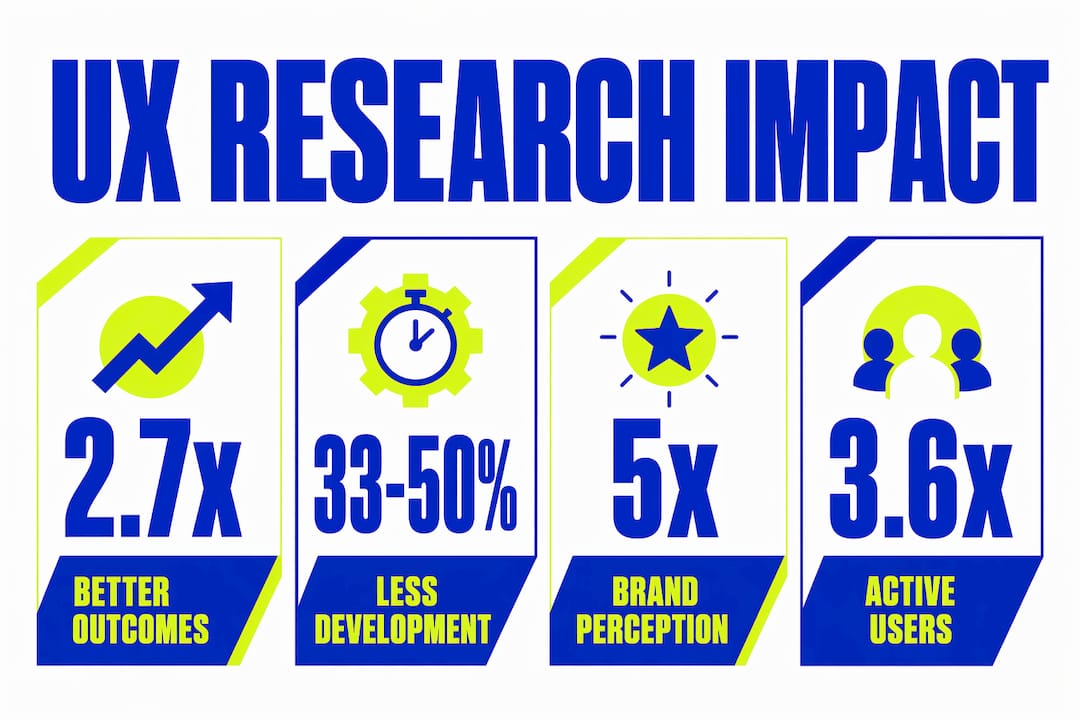
Why UX research matters: the business case in numbers
The financial argument for conducting UX research is direct. Companies using research regularly report 2.7x better outcomes on key business metrics compared to those that rarely use it. That gap compounds over time, separating thriving product businesses from those stuck in expensive revision cycles.
| Metric | Without UX research | With UX research |
|---|---|---|
| Conversion rate improvement | Baseline | Up to 400% increase |
| Product development time | Baseline | 33–50% reduction |
| Net Promoter Score change | Baseline | 20–30 point increase |
| Brand perception | Baseline | Up to 5x improvement |
The table above is not theoretical. Regular UX research cuts development time by 33–50% and reduces support costs significantly. For a business spending £500,000 on a product build, that reduction alone can save six figures before a single customer complaint arrives.
Embedding user insights into strategy also produces 5x better brand perception and 3.6x more active users. Those are retention and acquisition gains rolled into one research investment. For decision-makers focused on customer lifetime value, the importance of UX research extends well beyond the design team. It sits at the centre of product strategy, marketing positioning, and commercial growth.
Pro Tip: Track your Net Promoter Score before and after a research-informed redesign. The shift in that single number tells your board a story that design mockups never can.
How does UX research reduce business risk?
The most common misconception about user experience research is that it exists to fix usability bugs. That misunderstanding leads businesses to treat it as a quality-assurance step rather than a strategic input. The real role of UX research is to reduce avoidable business uncertainty and prevent investment in solutions that users do not need.
Consider the cost curve of fixing problems at different stages:
- Design stage: Fixing a usability issue costs a baseline amount.
- Development stage: The same fix costs 10x more during development than during design.
- Post-launch stage: That same issue costs 100x more to resolve after release.
Skipping early research does not save money. It defers costs and multiplies them. Teams that bypass discovery phases often find themselves extending development by up to 50% to accommodate rework that validated research would have prevented entirely. The operational disruption of late-stage changes, missed launch windows, and reputational damage from a poor first release adds costs that never appear in a project budget.
UX research also functions as an alignment tool. Successful product teams use research findings to prioritise features based on evidence rather than internal politics or the loudest voice in the room. When your engineering, marketing, and leadership teams share the same user data, decisions move faster and with greater confidence.

Pro Tip: Treat UX research as an ongoing capability, not a one-off project. Build a research calendar that maps to your product roadmap, so insights arrive before decisions are made, not after.
Qualitative vs quantitative: which research method should you use?
UX research techniques fall into two broad categories, and understanding when to use each is one of the most practical skills a business leader can develop. Qualitative research uncovers why users behave in certain ways, while quantitative research confirms what is happening and how many users are affected. Neither method is superior. They answer different questions.
| Method type | Techniques | Sample size | Best used when |
|---|---|---|---|
| Qualitative | User interviews, usability testing, diary studies | 5–20 participants | Exploring motivations, uncovering pain points |
| Quantitative | Surveys, A/B testing, analytics review | 100+ participants | Validating patterns, measuring frequency |
| Mixed methods | Contextual enquiry, card sorting with surveys | Variable | Confirming qualitative findings at scale |
A particularly useful finding for resource-conscious businesses: five participants in usability testing uncover approximately 85% of usability problems. You do not need a vast research budget to generate meaningful insight. A morning of structured interviews with five representative users can surface the critical friction points in your product before a single line of code is written.
The most confident decisions come from integrating both approaches. Qualitative research with a small group reveals the story behind user behaviour. Quantitative data then tells you how widespread that story is. Together, they give you the evidence to commit to a direction with genuine conviction rather than educated guessing. For better interface design outcomes, this combination is the standard that separates good products from great ones.
How to integrate UX research into your business strategy
Knowing the benefits of user research is one thing. Building it into your operations is another. The following steps give you a practical framework for making research a consistent part of how your business makes decisions.
-
Define the decision first. Every research project should begin with a specific business question. “What do users think of our product?” is not a research question. “Why are users abandoning the checkout at the payment stage?” is. Clarity here determines whether your findings are useful or vague.
-
Recruit representative participants. Your research is only as good as the people in it. Recruit users who match your actual customer profile, not colleagues, friends, or whoever is available. Tools like Respondent and UserTesting’s panel services make this straightforward even for small teams.
-
Run research in cycles, not sprints. Research-driven design decisions improve conversion, retention, and alignment across leadership and engineering when they are continuous rather than episodic. Map research activities to each phase of your product lifecycle: discovery, development, launch, and post-launch review.
-
Translate findings into recommendations. Raw data does not change behaviour in organisations. A report that says “users struggled with navigation” sits in a folder. A recommendation that says “restructure the top navigation to surface the three most-used features, reducing clicks to purchase from four to two” gets acted upon. Frame every finding as a decision.
-
Share insights across functions. UX research as a strategic driver only works when findings reach marketing, product, and leadership simultaneously. A shared research repository, even a simple Notion or Confluence space, prevents duplication and keeps the whole business oriented around the same user reality.
Pro Tip: Communicate research findings as recommendations with a clear rationale, not as a list of problems. Decision-makers act on solutions, not symptoms.
For a deeper look at how human-centric design connects research to business growth, the principles are consistent: the closer your decisions are to real user evidence, the better your outcomes.
Key takeaways
UX research delivers measurable business value by reducing development costs, improving conversion, and aligning product decisions with real user needs rather than assumptions.
| Point | Details |
|---|---|
| ROI is quantifiable | Every £1 invested in UX research returns approximately £100 through better outcomes and reduced rework. |
| Early research saves money | Fixing usability issues at the design stage costs 100x less than resolving them post-launch. |
| Both method types matter | Qualitative research reveals why users behave as they do; quantitative confirms how widespread those behaviours are. |
| Research reduces risk | Continuous research prevents investment in wrong solutions and aligns teams around evidence rather than opinion. |
| Integration is the goal | Research embedded into product strategy produces 2.7x better key metric outcomes than ad-hoc approaches. |
The uncomfortable truth about skipping research
I have worked alongside business owners who built products they were genuinely proud of, only to watch them underperform because no one had asked users what they actually needed. The pattern is always the same. A confident brief, a talented design team, a launch with real excitement, and then a quiet disappointment when the numbers do not move. The product was not bad. It was just built on assumptions.
What I find most telling in 2026 is that the businesses treating UX research as a strategic investment are pulling ahead of those treating it as optional. ROI pressure is reshaping how research is justified, with teams now expected to demonstrate direct links between research activity and outcomes like adoption, efficiency, and loyalty. That is a healthy shift. It means research is finally being held to the same commercial standard as every other business function.
The pitfall I see most often is treating a single round of user interviews as “done.” Research is not a checkbox. It is a capability. The businesses that build it into their rhythm, running small, focused studies at every major decision point, are the ones that stop being surprised by their users. They already know what their customers want because they asked.
My honest recommendation: start smaller than you think you need to. Five users, one clear question, one afternoon. The insight you gain will pay for itself before the week is out.
— Kukoo
Research-informed design that builds real brand impact
At Kukoocreative, we have spent over a decade helping business owners create designs that connect with the people who matter most. Good design does not start with aesthetics. It starts with understanding your users, and that is exactly where UX research fits into every project we take on.
Whether you are building a new website or refreshing your brand identity, research-informed decisions mean your investment works harder. Our web design process for Leeds businesses is built around user insight at every stage, from initial discovery through to launch. If you want to see how that approach translates into real results, explore our client portfolio and see the difference that purposeful, research-led design makes. We would love to help you build something your customers genuinely love.
FAQ
What is UX research and why does it matter?
UX research is the systematic study of user behaviour, needs, and motivations to inform design and product decisions. It matters because it replaces costly assumptions with evidence, reducing development risk and improving business outcomes.
How much does UX research cost to implement?
The cost varies widely, but the barrier is lower than most business owners expect. Five participants in usability testing uncover approximately 85% of usability problems, meaning a focused half-day study can generate significant insight without a large budget.
What is the difference between qualitative and quantitative UX research?
Qualitative research, such as user interviews and usability testing, reveals why users behave as they do. Quantitative research, such as surveys and analytics, confirms what is happening and at what scale. Using both together produces the most reliable findings.
When should a business start conducting UX research?
The earlier the better. Fixing usability issues during the design stage costs 100x less than resolving them after launch, so research conducted before development begins delivers the greatest return on investment.
How does UX research improve conversion rates?
By identifying and removing friction in the user journey, research-informed design changes have been shown to produce conversion rate improvements of up to 400%. Removing a single unnecessary step in a checkout flow, for example, can produce measurable revenue gains within weeks of launch.