
TL;DR:
- Grid systems create consistency, professionalism, and alignment across all brand materials.
- They improve user experience by making websites more organized, readable, and responsive.
- Small businesses benefit from grids by enhancing brand recognition and ensuring cohesive visual identity.
If your website feels cluttered or your brand looks different across every leaflet, business card, and social post, you’re not alone. Many small business owners pour time and money into their visuals, only to end up with something that feels… off. The culprit is often invisible. Not a bad logo or a weak colour palette, but the absence of a grid system. This fundamental design tool is what separates polished, professional brands from those that feel inconsistent and hard to trust. In this article, we’ll explain what grid systems are, why they matter for your brand, and how you can start using them to create visuals that actually work.
Table of Contents
- What is a grid system in design?
- Types of grid systems and where they’re used
- Why grid systems are vital for consistent branding
- How grid systems improve user experience on websites
- Why every small business should embrace grid systems
- Take your brand further with professional design expertise
- Frequently asked questions
Key Takeaways
| Point | Details |
|---|---|
| Grid systems explained | A grid system is a hidden framework that brings order and clarity to designs. |
| Boosts brand consistency | Using grid systems ensures every element of your brand looks unified and professional. |
| Enhances web usability | Grid-based websites are easier to navigate and help convert visitors into customers. |
| Types of grids | Different grids suit print, logos, and digital—choose the right one for your needs. |
| Accessible for all | Anyone can use grid systems with simple tools, no specialist training required. |
What is a grid system in design?
A grid system is an invisible framework of horizontal and vertical lines that designers use to organise content on a page or screen. Think of it like the scaffolding behind a building. You never see it in the finished structure, but without it, everything would be unstable.
Grids divide a layout into columns, gutters, and margins. Columns are the vertical sections that hold your content. Gutters are the spaces between those columns. Margins are the breathing room around the edges. Together, they create a visual rhythm that makes your design feel intentional and balanced.
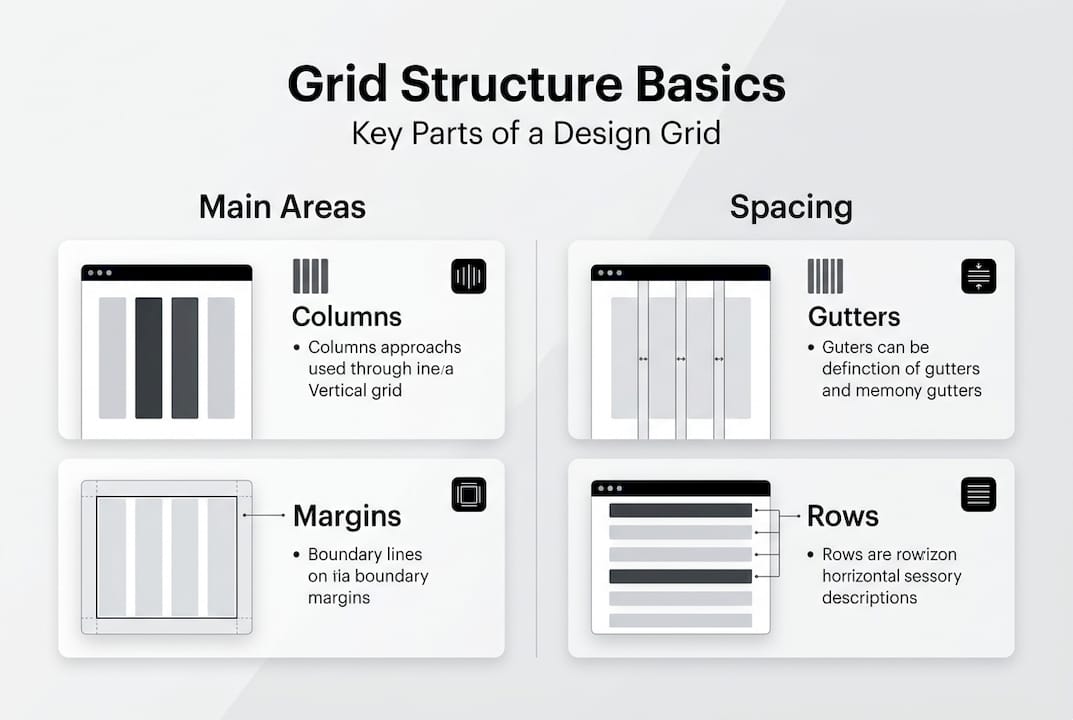
As grid systems explained by Smashing Magazine, grids provide an underlying structure to visual layouts, improving coherence across every element on the page. That coherence is what makes a brand feel credible and trustworthy at a glance.
Professional designers rely on grids because they remove guesswork. Instead of placing elements by eye and hoping for the best, a grid gives every decision a logical foundation. The result is layouts that feel balanced, predictable, and easy to read. You can see this in action across visual branding examples from well-known agencies.
Key benefits of grid systems:
- Consistency: Every page or material follows the same visual rules
- Efficiency: Designers work faster with a clear structure in place
- Scalability: Grids adapt easily as your brand grows and adds new materials
- Alignment: Elements line up naturally, reducing visual clutter
- Professionalism: Layouts feel polished without extra effort
| Feature | Without a grid | With a grid |
|---|---|---|
| Alignment | Inconsistent, elements feel scattered | Precise, everything lines up |
| Readability | Hard to scan, confusing hierarchy | Clear flow, easy to follow |
| Brand consistency | Varies across materials | Uniform across all touchpoints |
| Design time | Longer, more trial and error | Faster, structured decisions |
| User trust | Lower, feels unprofessional | Higher, looks credible |
“A grid is not a cage. It is a structure that gives you freedom to design with confidence.” — Josef Müller-Brockmann, graphic design pioneer
Types of grid systems and where they’re used
Not all grids are the same. Different design projects call for different grid types, and choosing the right one makes a significant difference to the final result. As grid system for web design research shows, different grids suit different design needs, from simple posters to complex responsive websites.
Here are the four main types:
Manuscript grid: The simplest type. One large column fills most of the page, with margins around it. Best for long-form reading like books, reports, or blog posts where the focus is entirely on text.
Column grid: Multiple vertical columns allow content to be arranged side by side. This is the most common grid for websites, magazines, and newspapers. It gives you flexibility while keeping everything aligned.
Modular grid: Both columns and rows divide the layout into a series of modules or cells. Ideal for complex web pages, e-commerce sites, and editorial layouts where images and text need to coexist in a structured way.
Hierarchical grid: A more organic grid that organises content based on importance rather than rigid columns. Often used in app interfaces and creative websites where visual hierarchy matters most.
| Grid type | Best used for | Key feature |
|---|---|---|
| Manuscript | Books, reports, long articles | Single column, focused reading |
| Column | Websites, magazines, newspapers | Flexible multi-column layouts |
| Modular | E-commerce, editorial, dashboards | Rows and columns create cells |
| Hierarchical | Apps, creative sites | Organised by visual importance |
Common pitfalls when choosing the wrong grid:
- Using a manuscript grid on a product page makes it feel flat and hard to scan
- Applying a modular grid to a simple blog post creates unnecessary visual complexity
- Ignoring responsive behaviour when choosing a grid leads to broken mobile layouts
- Mixing grid types without purpose creates visual confusion across your brand materials
Your visual branding workflow should define which grid you use for each material type early in the process. And if you’re thinking about designing for user experience, the grid you choose will shape how visitors feel the moment they land on your site.
Pro Tip: Start with a 12-column grid for your website. It divides evenly into halves, thirds, and quarters, giving you enormous flexibility without overcomplicating your layout.
Why grid systems are vital for consistent branding
Once you know which grid to use, it’s important to see how grids really make a difference in bringing a brand to life. Consistency is the backbone of strong branding, and grids are what make consistency achievable at scale.

When your logo design visual identity is built on a grid, it scales cleanly across every size and format. The same logic applies to your website, business cards, brochures, and social graphics. When they all share the same underlying structure, your brand feels unified and intentional.
As grid-based design for branding demonstrates, consistent grids improve brand recognition and create a trustworthy look that customers respond to positively. That trust is not a small thing. It directly influences whether someone chooses your business over a competitor.
Five ways grids enhance brand consistency:
- Logo placement: A grid ensures your logo always sits in the correct position relative to other elements
- Website layout: Pages feel familiar and easy to navigate because the structure repeats
- Colour blocking: Grid modules create natural zones for colour, making your palette feel deliberate
- Alignment: Text, images, and buttons line up across every page and material
- Spacing: Gutters and margins create consistent breathing room that feels premium
Studies show that brand recognition increases significantly when visual elements are presented consistently across touchpoints. For a small business, that recognition is your competitive edge.
Pro Tip: Once you’ve established your grid, document it in a simple brand style guide. Share it with anyone who creates materials for your business, from freelancers to in-house staff. This single step can transform how consistent your brand looks overnight.
When you’re presenting design concepts to stakeholders or clients, a grid-based layout also makes your work far easier to explain and defend. Structure is persuasive.
How grid systems improve user experience on websites
Beyond brand consistency, grid systems also play a crucial role in how users engage with your website. A well-structured grid does not just look good. It actively guides your visitors towards the actions you want them to take.
Websites built with grids are more readable and user-friendly, making it easier for visitors to find what they need and take action. That readability directly affects your conversion rates.
Here is how a visitor typically experiences a grid-based website compared to one without:
- First impression: A grid-based site feels calm and organised. A non-grid site feels busy and confusing.
- Scanning: Grid layouts create clear visual lanes that the eye follows naturally. Non-grid layouts force the eye to search.
- Finding information: Consistent column structures mean users know where to look for navigation, content, and calls to action.
- Taking action: Buttons and links placed on grid points feel natural and easy to click.
- Returning visits: Familiar structure builds comfort. Users come back because the site feels reliable.
Grids also support accessibility. When content is aligned to a consistent structure, screen readers and assistive technologies can interpret the page more accurately. Responsive grids adapt to mobile, tablet, and desktop screens, ensuring your site works well for every visitor regardless of their device. This matters enormously for improving user experience across your entire audience.
“When a layout is built on a grid, users don’t notice the grid. They just notice that everything feels right.” — Khoi Vinh, design director and author
Consider a small retail business that redesigned its website using a 12-column modular grid. Product images aligned cleanly, descriptions sat in consistent columns, and the checkout button always appeared in the same grid position. Bounce rates dropped and average session time increased. The grid was invisible. The results were not.
Why every small business should embrace grid systems
Here is something we’ve observed after more than a decade working with small business owners: the ones who resist grid systems often think they’re protecting their creativity. They worry that structure will make their brand feel rigid or generic. That instinct is understandable, but it’s wrong.
Grids do not limit creativity. They channel it. Without a grid, creative decisions become arbitrary. With one, every choice has a reason, and the cumulative effect is a brand that feels confident and coherent rather than chaotic.
Small businesses actually have the most to gain from grid systems. You rarely have a large design team checking every output. A grid becomes your quality control. It ensures that even when you’re creating a quick social graphic at midnight, the result still looks like you.
The best part? Grid frameworks cost nothing to adopt. Free tools like Figma, Canva, and even Google Slides support grid overlays. You don’t need a big budget to start benefiting from structure.
As we explore in our branding agency insights, the businesses that build lasting brand recognition are rarely the ones with the biggest budgets. They’re the ones with the most consistent visual language. A grid is the simplest way to build that language.
Try applying a simple 12-column grid to your next design project. The improvement will be immediate and obvious.
Take your brand further with professional design expertise
Understanding grid systems is a fantastic first step. Applying them consistently across your entire brand is where the real transformation happens.
At Kukoo Creative, we’ve spent over a decade helping small business owners across the UK build brands that look credible, feel consistent, and connect with the right people. From your logo design brief to a fully structured website, we apply proven grid-based design principles at every stage of your brand workflow guide. Whether you’re starting from scratch or refreshing an existing brand, our team provides personalised support tailored to your goals. Explore our work and discover how logo design insights can shape the way customers see your business. Get in touch today for a free discovery conversation.
Frequently asked questions
Are grid systems only for designers or can anyone use them?
Non-designers can leverage grids for layout consistency, as most modern design tools include built-in grid features that require no technical knowledge to activate. Anyone creating visual content for their business can benefit from applying a basic grid structure.
Which grid should I use for my small business website?
Column and modular grids are widely used in responsive design, making them the most practical choice for small business websites that need to look great on both desktop and mobile screens.
Do grid systems limit creativity in design?
Grids foster creativity through structured freedom, giving you a reliable foundation from which to make bold, intentional design choices rather than guessing at placement and spacing.
How do grid systems improve user experience on mobile devices?
Grid systems are essential for responsive web design, automatically adjusting column widths and spacing so your content remains readable and well-organised across every screen size.