
TL;DR:
- Nearly half of all Google searches have local intent, with 76% of local searches leading to visits within 24 hours. Local SEO enhances business visibility by targeting geographic-specific searches and optimizing assets like Google Business Profile, citations, reviews, and location content. Implementing a consistent, ongoing strategy can drive immediate customer actions and sustainable growth for small UK businesses.
Nearly half of all Google searches have local intent, and 76% of people who search locally visit a business within 24 hours. That is not a statistic about global corporations with massive marketing budgets. That is about your potential customers, right now, searching for exactly what you offer, a few streets away. Understanding what is local SEO, and putting it to work, could be the difference between a thriving local business and one that stays invisible online.
Table of Contents
- What is local SEO and how does it differ from traditional SEO?
- Key components of local SEO for UK small businesses
- How local SEO drives immediate customer actions and business growth
- Common challenges and misconceptions in UK local SEO
- Step-by-step UK local SEO strategy for small businesses
- Why local SEO success requires treating Google Business Profile as your frontline brand asset
- How we help UK small businesses shine locally with branding and online visibility
- Frequently asked questions
What is local SEO and how does it differ from traditional SEO?
Local SEO is the process of making your business visible in searches that have a geographic element. Think “plumber in Manchester,” “coffee shop near me,” or “accountant in Leeds.” These are people ready to act, not people browsing idly. Local SEO focuses on geographic intent and visibility in local search results and Google Maps, rather than broad keyword ranking that targets anyone, anywhere.
Traditional SEO, by contrast, aims to rank for wider search terms. A national retailer might target “buy running shoes online.” That approach takes longer, costs more, and competes with thousands of sites. Local SEO is narrower, faster to show results, and far more relevant for businesses that serve a specific area.
Here is what sets local SEO apart:
- It targets searches with “near me” or location-specific phrases
- Results appear in Google Maps and the Local Pack (the map and three business listings at the top of results)
- It prioritises customers who are physically nearby and ready to visit or call
- It relies on trust signals like reviews, accurate business information, and local content
If you want to go deeper on the broader picture, our guide on SEO for small businesses is a great starting point alongside this article.
Key components of local SEO for UK small businesses
With the difference established, let us explore the essential building blocks for effective local SEO in the UK market.
Google Business Profile (GBP) is your most powerful asset. GBP is the single most important local SEO asset, and it directly influences whether you appear in the Local Pack when someone searches nearby. Claiming it is free. Not claiming it is a significant missed opportunity.
NAP consistency refers to keeping your Name, Address, and Phone number identical across every online directory. Consistent NAP citations build trust and are one of Google’s core local ranking signals. In the UK, that means listing your business accurately on directories like Yell, Thomson Local, and Bing Places, and making sure the details match your website exactly.
Customer reviews are trust made visible. Genuine, positive reviews signal credibility to both Google and potential customers. They improve your ranking and your conversion rate at the same time.
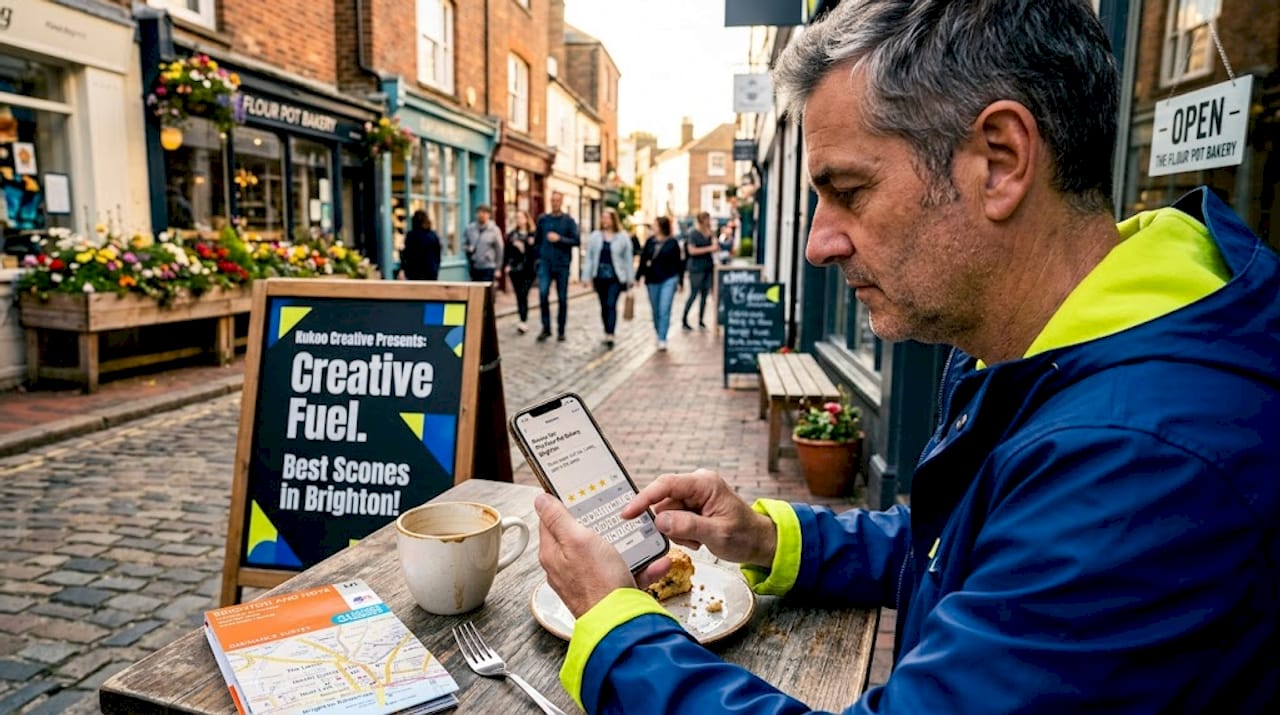
Location-specific content tells Google (and your visitors) exactly who you serve. A blog post about “the best flooring options for Victorian terraces in Sheffield” does more for your local visibility than a generic “flooring services” page ever will. This is where professional copywriting becomes a real advantage.
Here is a quick overview of the key local SEO components and what they affect:
| Component | What it does | UK example |
|---|---|---|
| Google Business Profile | Drives Local Pack and Maps visibility | Claiming your GBP on Google |
| NAP citations | Builds trust and consistency signals | Listings on Yell, Thomson Local |
| Customer reviews | Improves ranking and conversion | Responding to Google reviews |
| Location content | Signals geographic relevance | City or area-specific blog posts |
| On-page local signals | Connects website to local searches | Address in footer, local schema |
For a look at tools that can support your efforts, our article on local SEO tools in Leeds covers practical options worth exploring. And for a clear external overview, BrightLocal’s explanation of local SEO is one of the most thorough available.
Pro Tip: Treat your Google Business Profile like a data product, not just a listing. Every detail, your opening hours, service areas, photos, and description, needs to match your website and citations exactly. Inconsistencies confuse Google and quietly damage your credibility.
How local SEO drives immediate customer actions and business growth
Understanding what local SEO is and its components, let us examine how these efforts lead directly to faster customer actions and real revenue.
Here is the thing most people miss. Local SEO is not about building awareness over months. It connects you with customers who are already in buying mode. 76% of people who search locally on their phone visit a business within 24 hours. That is a direct line between your visibility and a real-world visit.
“Local search is not the top of a funnel. It is often the last step before a customer walks through your door.”
The actions that follow a local search are highly commercial. People are looking for directions, phone numbers, opening hours, and reviews. They want to make a decision now, not later. That is precisely why local SEO is so valuable for small businesses.
Here is how local search intent translates into business outcomes:
- A customer searches “electrician near me” on their phone
- They see a Local Pack with three businesses, photos, reviews, and ratings
- They tap on the listing with the most reviews and complete information
- They call directly from the search results
- That call becomes a booking, often within the hour
Businesses that boost local visibility through consistent, well-managed local signals regularly outperform competitors that rely entirely on word-of-mouth. Word-of-mouth is wonderful. But it cannot be switched on when you need more customers in January.
Common challenges and misconceptions in UK local SEO
Having seen local SEO’s benefits, it is vital to understand common mistakes and realistic challenges you might face when implementing it.
The biggest misconception? That local SEO is just about adding your town name to your website pages a few times. It is not. Local rankings depend on trust signals like reviews and consistent information, not keyword placement alone. Stuffing “plumber in Birmingham” into every paragraph will not help and may actively hurt your standing.
Another common trap: using one business listing to cover multiple locations. If your cleaning company serves Leeds, Bradford, and Wakefield, a single generic listing will not rank well in any of them. Businesses serving multiple areas need distinct location-based content rather than one page trying to cover all bases.
Watch out for these mistakes:
- Inconsistent phone numbers or addresses across directories
- Leaving your Google Business Profile unclaimed or incomplete
- Ignoring negative reviews rather than responding to them
- Creating location pages that are thin, duplicated, or clearly templated
- Treating local SEO as a one-time setup rather than ongoing maintenance
Getting your website structure right is also part of the puzzle. Clear, separate location pages with genuine, useful content improve local relevance significantly.
Pro Tip: Stop tracking generic keyword rankings as your main measure of local SEO success. Instead, track actions from your Google Business Profile: calls, direction requests, and website clicks from Maps. Those numbers tell you whether local SEO is actually driving customers to your door.
Step-by-step UK local SEO strategy for small businesses
To make local SEO actionable, here is a clear, practical roadmap tailored for UK small businesses.
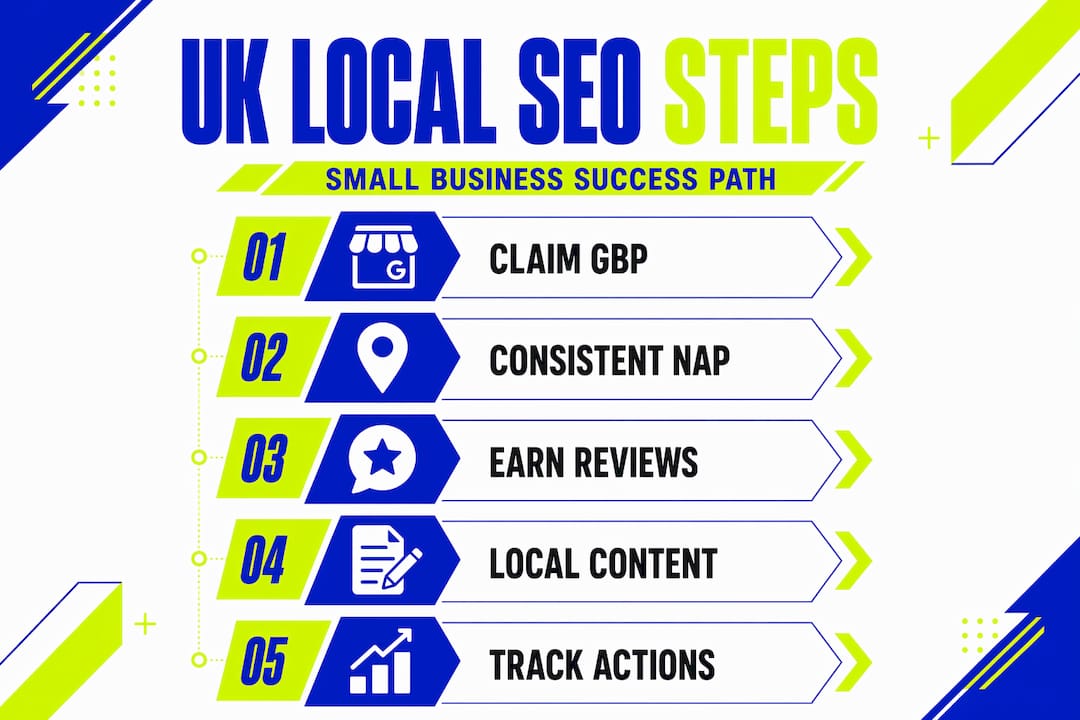
Improving local visibility starts with your Google Business Profile and builds outward from there. Here are the five steps to follow:
-
Claim and fully optimise your Google Business Profile. Add your business name, address, phone number, opening hours, service categories, photos, and a detailed description. Fill in every single field.
-
Build consistent citations in UK directories. Start with Yell, Thomson Local, Bing Places, and Apple Maps. Make sure your NAP information is identical everywhere, including punctuation and formatting.
-
Encourage and manage genuine customer reviews. Ask happy customers directly, via email, text, or a printed card with a QR code linking to your review page. Respond to every review, positive or negative, with care and professionalism.
-
Develop location-specific website content. Create dedicated pages or blog posts for each area you serve. Include local landmarks, area-specific services, and language that reflects the community.
-
Monitor your local search performance. Use Google Business Profile Insights to track calls, direction requests, and website visits from Maps. Adjust your efforts based on what the data tells you.
Here is how local SEO compares to traditional SEO across key factors:
| Factor | Local SEO | Traditional SEO |
|---|---|---|
| Target audience | Nearby, ready-to-act customers | Broad, national or global audience |
| Primary channel | Google Maps and Local Pack | Organic search results |
| Speed of results | Faster, especially with GBP | Slower, often 6 to 12 months |
| Cost | Lower for small local budgets | Can be significant at scale |
| Key assets | GBP, citations, reviews | Backlinks, domain authority, content volume |
Our branding services for small businesses are built around helping you show up consistently and credibly, both online and in local search.
Pro Tip: Update your Google Business Profile regularly. Add new photos monthly, post updates about offers or events, and respond to every review within 48 hours. Activity signals to Google that your business is current and trustworthy.
Why local SEO success requires treating Google Business Profile as your frontline brand asset
Most guides tell you to “fill out your GBP.” That is table stakes. The shift that actually moves the needle is thinking about your Google Business Profile not as an admin task, but as the first impression your brand makes on customers who are moments away from choosing you.
Your GBP shapes the exact experience customers see before they ever visit your website. Your photos, your reviews, your description, your response to that one star rating from last winter. All of it is visible, all of it influences trust, and all of it is in your hands.
Here is what we have observed working with UK small businesses over the years. The ones who treat their GBP as an extension of their brand identity, using consistent language, on-brand photography, and thoughtful review responses, tend to outperform competitors with technically similar setups. It is not just about the algorithm. It is about what happens when a customer compares two listings and one feels credible, current, and cared for.
Inconsistencies between your GBP, your website, and your directory listings create friction. A wrong phone number on one directory does not just annoy a potential customer. It sends a signal of unreliability that affects both your ranking and your reputation.
Think of your GBP as your local storefront window. What does it say about you before someone steps inside? If the answer is “not much” or “it is a bit out of date,” that is exactly where to start. Our work on SEO in branding locally explores precisely this intersection between brand identity and local search presence.
How we help UK small businesses shine locally with branding and online visibility
If you are ready to take your local SEO further, here is how Kukoo Creative can support your journey to greater local visibility and genuine business growth.

We have spent over a decade helping UK small business owners build brands that get noticed. That means creating visual identities that look credible and consistent everywhere your customers find you, from your website to your Google Business Profile. Our branding and SEO services are tailored for small businesses that want to attract more local customers without the overwhelm. Whether you need a stronger brand identity, a website built for local search, or content that resonates with your community, we are ready to help you build something fantastic. Get in touch and let us make your business the obvious local choice.
Frequently asked questions
What exactly does local SEO mean for my small business?
Local SEO means optimising your online presence so your business shows up prominently when nearby customers search for what you offer. It connects you with customers who are ready to choose, not just browse.
Why is my Google Business Profile so important for local SEO?
Your Google Business Profile is the main factor that places you in the Local Pack and Google Maps. GBP is the single most important local SEO asset, giving customers trusted, accurate information at the exact moment they are deciding.
How can I build more local customer reviews ethically?
Ask happy customers directly after a positive experience, whether in person, by email, or via a QR code linking to your review page. Respond promptly to all reviews, and avoid fake or incentivised reviews, which breach Google’s guidelines and damage long-term local SEO rankings.
Is one business listing enough if I serve multiple areas?
No. Businesses serving multiple areas need distinct, location-specific pages or listings for each area to rank well in local searches across different locations.
How soon can I expect results from local SEO efforts?
Results can come quickly. 76% of local searchers visit a business within 24 hours of searching, which means that once your visibility improves, customer actions can follow almost immediately.