
Struggling to stand out from larger competitors in Leeds is a challenge many small business owners face. Your reputation and growth depend on more than just eye-catching logos—how your brand is experienced by customers and understood by your own team shapes that success. A brand audit offers clear insight into your business strengths and weaknesses, revealing powerful ways to connect with your community and build lasting trust.
Table of Contents
- Defining A Brand Audit For Small Businesses
- Types Of Brand Audits And Their Purposes
- The Step-By-Step Brand Audit Process
- Brand Alignment And Measuring Effectiveness
- Common Brand Audit Mistakes To Avoid
Key Takeaways
| Point | Details |
|---|---|
| Understanding Brand Audits | A brand audit provides clarity on internal and external perceptions, helping businesses identify strengths and weaknesses in their branding efforts. |
| Focus on Internal and External Alignment | Ensure that your branding message aligns with your company’s mission and values to enhance customer trust and loyalty. |
| Gather Comprehensive Feedback | Collect insights from customers and employees to identify blind spots that may not be visible from within the business. |
| Act on Findings | Use the findings from the audit to create an actionable plan, prioritising areas for improvement to avoid common pitfalls. |
Defining a Brand Audit for Small Businesses
A brand audit is a structured review of how your brand currently operates and how customers perceive it. It’s the difference between guessing what’s working and knowing exactly where you stand.
Think of it as taking your business’s pulse. You’re checking whether your logo looks professional on your website, whether your team talks about your values consistently, and whether customers actually understand what you do.
What a Brand Audit Examines
A comprehensive brand audit looks at three main areas:
-
Internal branding: Your company’s mission, values, and culture. Does your team live these daily? Are they aligned with what you tell customers?
-
External branding: Every visual touchpoint customers see—logos, packaging, social media, websites, and marketing materials. Do they all feel like they belong to the same business?
-
Customer experience: How people interact with your brand during sales, support, and beyond. Does your service match your brand promise?
Small businesses often discover that their internal reality differs from their external image. Evaluating brand consistency across these areas reveals gaps you can actually fix.

Why It Matters for Leeds Small Businesses
You’re competing against larger companies with bigger budgets. What you have instead is authenticity and the ability to move quickly. A brand audit shows you exactly where that advantage lies.
It also prevents costly mistakes. You might be spending money on marketing materials that contradict your brand values, or your website might tell a different story than your shop window.
A brand audit transforms vague concerns into concrete data you can act on immediately.
When you know your strengths, you can emphasise them. When you find weaknesses, you can fix them before they damage customer trust.
How Small Businesses Conduct Brand Audits
You don’t need expensive consultants. You can start by reviewing your own materials:
- Gather all marketing materials (print, digital, social media posts)
- Assess your website analytics and user behaviour
- Review social media metrics and customer comments
- Send customer surveys or conduct informal focus groups
- Document what you find—the gaps and the wins
Many small business owners conduct effective brand evaluation by simply asking customers directly. What do they think you stand for? What would they change? Their answers reveal blind spots you can’t see from inside.
Pro tip: Start with one week of collecting feedback through a simple Google Form and your social media channels. Real customer insights beat guesswork every time.
Types of Brand Audits and Their Purposes
Not all brand audits are the same. Different types focus on different aspects of your business, and understanding which ones matter helps you conduct a more targeted review.
Think of brand audits as having specialised versions, much like health checks. A general practitioner gives you an overview, but sometimes you need a specialist to examine one specific area closely.
The Three Main Audit Types
Brand audits typically cover three distinct areas:
-
Internal branding audits: Review your company mission, values, and culture. Do your team members actually believe in what you claim to stand for? Are recruitment, training, and daily operations aligned with your stated values?
-
External branding audits: Examine everything customers see—your logo, website, packaging, social media presence, and marketing materials. Do they all communicate the same message and feel cohesive?
-
Customer experience audits: Assess how people interact with your brand during sales, customer service, and beyond. Does your service match what your marketing promises?
Each type reveals different weaknesses. You might have brilliant visual branding but poor customer service. Or strong internal culture that nobody knows about because your marketing is outdated.
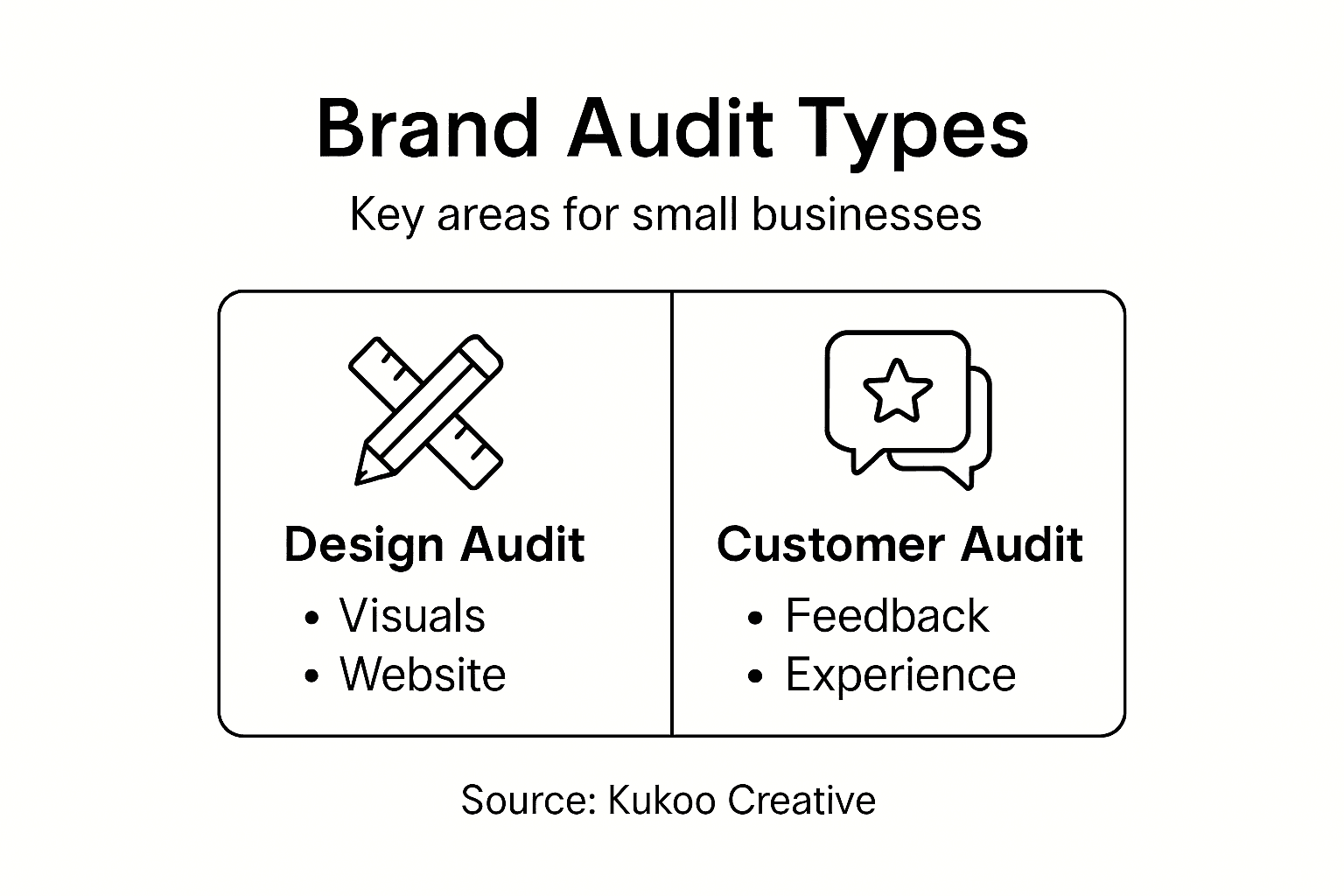
For small businesses, each audit type addresses unique branding challenges:
| Audit Type | Primary Purpose | Typical Outcome | Suitable for Businesses With |
|---|---|---|---|
| Internal Branding Audit | Strengthen company values and culture | Improved team alignment | Team morale issues |
| External Branding Audit | Refine visuals and customer messaging | Cohesive brand presentation | Confusing marketing assets |
| Customer Experience Audit | Enhance brand interactions and service | Increased customer loyalty | Poor feedback or declining sales |
| Design Audit | Improve design and usability | Professional online presence | Outdated website & materials |
Design and Visual Identity Audits
Design audits deserve special mention because they’re increasingly important for Leeds small businesses competing online. Evaluating visual identity and design consistency across touchpoints ensures your brand looks professional everywhere customers encounter it.
These audits examine usability, accessibility, and how well your design supports your brand objectives. A poor website design can undermine excellent products. Inconsistent logos across platforms confuse customers.
A single design audit can reveal why customers trust your competitor instead of you.
Design audits also assess information architecture—whether customers can actually find what they need on your website or social media.
Which Audit Should You Start With?
Small business owners often wonder where to focus first. The answer depends on your biggest concern:
- Start with external audits if customers seem confused about what you offer
- Start with internal audits if your team seems disengaged or inconsistent
- Start with design audits if you suspect your visual presence is holding you back
- Start with customer experience audits if you’re losing sales despite good marketing
Many small businesses actually benefit from understanding how strong branding drives customer loyalty and sales growth. This perspective helps you prioritise which audit type matters most for your bottom line.
Pro tip: Pick one audit type and go deep rather than skimming all three. Fifteen days of focused review beats three weeks of scattered effort.
The Step-by-Step Brand Audit Process
A brand audit doesn’t need to be complicated. You can walk through it systematically, gathering real data about how your brand performs. The process takes time but reveals exactly what matters.
You’re essentially asking: What promises are we making? Who are we making them to? And are we actually keeping those promises?
Step 1: Define Your Brand Promise and Target Audience
Start by clarifying what your brand actually promises customers. Not what you wish it promised—what it genuinely does.
Write down:
- Your core value proposition (what makes you different)
- Who your target customer actually is (not who you hope to reach)
- What problem you solve for them
- Why they should choose you over competitors
This clarity becomes your measurement stick. Everything else you audit gets compared against this promise.
Step 2: Audit Your External Materials
Gather every piece of external branding: logos, business cards, website, social media profiles, packaging, shop signage, email templates. Print or screenshot everything.
Now review for consistency:
- Do colours match across materials?
- Is your tone of voice consistent (formal vs. friendly)?
- Do all materials clearly communicate your value proposition?
- Do they look professionally designed?
Inconsistent branding makes customers question your professionalism.
Step 3: Analyse Your Digital Metrics
Website analytics and social engagement tell you how customers actually interact with your brand online. Log into Google Analytics and your social media platforms.
Check:
- Website traffic sources and bounce rates
- Which pages hold attention longest
- Social media engagement rates
- Click-through rates on key calls to action
- Time spent on different sections
High bounce rates suggest your messaging isn’t matching customer expectations. Low engagement means your content isn’t resonating.
Step 4: Gather Customer Feedback Directly
You need to understand how customers actually perceive your brand. Designing quantitative research helps measure customer opinions systematically.
Use multiple channels:
- Email surveys (ask 5–7 specific questions)
- Social media polls or comments
- Direct conversations with recent customers
- Phone calls asking what drew them to you
Ask open questions: “What do you think we stand for?” or “Why did you choose us over competitors?” Their answers reveal gaps between your perception and reality.
Step 5: Synthesise Your Findings
Compile everything—analytics, customer feedback, visual audit results, internal consistency checks. Look for patterns.
Identify:
- Strengths: What’s working brilliantly?
- Gaps: Where are promises not being kept?
- Opportunities: What could be improved quickly?
- Threats: What’s damaging perception?
A thorough step-by-step branding process helps turn these insights into concrete improvements your team can execute.
Step 6: Create an Action Plan
Prioritise three to five changes based on impact and effort. Quick wins build momentum. Don’t try to fix everything simultaneously.
Pro tip: Document your current state before making changes. Take screenshots, save analytics reports, and note customer feedback. Six months later, you’ll have clear evidence of improvement.
Brand Alignment and Measuring Effectiveness
A brand audit only matters if it leads to real improvements. That means understanding what alignment looks like and knowing how to measure whether your changes actually work.
Alignment means your business strategy, brand messaging, and team behaviour all pull in the same direction. Measuring effectiveness means proving you’ve actually moved the needle.
What Brand Alignment Really Means
Brand alignment happens when three things work together seamlessly:
- Your business strategy matches what you tell customers
- Your employees believe in and live your brand values
- Your marketing delivers on what customers actually experience
When these align, customers trust you. When they don’t, you waste marketing budget trying to overcome your own contradictions.
A Leeds café might claim to be “eco-conscious” but use single-use plastics everywhere. That misalignment damages credibility faster than silence would.
Internal vs. External Brand Health
Internal brand health measures whether your team actually embodies your values. Are staff trained on brand standards? Do they understand why the brand exists?
External brand health measures customer perception. Do they see you as you want to be seen? Do they trust you?
Both matter equally. Brilliant external messaging falls apart if employees don’t deliver it consistently.
Brand alignment isn’t about perfection—it’s about consistency between what you promise and what you deliver.
Key Metrics to Track
You need to measure actual results, not just activity. Focus on metrics that connect to business outcomes:
- Brand awareness: What percentage of your target market knows you exist?
- Brand perception: How do customers describe you compared to competitors?
- Customer loyalty: Do repeat customers return? What’s your retention rate?
- Net Promoter Score (NPS): Would customers recommend you? Track this quarterly.
- Conversion rates: Are brand improvements translating to more sales?
- Customer satisfaction: Track feedback scores over time.
Many small business owners focus on vanity metrics like social media followers. Real metrics connect to revenue.
To measure ongoing brand health, focus on these core business metrics:
| Metric | What It Measures | Business Value | Frequency of Tracking |
|---|---|---|---|
| Brand Awareness | Market recognition | Attracts new customers | Quarterly |
| Net Promoter Score | Willingness to recommend | Predicts loyalty & referrals | Monthly |
| Repeat Customer Rate | Customer retention | Indicates satisfaction & trust | Monthly |
| Conversion Rate | From interest to purchase | Tracks sales effectiveness | Weekly |
| Customer Satisfaction | Service and product quality | Reveals improvement areas | Monthly |
Assessing Brand Credibility
Brand credibility comprises trustworthiness and expertise, influencing whether customers actually choose you. You can’t fake credibility, but you can measure it.
Ask customers:
- Do you trust this brand?
- Does it deliver on its promises?
- Would you recommend it to friends?
- Why did you choose this brand over alternatives?
Their answers reveal credibility gaps. If customers say “trustworthy” but “confusing,” you’ve got clarity problems, not trust problems.
Creating Your Measurement Dashboard
Pick three to five key metrics and track them monthly. Create a simple spreadsheet documenting baseline numbers from your audit, then track progress.
Example tracking:
- Month 1 (baseline): NPS score 42, repeat customer rate 38 per cent
- Month 4: NPS score 51, repeat customer rate 44 per cent
Progress becomes visible. Your team sees effort paying off.
Pro tip: Track one metric obsessively for 90 days before adding more. Real improvement takes time; jumping between metrics creates false urgency and demoralises teams.
Common Brand Audit Mistakes to Avoid
Most brand audits fail not because the process is flawed, but because businesses skip crucial steps or misinterpret the data. Understanding these pitfalls saves time and prevents costly missteps.
The difference between a useful audit and a wasted effort often comes down to avoiding a few common traps.
Starting Without Clear Objectives
Unclear objectives sink audits before they begin. You can’t measure success if you don’t know what you’re trying to discover.
Many business owners start audits asking vague questions: “How’s our brand doing?” That’s too broad. You need specific ones:
- Why are we losing customers to competitors?
- Does our website reflect our values?
- Are employees representing our brand consistently?
- Are we reaching our target audience?
Clear objectives mean you know exactly what data to collect and how to interpret it. Vague audits produce vague insights.
Ignoring Your Team’s Perspective
Your employees live your brand daily. Yet many business owners conduct audits without asking them anything. That’s a critical mistake.
Internal brand culture directly affects external brand perception. If your team doesn’t understand your values, customers won’t either. Employees are your first brand ambassadors.
Include staff in your audit by asking:
- What do you think our brand stands for?
- Do we actually live these values daily?
- What frustrates you about how we’re perceived?
- What are we genuinely good at?
Their answers reveal gaps between intention and reality.
Relying Solely on Numbers
Balancing quantitative data with qualitative insights creates comprehensive understanding. Numbers tell you what happened; conversations explain why.
Google Analytics might show high bounce rates, but only customer interviews reveal the reason—confusing navigation, mismatched messaging, or poor mobile experience.
Use both:
- Quantitative: Website traffic, conversion rates, social media metrics
- Qualitative: Customer interviews, focus groups, employee feedback, open survey responses
Numbers show the problem; people explain the solution.
Overlooking Your Digital Presence
Small businesses often underestimate how much customers judge them online. Your website, social media, and Google Business Profile are audited constantly by potential customers.
Common oversights:
- Outdated website design or broken links
- Social media posts inconsistent with brand voice
- Conflicting information across platforms
- Slow loading times or poor mobile experience
- No clear calls to action
A Leeds plumber with a 2015 website loses customers to one with a modern site, regardless of service quality.
Not Acting on What You Find
The biggest mistake: Conducting an audit and then doing nothing. Data sitting in a spreadsheet changes nothing.
Strong brand guidelines protect and guide how you implement improvements consistently. After your audit, create a simple action plan with three priorities and assign responsibility.
Without action, audit insights evaporate into frustration.
Pro tip: Don’t wait for a “perfect” audit. A 70 per cent complete audit you act on beats a perfect audit gathering dust. Start with one insight and move forward.
Elevate Your Brand with a Precise Brand Audit and Expert Design
A successful brand audit uncovers crucial gaps between your brand promise and how your customers perceive you. If inconsistent messaging, outdated design, or unclear customer experience are holding your Leeds business back, it is time to act. Embrace the power of aligned branding to connect authentically and boost customer trust.
Discover how we at Kukoo Creative have partnered with small business owners for over a decade, delivering compelling logo and website designs that enhance brand recognition and meaningfully engage target audiences. Let us help you transform your external branding and improve your digital presence through a specialised design audit and tailored branding solutions. Start strengthening your brand today with our proven step-by-step branding process and stop guessing what works. Visit Kukoo Creative now to take your brand audit insights into action and secure your competitive edge.
Frequently Asked Questions
What is a brand audit?
A brand audit is a comprehensive review of how your brand is perceived by customers and how it operates internally. It examines brand consistency across internal culture, external visual elements, and customer experiences.
Why is a brand audit important for small businesses?
A brand audit is crucial for small businesses as it helps identify strengths and weaknesses, ensuring that marketing efforts align with authentic brand values. By recognising gaps, businesses can enhance customer trust and prevent costly mistakes.
How can small businesses conduct a brand audit?
Small businesses can start a brand audit by gathering all marketing materials, reviewing website analytics, analysing customer feedback, and assessing the consistency of internal communications with the brand’s values.
What are the key types of brand audits?
The key types of brand audits include internal branding audits, which focus on company culture and values; external branding audits, which review visual and messaging consistency; and customer experience audits, which evaluate interactions during sales and support.