
TL;DR:
- Color theory explains how colors interact and influence perception in visual communication. It provides designers with a structured framework, like the color wheel and the 60-30-10 rule, to create balanced and effective palettes. Using accessible contrast standards and color tokens ensures consistency, inclusivity, and strategic branding across all platforms.
Colour theory is defined as the scientific and artistic framework governing how colours interact, influence perception, and shape emotional responses in visual communication. Understanding the role of colour theory is non-negotiable for designers, marketers, and business owners who want their brand to land with confidence and credibility. Tools like Adobe Color and the traditional colour wheel give you a structured vocabulary for every visual decision you make. Colour drives up to 90% of a consumer’s first impression, formed within just 90 seconds of seeing a product. That single fact should change how seriously you treat every palette choice.
What are the fundamental principles of colour theory?
Colour theory in design begins with the colour wheel, first formalised by Sir Isaac Newton in 1666 and refined by artists and scientists ever since. The wheel organises colours into three groups:
- Primary colours: Red, yellow, and blue. These cannot be mixed from other colours.
- Secondary colours: Orange, green, and violet. Created by mixing two primaries.
- Tertiary colours: Produced by mixing a primary with an adjacent secondary, such as red-orange or blue-green.
Beyond the wheel, three properties define every colour you work with:
- Hue: The pure colour itself, such as red or teal.
- Saturation: The intensity or vividness of the colour.
- Value: The lightness or darkness of the colour.
Value contrast is processed first by human vision, before hue. This means a design can fail on hierarchy and readability even when the colours look beautiful in isolation.
Colour harmony refers to the pleasing arrangement of colours according to their relationships on the wheel. The most common schemes are analogous (colours sitting next to each other), complementary (colours directly opposite), and triadic (three colours equally spaced). Colour harmony separates polished designs from chaotic ones by guiding where the eye travels and what it prioritises.
Colour temperature adds another layer. Warm colours such as reds and yellows evoke energy, urgency, and warmth. Cool colours such as blues and greens communicate calm, trust, and professionalism. Choosing the wrong temperature for your brand message creates a disconnect that audiences feel even if they cannot name it.
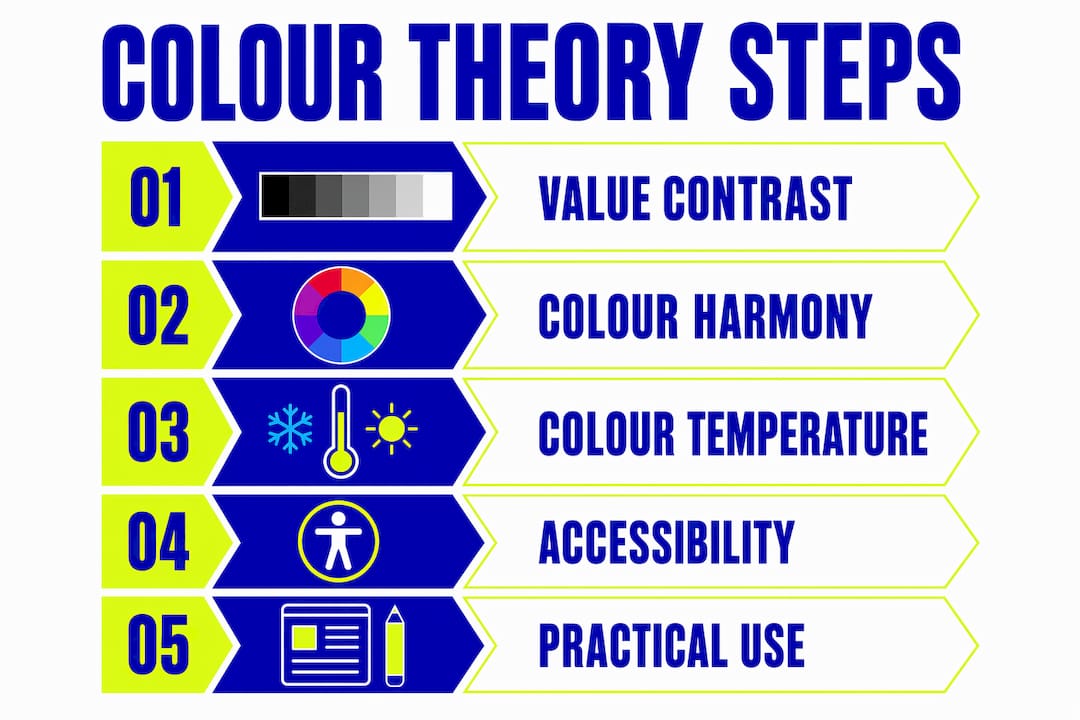
Pro Tip: When building a palette, test your chosen colours in greyscale first. If the hierarchy breaks down without colour, your value contrast needs work before you add hue.
How does colour influence consumer perception and brand behaviour?
Colour psychology significantly affects brand recognition and consumer loyalty through deliberate colour use. This is not abstract theory. It is the reason Barclays uses blue to signal trust, and why brands targeting impulse purchases lean on red and orange.
Different colours carry consistent emotional associations across Western markets:
- Red: Urgency, passion, appetite. Used by brands in food, retail, and entertainment.
- Blue: Trust, reliability, calm. Dominant in finance, healthcare, and technology.
- Yellow: Optimism, clarity, warmth. Effective for brands targeting families or creativity.
- Green: Nature, health, growth. Preferred by wellness, sustainability, and finance brands.
- Black: Luxury, authority, sophistication. A staple in premium and fashion branding.
“Colour is the first thing your audience sees and the last thing they consciously think about. Get it right and it works invisibly. Get it wrong and nothing else compensates.”
The impact of colour on mood extends beyond individual associations. Colour combinations create emotional contexts. A brand using navy blue with gold signals heritage and premium quality. The same navy paired with lime green reads as modern and disruptive. Neither is wrong. Both are deliberate.
For marketers, this means colour is not a finishing touch. It is a strategic decision that shapes how your audience feels before they read a single word of your copy. Understanding colour theory gives you the tools to make that decision with confidence rather than guesswork.

What accessibility standards should guide your colour choices?
Accessibility in colour use is governed by the Web Content Accessibility Guidelines, known as WCAG 2.1. These are not optional best practices. For many organisations in the UK, they carry legal weight under the Equality Act 2010.
| Text Type | Minimum Contrast Ratio | Recommended Ratio |
|---|---|---|
| Body text | 4.5:1 | 7:1 |
| Large text (18pt+) | 3:1 | 4.5:1 |
| UI components and icons | 3:1 | 4.5:1 |
WCAG 2.1 requires a minimum contrast ratio of 4.5:1 for body text and 3:1 for large text and interface components. Meeting these ratios means your design remains readable for users with low vision or colour blindness, which affects approximately 1 in 12 men in the UK.
Colour alone should never be the sole indicator of meaning. If you use red to signal an error, pair it with an icon or text label. Relying on colour alone excludes a significant portion of your audience.
Modern design systems address this at the foundation. Accessibility is now encoded at token level, meaning contrast thresholds are built into the colour system before any designer makes a choice. Tools like the Stark plugin for Figma and Adobe XD let you check contrast ratios in real time during the design process, removing the guesswork entirely.
Legacy colour models like HSL and RGB can be misleading because they do not reflect how human vision actually perceives brightness. Perceptually uniform colour spaces such as OKLCH and Lab offer more accurate contrast predictions, making them increasingly preferred in professional design systems.
Pro Tip: Run your final palette through the Stark plugin or the WebAIM Contrast Checker before sign-off. A colour combination that looks fine on your calibrated monitor may fail for a significant portion of your audience.
What practical frameworks make colour theory usable in real projects?
Knowing the theory is one thing. Applying it consistently across a logo, website, printed materials, and social media is another challenge entirely.
The 60-30-10 rule
The 60-30-10 rule provides a reliable heuristic for balanced colour composition. Sixty per cent of your design uses the dominant neutral or brand colour. Thirty per cent uses a secondary colour that supports and complements the dominant. Ten per cent is reserved for an accent colour that draws attention to calls to action and key details.
| Role | Proportion | Typical Use |
|---|---|---|
| Dominant colour | 60% | Backgrounds, large areas, primary brand colour |
| Secondary colour | 30% | Supporting elements, subheadings, secondary panels |
| Accent colour | 10% | Buttons, highlights, calls to action |
Deviating from this ratio, particularly by increasing the accent colour beyond 10%, creates visual noise. The accent loses its power to direct attention when it appears everywhere.
Colour tokens over raw hex codes
Design professionals build colour systems with tokens rather than raw hex codes to maintain consistency across platforms and contexts. A colour token is a named variable, such as “brand-primary” or “text-muted”, that maps to a specific hex value. When the brand colour changes, you update one token and the change propagates everywhere.
This approach supports scalable design systems and prevents the inconsistency that creeps in when different team members pull slightly different shades from memory or outdated files.
Pro Tip: If you are working with a developer or using a design system, ask for a colour token sheet rather than a flat hex list. It will save hours of corrections down the line.
How do you move from subjective colour preferences to objective decisions?
The most common frustration in design projects is the subjective feedback loop. A stakeholder says “I don’t like that blue” without being able to articulate why. Colour theory ends that conversation by giving you measurable parameters to work with.
Colour theory allows professionals to defend choices objectively against subjective opinions in stakeholder discussions. When you can point to contrast ratios, harmony relationships, and psychological associations, the conversation shifts from personal taste to strategic intent.
Here is how to apply this in practice:
- Hue: Is this colour consistent with the emotional territory the brand occupies? A wellness brand using aggressive red needs a clear rationale.
- Saturation: High saturation signals energy and urgency. Low saturation signals calm and sophistication. Does the level match the brand tone?
- Value: Does the lightness or darkness of the colour create the right hierarchy? Is the primary action the most visually prominent element?
- Contrast: Does every colour pairing meet WCAG 2.1 standards? Can you prove it with a tool like Adobe Color or Stark?
Colour is also relational. The same blue reads differently on a white background than on a dark navy. Ambient light, screen calibration, and print stock all shift how a colour is perceived. Understanding colour theory means accounting for these variables, not just picking a hex code and hoping for the best.
Choosing brand colours strategically requires this kind of systematic thinking. It is the difference between a brand that looks consistent everywhere and one that feels slightly off in ways your audience cannot name but absolutely feel.
Key takeaways
Colour theory is the most practical tool available for turning subjective design decisions into objective, defensible, and effective visual communication strategies.
| Point | Details |
|---|---|
| First impressions are colour-driven | Colour accounts for up to 90% of a consumer’s first impression, formed within 90 seconds. |
| Value contrast precedes hue | Human vision reads lightness before colour, making value the foundation of readable hierarchy. |
| Accessibility is non-negotiable | WCAG 2.1 requires 4.5:1 contrast for body text; use Stark or WebAIM to verify before launch. |
| The 60-30-10 rule prevents visual noise | Keeping accent colours at 10% preserves their power to direct attention to key actions. |
| Colour tokens beat raw hex codes | Token-based colour systems maintain brand consistency across every platform and team member. |
Why colour theory is the most underestimated tool in your brand arsenal
Most business owners I speak with treat colour as a finishing touch. They pick something they like, maybe match it to their logo, and move on. That approach costs them more than they realise.
Colour theory is a vocabulary of vision, perception, and systematic thinking. It is not a set of aesthetic rules. When you understand it properly, you stop asking “does this look nice?” and start asking “does this communicate the right thing to the right person at the right moment?” Those are completely different questions, and only the second one builds a brand.
The accessibility piece is where I see the most consistent blind spots. Designers will spend hours perfecting a palette and never once check a contrast ratio. Then the website launches and a significant portion of the audience struggles to read the navigation. WCAG 2.1 compliance is not just ethical. It protects your business and expands your reach.
The other mistake I see regularly is treating colour as a palette rather than a system. A palette is a collection of colours. A system is a set of rules for how those colours relate, when each one appears, and what role it plays. Palettes fall apart under pressure. Systems hold together across a rebrand, a new product line, or a new team member who has never met the original designer.
My honest advice: learn the 60-30-10 rule, build with tokens, and check your contrast before you call anything finished. Colour theory does not make design harder. It makes every decision faster and every conversation with a client or stakeholder cleaner.
— Kukoo
How Kukoocreative puts colour theory to work for your brand
At Kukoocreative, colour theory is not a background consideration. It is built into every project from the first brief to the final file. Over a decade of working with business owners across the UK has shown us that the brands which stand out are the ones where every colour choice has a reason behind it.

Whether you are starting from scratch or refreshing an existing identity, our approach to logo design and brand identity is grounded in the principles covered in this article. We apply colour harmony, accessibility standards, and the 60-30-10 framework to create designs that work beautifully and perform consistently. If you want to see how colour theory translates into real brand results, take a look at how logo design shapes your brand and discover what a systematic approach can do for your business.
FAQ
What is colour theory in simple terms?
Colour theory is the study of how colours interact, how they affect human perception, and how to combine them effectively. It gives designers and marketers a structured framework for making colour decisions that communicate the right message.
Why does colour matter so much in branding?
Colour drives up to 90% of a consumer’s first impression within 90 seconds. The colours you choose shape how your audience feels about your brand before they read a single word.
What is the 60-30-10 rule in colour design?
The 60-30-10 rule divides a colour palette into 60% dominant colour, 30% secondary colour, and 10% accent colour. This ratio creates visual balance and ensures accent colours retain their power to direct attention.
How do i check if my colours meet accessibility standards?
Use tools like the Stark plugin for Figma or the WebAIM Contrast Checker to verify your colour pairings. WCAG 2.1 requires a minimum contrast ratio of 4.5:1 for body text and 3:1 for large text and interface components.
What is a colour token and why should i use one?
A colour token is a named variable that maps to a specific colour value, such as “brand-primary” pointing to a hex code. Colour tokens ensure consistency across platforms and make brand updates far faster and more reliable than editing raw hex codes manually.