
Choosing how your business stands out on a busy Leeds high street is no small decision. For small business owners in retail and hospitality, the true power of brand positioning lies in creating a strong and lasting impression that speaks directly to local customers. By focusing on your own business’s strengths and communicating a clear and consistent identity, you can build real loyalty and set yourself apart from competitors. This guide unpacks the essentials of effective brand positioning, helping you shape a distinctive presence customers will remember.
Table of Contents
- What Brand Positioning Really Means
- Key Types and Real-World Examples
- Core Elements of Strong Brand Positioning
- The Brand Positioning Process Explained
- Common Pitfalls to Avoid in Positioning
Key Takeaways
| Point | Details |
|---|---|
| Strategic Brand Positioning | Brand positioning is a vital strategy that helps businesses articulate their unique value and build a strong identity in competitive markets. |
| Understanding Your Audience | Effective brand positioning hinges on deeply understanding customer needs, preferences, and what distinguishes your offering from others. |
| Consistency is Key | Success in brand positioning requires consistent messaging and alignment between brand promises and actual performance. |
| Continuous Refinement | Brand positioning should be regularly assessed and adapted based on market changes and customer feedback to maintain relevance. |
What Brand Positioning Really Means
Brand positioning represents far more than a simple marketing tactic – it’s a strategic approach that defines how your business communicates its unique value in a crowded marketplace. At its core, brand positioning helps small businesses in Leeds craft a distinctive identity that separates them from competitors and resonates deeply with their target customers.
For many small businesses, brand positioning is about understanding and articulating what makes your offering special. Strategic brand differentiation involves synthesising your visual identity, communication strategies, and core reputation to create an emotional connection with stakeholders. This means going beyond surface-level descriptions and uncovering the genuine essence of your business.
Key components of effective brand positioning include:
- Identifying your unique selling proposition
- Understanding your target audience’s specific needs
- Communicating your brand’s core values
- Developing a consistent visual and messaging framework
- Demonstrating how you solve customer problems differently from others
Successful brand positioning transforms your business from being just another option to becoming the preferred choice for your ideal customers. It’s about creating a memorable impression that lingers in people’s minds long after their initial interaction with your brand.
Pro tip: Spend time genuinely understanding what makes your business unique and craft a positioning statement that authentically reflects your strengths and values.
Key Types and Real-World Examples
Brand positioning strategies are not one-size-fits-all – they represent nuanced approaches tailored to different business contexts and market dynamics. Strategic positioning types offer small businesses powerful frameworks for distinguishing themselves in competitive environments.
Understanding these positioning strategies allows Leeds businesses to craft targeted approaches that resonate with their specific audience. The primary positioning types include:
- Cost-driven positioning: Emphasising affordability and price competitiveness
- Value-based positioning: Highlighting superior benefits relative to price
- Competitive positioning: Directly differentiating from market rivals
- Quality-driven positioning: Promoting premium standards and exceptional performance
- Purpose-driven positioning: Connecting through shared social or ethical values
Each positioning type requires a distinct strategic approach. A local Leeds café might use cost-driven positioning by offering competitive pricing, while a craft brewery could leverage quality-driven positioning by emphasising artisanal brewing techniques and premium ingredients.

Here is a quick comparison of common brand positioning strategies and when each is most effective:
| Positioning Type | Distinguishing Aspect | Ideal Use Case | Example Industry |
|---|---|---|---|
| Cost-driven | Focus on affordability | Highly price-sensitive markets | Fast food outlets |
| Value-based | Superior benefits for price | Value-conscious but quality-aware | Fitness clubs |
| Competitive | Direct differentiation | Saturated competitive environments | Tech consultancies |
| Quality-driven | Premium standards and excellence | Niche or luxury product sectors | Artisanal bakeries |
| Purpose-driven | Social or ethical values | Values-driven customer segments | Sustainable fashion |
The most effective brand positioning goes beyond simple categorisation. It’s about deeply understanding your target market’s specific needs and crafting a narrative that speaks directly to their desires, challenges, and aspirations.
Pro tip: Conduct thorough market research to identify which positioning strategy most authentically represents your brand’s unique strengths and customer expectations.
Core Elements of Strong Brand Positioning
Building a robust brand positioning strategy requires more than superficial marketing tricks. Strategic brand communication demands a comprehensive approach that connects authentically with your target audience and differentiates your business in the competitive Leeds marketplace.
The core elements of effective brand positioning encompass several critical dimensions that small businesses must carefully cultivate:
- Clarity of unique strengths: Precisely articulating what sets your business apart
- Consistent messaging: Ensuring your brand narrative remains uniform across all platforms
- Emotional resonance: Creating connections that go beyond transactional relationships
- Audience relevance: Tailoring your positioning to specific customer needs
- Authenticity: Aligning brand promises with actual business performance
Small businesses in Leeds can transform their brand positioning by understanding that it’s not just about what you say, but how consistently and genuinely you communicate your value. A local bakery might emphasise artisan techniques, while a digital marketing agency could highlight its data-driven approach and local expertise.
The following table outlines how brand positioning impacts different areas of a small business:
| Business Area | Positive Positioning Impact | Long-Term Benefit |
|---|---|---|
| Customer Loyalty | Builds trust and emotional connection | Repeat business, referrals |
| Marketing ROI | Improves message relevance | More effective campaigns |
| Competitive Edge | Highlights unique strengths | Increased market share |
| Staff Engagement | Aligns employees with brand values | Higher job satisfaction |
Brand positioning is less about being the best, and more about being the most relevant to your specific audience.
The most successful brand positioning strategies are dynamic, allowing businesses to adapt while maintaining a consistent core identity. This means regularly reassessing your market position, understanding evolving customer expectations, and refining your approach accordingly.
Pro tip: Invest time in deep customer research to uncover the nuanced insights that will make your brand positioning truly compelling and distinctive.
The Brand Positioning Process Explained
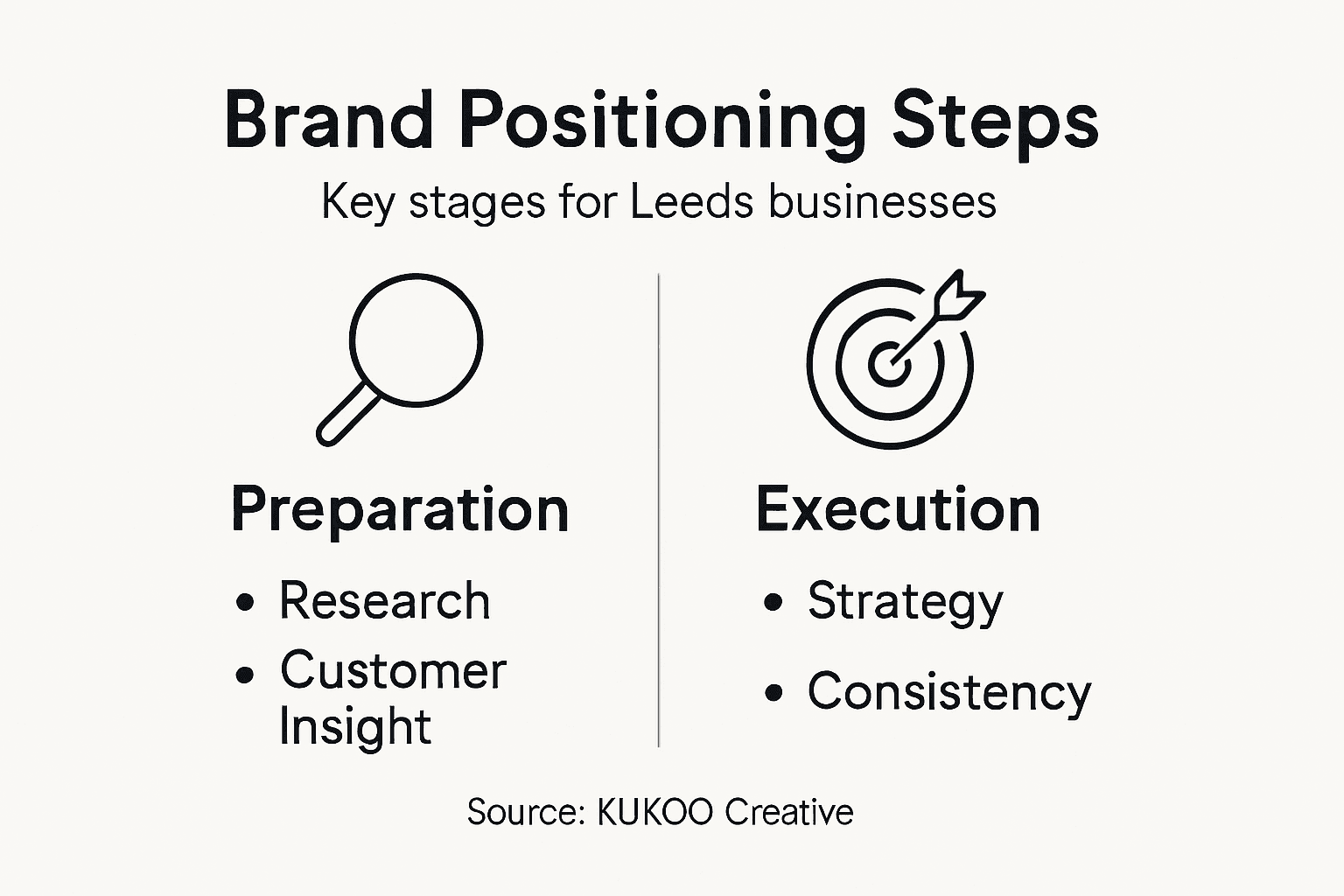
Developing an effective brand positioning strategy requires a systematic and introspective approach. Strategic brand analysis involves carefully examining your business’s unique strengths, understanding your target market, and crafting a narrative that resonates authentically with potential customers.
The brand positioning process typically unfolds through several critical stages:
- Internal assessment: Identifying your business’s core strengths and distinctive capabilities
- Market research: Understanding customer needs, preferences, and competitive landscape
- Value proposition development: Articulating what makes your offering unique
- Messaging framework creation: Designing consistent communication strategies
- Validation and refinement: Continuously testing and adapting your positioning
Small businesses in Leeds must recognise that brand positioning is not a one-time exercise, but an ongoing strategic dialogue with your market. A local graphic design studio might highlight its hyper-local understanding of Leeds’ creative ecosystem, while a neighbourhood café could emphasise its commitment to community and artisan ingredients.
Effective brand positioning transforms your business from being a commodity to becoming a distinctive, memorable choice for your ideal customers.
Successful brand positioning requires businesses to look beyond surface-level marketing tactics and develop a deep, genuine understanding of their unique value. This means moving past generic statements and creating a positioning strategy that truly reflects your business’s authentic strengths and customer promises.
Pro tip: Conduct regular customer interviews and market analysis to ensure your brand positioning remains relevant and compelling in an ever-changing business landscape.
Common Pitfalls to Avoid in Positioning
Navigating brand positioning requires strategic awareness and careful execution. Brand positioning mistakes can significantly undermine a business’s ability to connect authentically with its target audience, potentially derailing growth and market perception.
Small businesses in Leeds must be particularly vigilant about these common positioning errors:
- Overly generic messaging: Blending in instead of standing out
- Attempting to appeal to everyone: Diluting your brand’s unique identity
- Making unsustainable promises: Creating expectations you cannot meet
- Inconsistent brand communication: Sending mixed signals across platforms
- Neglecting market evolution: Failing to adapt to changing consumer preferences
A local bakery claiming to have the ‘best bread in Leeds’ without substantive proof exemplifies how vague positioning can backfire. Conversely, a bakery highlighting its use of locally sourced, organic ingredients from Yorkshire farmers creates a more compelling and authentic narrative.
Brand positioning is not about being everything to everyone, but being something significant to someone.
Effective positioning demands continuous refinement and honest self-assessment. Small businesses must regularly audit their brand messaging, ensuring it remains true to their core values while remaining responsive to market dynamics.
Pro tip: Conduct quarterly brand positioning reviews, gathering feedback from customers and team members to maintain strategic relevance and authenticity.
Elevate Your Leeds Small Business with Strategic Brand Positioning
Successful brand positioning hinges on clearly articulating your unique strengths and connecting emotionally with your ideal customers. As the article highlights, small businesses in Leeds face challenges like standing out in a crowded market and maintaining consistent, authentic messaging that resonates deeply. If you struggle with defining your unique value proposition or delivering consistent brand communication that truly reflects your business identity you are not alone.
At KUKOO Creative we specialise in partnering with business owners just like you to transform these brand positioning challenges into powerful growth opportunities. Our expert design solutions from impactful logos to tailored websites help you build a memorable brand that captures your core values and appeals directly to your target audience. Visit us at KUKOO Creative to discover how we can help you communicate your uniqueness effectively and boost your small business success.
Looking to create a strong visual identity that reflects your distinct positioning explore our design services. Ready to forge emotional connections through consistent brand messaging start your brand journey here today.
Act now and turn your brand positioning insights into tangible results by partnering with professionals who understand Leeds markets and your business ambitions.
Build your brand the right way and secure your place in your customer’s mind with KUKOO Creative. Visit https://kukoocreative.com/ to get started.
Frequently Asked Questions
What is brand positioning?
Brand positioning is a strategic approach that defines how a business communicates its unique value in a crowded marketplace, helping to create a distinctive identity that resonates with target customers.
Why is brand positioning important for small businesses?
Effective brand positioning helps small businesses stand out from competitors, foster emotional connections with customers, and ultimately become the preferred choice in their market.
What are common types of brand positioning strategies?
Common types of brand positioning strategies include cost-driven positioning, value-based positioning, competitive positioning, quality-driven positioning, and purpose-driven positioning, each tailored to different market dynamics and customer needs.
How can small businesses ensure their brand positioning is effective?
To ensure effective brand positioning, small businesses should conduct thorough market research, clearly articulate their unique strengths, maintain consistent messaging, and regularly reassess their positioning in response to changing consumer preferences.