
TL;DR:
- Choosing the right website hosting significantly impacts your business’s site speed, security, and availability. Small UK businesses should prioritize reliable hosts with strong support, security features, and scalability options to ensure trust and growth. Making an informed hosting choice depends on assessing needs, budget, and provider reputation, as poor hosting can lead to costly downtime and lost customer confidence.
Think website hosting is just about buying a bit of space online? It’s actually one of the most important decisions you’ll make for your business. Your hosting choice directly shapes how fast your site loads, how secure your customers’ data is, and whether your website is even available when someone tries to find you. Get it right and your site builds confidence from the first click. Get it wrong and you risk losing customers before they’ve read a single word about what you do.
Table of Contents
- What website hosting means for your business
- Types of website hosting: Which fits your needs?
- Key hosting features to boost business trust
- How to choose the right hosting for your UK business
- Why website hosting choices can make or break small businesses
- Launch your website with expert support
- Frequently asked questions
Key Takeaways
| Point | Details |
|---|---|
| Website hosting defined | Hosting is the service that makes your site accessible and reliable for your customers. |
| Choosing the right type | Different hosting options balance cost, performance, and growth potential. |
| Features build trust | Core hosting features—security, backups, support—directly affect customer confidence and site uptime. |
| Business-driven decisions | The best hosting depends on your business’s risk tolerance and future growth plans. |
| Expert support helps | Professional guidance ensures your site launches smoothly and stays online reliably. |
What website hosting means for your business
At its simplest, website hosting is the service that stores your website’s files and makes them available to anyone who visits your web address. Think of it like renting space in a building. The building is always open, and anyone can walk in and look around. Without that building, there’s nowhere for your business to exist online.
But hosting is far more than data storage. It’s about accessibility, reliability, and operational safety. Your hosting provider determines how quickly your pages load, how often your site is available, and how well it’s protected against threats like hackers and malware.
For a small business, this matters enormously. If a potential customer tries to visit your website and it’s slow or unavailable, they won’t wait around. They’ll go straight to a competitor. That’s why building trust online starts long before someone reads your content. It starts the moment your site loads, or fails to.
Here’s what good hosting provides for your business:
- Speed: Faster loading times keep visitors engaged and improve your Google ranking
- Uptime: A reliable host keeps your site online around the clock, not just during business hours
- Security: Protection against data breaches, malware, and unauthorised access
- Scalability: The ability to handle more visitors as your business grows
- Support: Access to help when something goes wrong
Pro Tip: Always check a hosting provider’s uptime guarantee before signing up. Look for 99.9% or above. Even a 99% guarantee means your site could be down for over seven hours per month.
Hosting is the foundation of your entire digital presence. Every other investment you make in your website, from design to content, depends on this foundation being solid.
Types of website hosting: Which fits your needs?
Now that you understand the core concept, let’s explore which hosting types suit various business scenarios. There are four main types of hosting that UK small businesses typically consider, and each has its own strengths.
Shared hosting is the most affordable option. Your website shares a server with many other websites. It’s like renting a desk in a co-working space. Costs are low, often between £3 and £10 per month, but performance can dip when other sites on the same server get busy. It’s a reasonable starting point for new or low-traffic websites.
VPS (Virtual Private Server) hosting gives you a dedicated portion of a server’s resources, even though the physical server is still shared. Think of it as having your own office within a larger building. You get better performance and more control than shared hosting, typically at £15 to £60 per month. It suits growing businesses that need reliability but aren’t ready for the top tier.
Dedicated hosting means you have an entire physical server to yourself. It’s the most powerful and most expensive option, often starting at £80 to £200 per month. Most small businesses don’t need this, but it’s worth knowing about if you run an e-commerce site with thousands of daily transactions.
Cloud hosting distributes your website across multiple servers. If one server has a problem, another picks up the slack. It scales flexibly with traffic spikes and is often billed on usage, which suits businesses with seasonal peaks or rapid growth. For website scalability advice tailored to UK businesses, this type of hosting is increasingly popular.
| Hosting type | Approximate monthly cost | Best suited for | Key limitation |
|---|---|---|---|
| Shared | £3 to £10 | New or small sites | Performance affected by neighbours |
| VPS | £15 to £60 | Growing businesses | Requires some technical know-how |
| Dedicated | £80 to £200+ | High-traffic sites | Expensive for small budgets |
| Cloud | £5 to £50+ | Scaling businesses | Costs can be unpredictable |
As PCMag highlights, the best hosting choice depends on your risk tolerance and how critical downtime is to your revenue. A local florist might survive a few hours of downtime. An online retailer running promotions simply cannot.
Here are four questions to ask before selecting a hosting type:
- How much traffic do you currently receive, and how much do you expect in the next 12 months?
- Does your income depend directly on your website being available at all times?
- How comfortable are you with managing technical settings, or do you need a fully managed service?
- Are you working with a web designer who can advise on the technical setup?
Answering these honestly will point you towards the right tier. Most small businesses in the UK start with shared or cloud hosting and upgrade as their needs grow.
Key hosting features to boost business trust
With hosting categories covered, it’s crucial to examine which features matter most for your brand’s reputation and customer trust. Performance specs alone won’t protect your business. You need to look deeper.
“Hosting providers frame their offerings around raw performance versus operational safety. Small businesses must weigh both carefully to find the right balance.”
Security is non-negotiable. Every credible hosting package should include an SSL certificate (this creates the padlock symbol in your browser address bar, telling visitors your site is secure), a firewall to block suspicious traffic, and malware scanning to catch threats early. These aren’t optional extras. They’re table stakes for any business that collects customer information or takes payments. The trust-building essentials for small businesses online all point back to security as a fundamental layer.
Automatic backups are something many small business owners overlook until it’s too late. If your website is hacked, crashes, or gets corrupted, a recent backup means you can restore everything quickly. Without one, you could lose weeks of updates, blog posts, product listings, and customer data. Look for daily automated backups as a minimum.
Customer support is more valuable than many business owners realise. When your site goes down at 10pm on a Sunday before a big promotion, you need someone to answer the phone or live chat immediately. Prioritise providers that offer 24/7 support, and test them before you commit.
| Feature | Why it matters | What to look for |
|---|---|---|
| SSL certificate | Encrypts data and builds visitor trust | Free SSL included with plan |
| Automated backups | Restores site after failure or attack | Daily backups, 30-day retention |
| Uptime guarantee | Keeps site accessible to customers | 99.9% or above |
| Malware scanning | Prevents and detects security threats | Regular automated scans |
| 24/7 support | Fast response during critical issues | Phone, chat, and ticket options |
Good UI security features built into your website design also reinforce trust visually, but hosting provides the technical infrastructure underneath all of it.
Here’s what to check in any hosting plan before you buy:
- Is SSL included free or charged as an add-on?
- How often are backups taken, and can you restore them yourself?
- What is the guaranteed uptime, and is there compensation if they miss it?
- Are security scans automated or manual?
- Is support available 24/7, and through which channels?
Speed matters enormously too. A one-second delay in page load time can reduce conversions significantly. Look for hosts with content delivery networks (CDNs) and solid-state drives (SSDs), both of which improve how quickly your pages load for visitors across the UK and beyond.
How to choose the right hosting for your UK business
To bring all the factors together, this section shows step-by-step how to make a hosting decision that suits your unique business context. The right choice isn’t always the cheapest or the most powerful. It’s the one that fits your actual risk profile and growth ambitions.
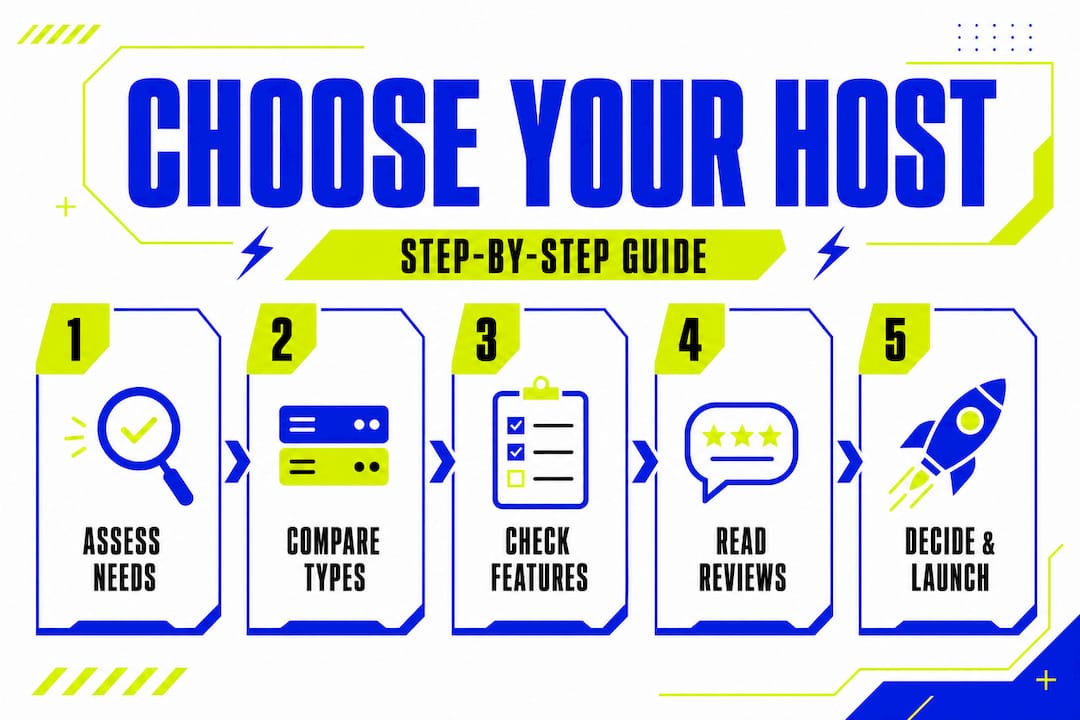
As PCMag explains, the right hosting hinges on your tolerance for risk and how critical your website is to sales. That’s the real starting point.
Follow these steps:
-
Assess your business needs. Is your website primarily informational, or does it generate direct revenue? An online shop needs higher reliability and security than a simple portfolio page. Write down what your website must do and how often customers rely on it.
-
Set a realistic hosting budget. Don’t just look at the introductory price. Many hosts offer low first-year rates and then increase costs significantly on renewal. Check the renewal price before signing up, and factor in any extras like SSL certificates, backups, or premium support.
-
Research provider reputation. Read independent reviews on platforms like Trustpilot. Look specifically at comments about support response times and how providers handle downtime. A flashy website doesn’t mean reliable service.
-
Confirm scalability options. Can you upgrade your plan quickly if your traffic doubles? Knowing you can scale without migrating your whole site saves significant hassle later. This is especially important if you plan to run seasonal promotions or launch new products.
-
Check for compatibility with your platform. Whether you’re building with WordPress, Shopify, Wix, or a custom site, your host should support your chosen platform fully. Talk to professional website designers about which hosts they recommend for the platform you’re using.
-
Trial the support. Before committing, send a pre-sales question via their live chat or support ticket system. How quickly they respond and how helpfully they answer tells you a great deal about the experience you’ll have as a customer.
Pro Tip: Avoid signing long contracts (two or three years) with a new provider until you’ve tested them for at least six months on a short-term plan. Good hosts are confident enough to earn your loyalty rather than lock you in.
When choosing a website designer, ask them which hosting providers they have experience with. Many designers have strong opinions based on real-world project experience, and that insight is genuinely valuable.
Why website hosting choices can make or break small businesses
Most hosting advice focuses on speed benchmarks and storage limits. Those things matter, but they’re not what keeps small businesses awake at night. What actually costs business owners money is downtime, lost data, and slow support responses at critical moments.
We’ve seen it time and again. A business invests in a beautiful website, runs a successful ad campaign, and then the hosting buckles under the traffic spike. Or worse, the site gets hacked and there’s no recent backup to restore from. The website is offline for two days, customers see a broken page, and trust evaporates almost instantly.
Conventional wisdom often over-emphasises speed. But in reality, stability and support may matter more for revenue continuity, particularly for small businesses where every customer interaction counts.
Here’s our genuine take: for most small UK businesses, a mid-tier cloud or VPS host with excellent support and reliable backups will outperform a technically superior but poorly supported provider every single time. Speed improvements of a few hundred milliseconds rarely change business outcomes. But recovering from a site outage in twenty minutes rather than twenty hours? That changes everything.
The hidden cost of downtime isn’t just the lost sales during the outage. It’s the Google ranking impact, the customer who couldn’t access your booking form and went elsewhere, and the social media mention from someone who tried to visit your site and found it broken.
Think of your hosting as the silent engine of your business website. Nobody notices it when it works well. Everyone notices it when it fails. Invest in quality, prioritise support and backups over raw speed, and review your hosting annually as your business grows.
Launch your website with expert support
Choosing the right hosting is a brilliant first step, but building a website that truly represents your business takes more than good infrastructure.
At Kukoo Creative, we’ve spent over a decade helping UK business owners launch and grow their online presence with confidence. From our portfolio of diverse client results, you’ll see what a professionally designed website looks and feels like in practice. We guide you through the entire journey, from understanding your web design process to getting your branding right from the start. We’ll help you pair the right hosting with the right design, so your website works hard for your business from day one. Get in touch today and let’s build something fantastic together.
Frequently asked questions
Is website hosting necessary for every business site?
Yes, hosting is essential for any website to be publicly accessible online. Without it, your site simply cannot be viewed by customers.
How much should a small UK business budget for website hosting?
Most small businesses pay between £5 and £25 per month for reliable hosting, though costs vary widely depending on features, provider, and plan tier. Always check renewal prices, not just introductory offers.
What are the main risks of poor hosting?
The primary risks include website downtime, slow loading speeds, and security breaches, all of which erode customer trust. As PCMag notes, your risk tolerance should match the business impact a potential outage would cause.
Can I change hosting providers without rebuilding my site?
Yes, in most cases you can migrate your website to a new provider without rebuilding, provided the new host supports your existing platform. Always take a full backup before starting any migration.