
TL;DR:
- Social proof reassures visitors by showing others have trusted the brand, boosting conversions.
- Effective placement near calls-to-action and use of authentic, specific proof increase trust.
- Avoid fake or irrelevant proof, as it damages credibility and trust with UK consumers.
Most business owners assume that a polished logo and clean layout are enough to win customer trust. They’re not. What genuinely moves people from browsing to buying is seeing that others have already made that leap. Social proof in design is one of the most powerful yet underused tools in your branding arsenal. It draws on deep-rooted psychological behaviour to reassure visitors, reduce hesitation, and drive action. This guide covers what social proof actually is, which types work best for UK brands, how to place it strategically, and the costly mistakes to avoid along the way.
Table of Contents
- What is social proof and why does it matter in design?
- Types of social proof and real examples for UK brands
- Best practices: Placing and optimising social proof in your design
- What to avoid: Pitfalls and credibility risks with social proof
- Why most businesses still miss the mark with social proof in design
- Supercharge your brand credibility with expert design support
- Frequently asked questions
Key Takeaways
| Point | Details |
|---|---|
| Trust boosts conversions | Authentic social proof in design increases trust and drives more customer actions. |
| Placement is critical | Putting social proof near CTAs and hesitation points maximises its effectiveness. |
| Avoid fake signals | Fake reviews or irrelevant proof can ruin brand credibility and trust. |
| Always test and validate | Continuous A/B testing helps ensure the mix and location of social proof works for your audience. |
What is social proof and why does it matter in design?
Social proof is the idea that people look to others when they’re unsure what to do. It’s a well-documented psychological principle, rooted in Robert Cialdini’s research on influence and Solomon Asch’s conformity experiments. When a potential customer lands on your website and feels uncertain, they instinctively scan for signals that others have been here before and found it worthwhile.
In design terms, social proof leverages psychological principles where users follow others’ actions in uncertain situations to build trust and drive conversions. That uncertainty is the key word. The higher the stakes or the less familiar the brand, the more powerful social proof becomes. A new visitor to your site is essentially asking: “Can I trust these people?” Your design needs to answer that question before they even realise they’re asking it.
“People don’t just buy products or services. They buy confidence. Social proof is the design element that delivers that confidence at the exact moment it’s needed.”
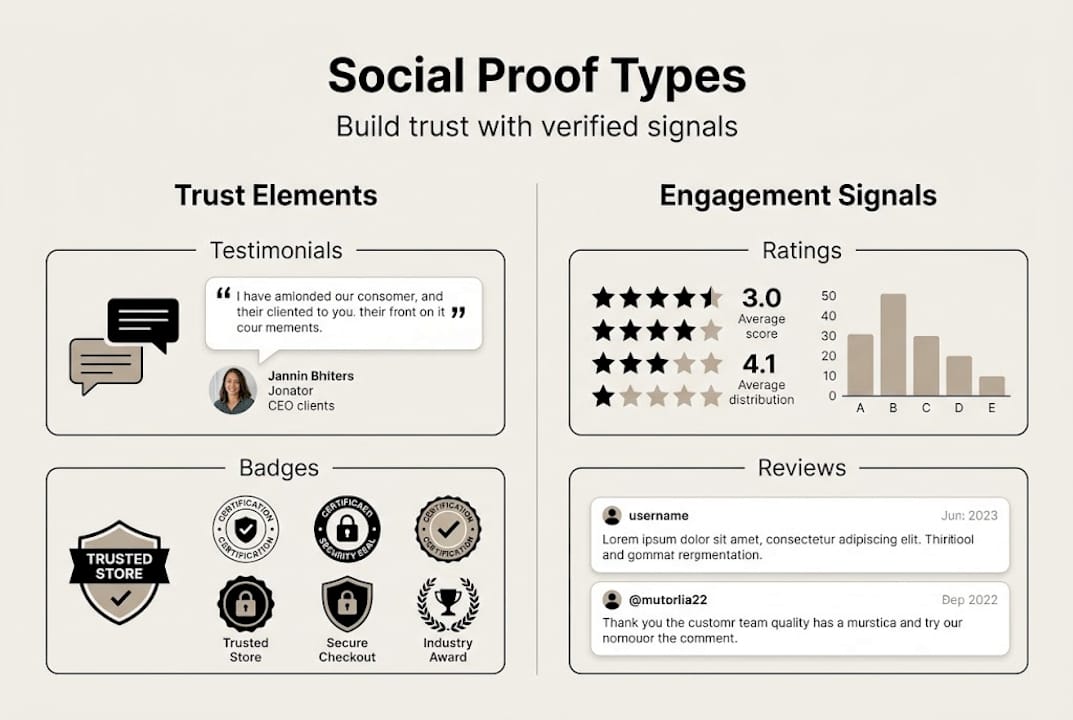
Social proof appears in design in several forms. Understanding the role of feedback in design helps you see how each signal contributes to a broader sense of credibility. Here are the most common formats you’ll encounter:
- Customer testimonials and reviews placed near calls-to-action or on landing pages
- Star ratings and review widgets from platforms like Trustpilot or Feefo
- Trust badges such as industry accreditations, security seals, or award logos
- Real-time activity signals like “12 people viewing this right now”
- Case studies and client logos that demonstrate experience and scale
- Social media follower counts or embedded posts showing engagement
For UK businesses specifically, local and verified signals carry more weight than generic ones. A five-star rating from a recognisable UK review platform resonates more than an anonymous quote. Authenticity matters enormously to British consumers, who tend to be sceptical of anything that feels manufactured or overly salesy.
When social proof is integrated thoughtfully into your design, the outcomes are tangible. You’ll see stronger credibility, higher engagement, and improved conversion rates. It’s not a gimmick. It’s a fundamental part of how trust is built visually.
Types of social proof and real examples for UK brands
Now that you know what social proof is, let’s look at the most effective types for modern UK brands.
Each type of social proof serves a slightly different purpose and works best in specific contexts. Here’s a comparison to help you decide where to start:
| Type | Example | Where it works best |
|---|---|---|
| Customer testimonials | Written quotes with name and photo | Landing pages, service pages |
| Review widgets | Trustpilot or Feefo star ratings | Homepage, checkout, pricing pages |
| Trust badges | Award logos, security seals | Header, footer, checkout |
| Real-time signals | “8 people bought this today” | Product pages, booking flows |
| Case studies | Before/after results with data | Portfolio or results pages |
| Social media proof | Embedded posts, follower counts | About pages, campaign landing pages |
A brilliant UK example is Lovat Parks, a holiday parks brand that used A/B testing to measure the impact of Feefo review widgets. Their results showed that trust signals convert significantly better when placed at key decision points. No heavy redesign required. Just smarter placement of authentic proof.
For design inspiration for UK businesses, looking at how established brands layer their social proof is genuinely instructive. Damart, the clothing brand, uses real-time popularity signals alongside verified reviews to create a sense of momentum and reassurance simultaneously.
Understanding social proof psychology helps explain why certain types outperform others in specific situations. Expert endorsements work well for professional services. Peer reviews work better for consumer products. Context shapes everything.

Pro Tip: Mix at least two types of social proof on any key page. A review widget paired with a trust badge creates layered credibility that’s far more persuasive than either element alone.
One important warning: avoid fake, generic, or irrelevant proof at all costs. Stock photo testimonials, invented statistics, or badges from unknown organisations do more harm than good. British consumers are quick to spot inauthenticity, and once trust is lost, it’s very difficult to recover.
Best practices: Placing and optimising social proof in your design
Understanding the types is important, but placement and execution can make or break results.
Strategic placement near CTAs and hesitation points, combined with specific quantifiable outcomes and A/B testing, consistently delivers the strongest results. Here’s a step-by-step approach to get it right:
- Map your hesitation points. Identify where visitors are most likely to pause or leave. Pricing pages, checkout flows, and contact forms are common spots.
- Match proof to the hesitation. A pricing page needs outcome-focused testimonials. A checkout page needs security badges and verified review scores.
- Position proof near your call-to-action. Don’t bury it at the bottom of the page. Place it directly above or beside the button you want visitors to click.
- Use specific, quantifiable language. “Saved us 40% on admin time” is far more convincing than “Great service.”
- Optimise for mobile. Most UK users browse on their phones. Ensure your responsive design for mobile keeps social proof visible and readable on smaller screens.
- Run A/B tests regularly. What works for one audience may not work for another. Test placement, format, and type.
Here’s a simple overview of what A/B testing typically reveals:
| Element tested | Common result |
|---|---|
| Testimonial near CTA vs. footer | Near CTA increases clicks by 15 to 30% |
| Star rating visible vs. hidden | Visible rating improves trust scores |
| Specific outcome vs. vague quote | Specific outcome lifts conversions |
| Mobile-optimised badge vs. desktop only | Mobile version reduces bounce rate |
Exploring branding automation tools can also help you manage and update social proof elements efficiently, particularly if you’re running multiple campaigns or updating review feeds regularly.
Pro Tip: Verified badges with quantifiable outcomes convert best. If a customer says you saved them time or money, ask for the specific figure. That number is worth more than a paragraph of praise.
Avoid overloading your pages with too many proof elements. When everything is highlighted, nothing stands out. Be selective, be strategic, and let quality lead over quantity.
What to avoid: Pitfalls and credibility risks with social proof
Even great execution can go wrong if the wrong types of proof are used or credibility is ignored.
The risks are real. Fake reviews, irrelevant trust signals, and low-quality badges can actively reduce trust rather than build it. Here’s what to watch out for:
- Fake or purchased reviews. These are increasingly easy to spot, and platforms like Google and Trustpilot actively remove them. Getting caught damages your reputation severely.
- Generic stock testimonials. A quote without a real name, photo, or verifiable source reads as fabricated. Visitors notice.
- Irrelevant badges. An award from an obscure organisation that your audience doesn’t recognise adds no value. It may even raise suspicion.
- Outdated proof. A testimonial from 2018 or a review score that hasn’t been updated signals stagnation, not success.
- Mismatched proof and audience. B2B buyers need case studies and client logos. Consumer shoppers want peer reviews. Using the wrong type for your audience reduces impact.
- Overloading the page. Too many proof elements compete for attention and create visual noise rather than reassurance.
The risks of weak design signals extend beyond aesthetics. Poor credibility signals can actively push potential customers towards your competitors.
“Prioritise specific, verified, quantifiable social proof near decision points. Avoid generic or fake elements that backfire. Layer types for comprehensive credibility.”
Credibility is harder to rebuild than it is to build in the first place. One well-placed, genuine testimonial from a real UK customer will outperform ten vague, unverifiable quotes every single time. Build your social proof strategy on authenticity, and it will compound in value over time.
Why most businesses still miss the mark with social proof in design
To sum up the best tactics, let’s confront a persistent misconception about social proof in the business world.
Most businesses either ignore social proof entirely or treat it as a box to tick. They add a Trustpilot widget to the homepage and consider the job done. That’s not a strategy. That’s decoration.
The businesses that genuinely benefit from social proof treat it as a living asset. They test it, update it, and tailor it to specific audiences and contexts. They understand that what convinces a first-time visitor is different from what reassures a returning customer weighing up a larger purchase.
Copying what your competitors do is tempting but rarely effective. Your audience, your brand voice, and your customer journey are unique. Custom branding advantages apply just as much to social proof as they do to logos or colour palettes. A proof strategy built around your specific customers will always outperform a borrowed one.
Social proof is not a one-off fix. It needs ongoing validation, fresh content, and deliberate placement decisions. Treat it that way, and it becomes one of your most valuable brand assets.
Supercharge your brand credibility with expert design support
For those wanting practical help beyond DIY, design experts can ensure social proof works seamlessly with your brand.
Knowing what to do and actually doing it well are two very different things. Integrating social proof into your design requires more than dropping in a widget. It means understanding your brand, your audience, and the precise moments where trust needs to be reinforced.
We’ve spent over a decade helping UK business owners build brands that genuinely connect with their customers. From structuring a branding workflow for UK businesses to building brand recognition for small businesses, we bring the expertise and creative thinking that turns good intentions into real results. If you’re ready to make social proof work harder for your brand, let’s talk.
Frequently asked questions
How do I measure the impact of social proof on my website conversions?
A/B testing different placements and types of social proof is the most reliable way to see direct impact on engagement and conversions. Track click-through rates and form completions before and after each change.
Is it better to use written testimonials or review widgets?
Both have value, but branded review widgets from platforms like Feefo or Trustpilot are generally more trusted by UK users because they’re independently verified and harder to fabricate.
Will using fake reviews help if my business is new?
No. Fake elements backfire and can reduce trust far more than having limited proof. Start with genuine testimonials from early customers and build from there.
How many types of social proof should I use on my site?
Layering at least two types, such as verified reviews and trust badges, gives the strongest credibility without overwhelming your visitors. Quality and relevance matter more than volume.