
TL;DR:
- Improving website SEO requires fixing technical issues first and establishing topical authority through structured content. High-quality on-page optimisation and ethical backlink building are essential for long-term ranking success. Focusing on technical health, authoritative content, and user experience creates a strong foundation for visibility.
Improving website SEO is the practice of optimising your site’s technical performance, content relevance, and authority to increase visibility in search engine results. Organic search drives approximately 63% of website traffic, making it the single most valuable channel for most businesses. Google’s E-E-A-T framework (Experience, Expertise, Authoritativeness, Trustworthiness) and Core Web Vitals benchmarks are the two standards shaping how rankings are earned in 2026. Get these right, and you give every other SEO effort a solid foundation to build on.
What are the essential technical SEO improvements to fix first?
Fixing technical SEO issues first ensures your content improvements will actually produce ranking gains. A site with crawl errors, broken redirects, or poor page speed will not rank well, regardless of how good the writing is. Think of technical SEO as clearing the road before you drive.
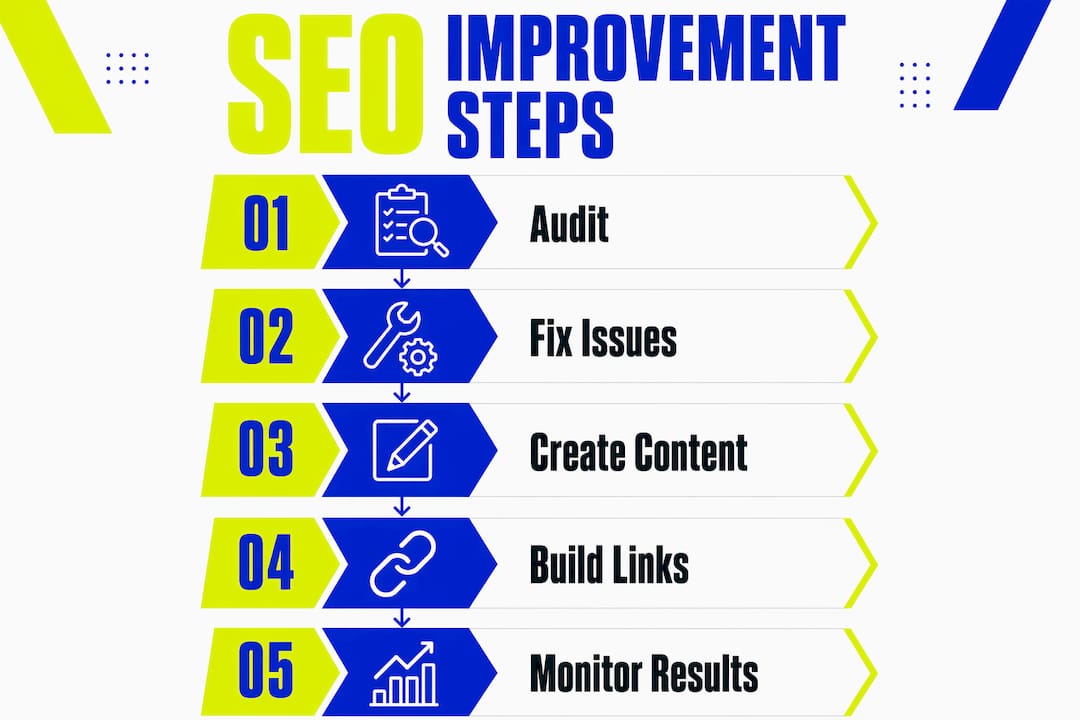
Start with a thorough site audit to surface the issues you cannot see from the front end. A structured audit uncovers indexing errors, crawlability problems, and page speed bottlenecks that silently block your ranking potential. Google Search Console is the right starting point. It shows which pages are indexed, which are excluded, and why.
Google’s Core Web Vitals set the performance bar for technical health:
- LCP (Largest Contentful Paint): must be under 2.5 seconds. This measures how quickly your main content loads.
- INP (Interaction to Next Paint): must be under 200 milliseconds. This measures how fast your page responds to user input.
- CLS (Cumulative Layout Shift): must be under 0.1. This measures visual stability, so elements do not jump around as the page loads.
Core Web Vitals benchmarks are Google’s recommended thresholds for strong technical SEO health. Failing any one of them signals a poor user experience, which directly affects your ranking.
Beyond speed, address these technical priorities:
- Fix broken internal and external links
- Resolve redirect chains (A redirects to B, which redirects to C)
- Confirm all key pages are mobile-friendly
- Implement structured data (schema markup) on product, article, and FAQ pages to earn rich results in search
Pro Tip: Run your audit before you produce a single new piece of content. Publishing great articles onto a technically broken site is like filling a leaking bucket.
| Technical issue | Impact on SEO | Priority |
|---|---|---|
| Crawl errors and blocked pages | Prevents indexing of key content | Critical |
| Slow LCP score | Reduces rankings and increases bounce rate | High |
| Broken redirects | Wastes crawl budget and loses link authority | High |
| Missing structured data | Misses rich result opportunities | Medium |
| Poor mobile usability | Harms rankings on mobile-first index | High |
How to create and organise content that drives SEO success
Topical authority is the most reliable way to build lasting rankings. Structured content clusters signal expertise to Google’s algorithms and improve ranking potential far more than isolated keyword pages. The pillar-satellite model works like this: one comprehensive pillar page covers a broad topic, and multiple satellite articles cover related subtopics in depth. Each satellite links back to the pillar, compounding authority across the cluster.

Google’s Helpful Content System rewards content that genuinely meets user needs. High-quality content must satisfy search intent, not simply rank by keyword presence. This means writing for the person searching, not for the algorithm. Ask yourself: does this page answer the question completely? Does it offer something the reader cannot find in ten seconds elsewhere?
E-E-A-T applies directly to how you write. Demonstrate real experience by citing specific examples, referencing data, and showing the outcome of applying your advice. Authoritativeness comes from being cited by others, so write content worth linking to. Trustworthiness comes from accuracy, clear authorship, and a site that looks credible.
Pro Tip: Target low-competition topics first. Keyword volume alone matters less than whether you can realistically build authority on that topic. A page ranking first for a niche query beats a page ranking twentieth for a high-volume one.
| Content type | SEO strength | Best use case |
|---|---|---|
| Pillar page | Very high | Broad topic overview with internal links to satellites |
| How-to guide | High | Captures instructional search intent |
| Comparison article | High | Targets decision-stage queries |
| News or trend piece | Medium | Short-term traffic, low long-term authority |
| Updated evergreen post | Very high | Compounds authority over time with regular refreshes |
Updating existing content is one of the highest-return activities in SEO. A page that already ranks on page two can often reach page one with a content refresh, new data, and improved internal linking. Prioritise those pages before creating new ones.
Which on-page SEO factors have the biggest impact on improving site ranking?
On-page SEO is where technical health meets content quality. Title tags should stay under 60 characters to avoid truncation in search results. Meta descriptions should sit between 145 and 155 characters to maximise click-through rates. These two elements are your first impression in the search results page, so treat them as copy, not an afterthought.
Structure your content with clear heading hierarchies. Use H1 for the page title, H2 for main sections, and H3 for subsections. This helps both readers and crawlers understand the page’s structure. Semantic markup, such as using schema for FAQs or articles, gives Google additional context about your content’s purpose.
Optimising images improves page speed and user experience, both of which are ranking factors. Compress images before uploading, use descriptive file names, and always include alt text. Alt text serves two purposes: it helps visually impaired users, and it tells search engines what the image depicts.
Key on-page factors to audit and fix:
- Title tags: unique, under 60 characters, include the primary keyword naturally
- Meta descriptions: 145–155 characters, written to earn the click
- Heading structure: logical H1 to H3 hierarchy on every page
- Internal links: every new page should link to at least two relevant existing pages
- Image alt text: descriptive, not keyword-stuffed
- Mobile usability: test every key page on a real mobile device, not just a browser emulator
Pro Tip: Use Google Search Console’s Performance report to find pages with high impressions but low click-through rates. Those pages need better title tags and meta descriptions, not more content.
Monitor your SEO performance with tools like Google Search Console and Google Analytics 4. Track impressions, clicks, average position, and Core Web Vitals scores monthly. Without measurement, you cannot tell what is working.
How to build and maintain authority with backlinks and site structure
Backlinks from relevant, authoritative sites are one of the strongest ranking signals in Google’s algorithm. One link from a trusted industry publication outweighs dozens of links from low-quality directories. Quality over quantity is not a preference here. It is the rule.
Ethical backlink acquisition takes time, but it compounds. The most reliable methods are:
- Publishing original research or data that others want to cite
- Writing guest articles for credible publications in your sector
- Creating genuinely useful tools, templates, or resources
- Building relationships with journalists and bloggers through PR outreach
Internal linking is an underused lever that clarifies site architecture, passes authority, and creates user pathways. Every time you publish a new article, link it to your relevant pillar page. Every time you update a pillar page, check whether new satellite content should be linked from it. Systematic internal linking compounds authority gains over time.
Keyword cannibalisation quietly destroys rankings. It happens when two or more pages on your site target the same keyword, causing them to compete against each other. Audit your site for overlapping content and consolidate similar pages into one authoritative resource. Redirect the weaker page to the stronger one.
Pro Tip: Before building new backlinks, audit your existing link profile for toxic or spammy links. A handful of harmful links can suppress your entire domain’s ranking potential.
Prune content that no longer serves a purpose. Thin pages with no traffic, no links, and no clear intent drag down your site’s overall quality signals. Consolidate, redirect, or delete them. A smaller, tighter site with strong topical focus outperforms a sprawling one with hundreds of weak pages.
Key takeaways
Improving website SEO requires fixing technical foundations first, then building topical authority through structured content clusters, precise on-page optimisation, and ethical backlink acquisition.
| Point | Details |
|---|---|
| Fix technical issues first | Run a site audit before creating new content to clear crawl errors and speed problems. |
| Meet Core Web Vitals thresholds | Target LCP under 2.5s, INP under 200ms, and CLS under 0.1 for strong technical health. |
| Build topical authority | Use pillar and satellite content clusters to signal expertise to Google’s algorithms. |
| Optimise on-page elements | Keep title tags under 60 characters and meta descriptions between 145 and 155 characters. |
| Earn quality backlinks | Prioritise links from relevant, authoritative sites over high volumes of low-quality ones. |
What I have learned from years of watching SEO strategies succeed and fail
The biggest mistake I see business owners make is producing content before their site is technically sound. You can write brilliant articles, but if Google cannot crawl your pages properly, those articles will not rank. Fix the foundations first. Every time.
The second mistake is chasing keyword volume instead of building genuine authority. SEO takes months to show significant results because Google’s algorithm prioritises trust and expertise, not just relevance. Businesses that focus on topical depth, real expertise, and consistent internal linking outperform those chasing high-volume keywords with thin content.
I have also watched businesses neglect internal linking entirely, treating it as a minor detail. It is not. Systematic internal linking from new content to pillar pages compounds authority gains and reinforces your topical clusters in a way that no amount of external link building can replicate on its own.
One more thing worth saying plainly: AI-generated content without genuine expertise behind it will not sustain rankings under Google’s Helpful Content System. The businesses winning in 2026 are those producing content that reflects real experience and real knowledge. That is what E-E-A-T actually means in practice.
— Kukoo
How Kukoocreative supports your SEO and brand presence
SEO and branding are not separate disciplines. A credible, well-designed website builds the trust signals that support your rankings. Visitors who land on a polished, professional site stay longer, engage more, and convert at higher rates. Those behavioural signals feed back into your SEO performance.
At Kukoocreative, we have spent over a decade helping business owners build brands that people trust and search engines respect. From professional logo design that anchors your visual identity to SEO-friendly web design built with performance in mind, we bring design and digital strategy together. Take a look at our portfolio to see how we have helped businesses like yours build credible, high-performing websites. We would love to help you do the same.
FAQ
What is the fastest way to improve site ranking?
Fix technical SEO issues first, including crawl errors, broken links, and Core Web Vitals scores. Technical improvements unlock the ranking potential already present in your existing content.
How long does SEO take to show results?
SEO typically takes months to produce significant ranking improvements. Google’s algorithm prioritises trust, expertise, and authority, all of which build gradually over time.
What are the most important on-page SEO techniques?
Optimise title tags to under 60 characters, write meta descriptions between 145 and 155 characters, use a clear heading hierarchy, and add descriptive alt text to every image.
How do I build backlinks ethically?
Publish original research, write guest articles for credible publications, and create genuinely useful resources that others want to cite. Quality backlinks from authoritative sites carry far more weight than large volumes of low-quality links.
What is topical authority and why does it matter?
Topical authority is the depth of expertise your site demonstrates on a given subject, built through interlinked pillar and satellite content. Google’s algorithm rewards sites that cover topics thoroughly over those that publish isolated keyword pages.