
Running a business in Leeds means constantly facing new challenges, from changing customer expectations to pressures from larger competitors. For many owners, traditional problem-solving methods often leave genuine needs unaddressed. Embracing design thinking as a non-linear, iterative problem-solving process puts real people and their experiences at the heart of innovation. Discover how this human-centred approach can help your business create stronger brand connections and deliver solutions that truly resonate.
Table of Contents
- What Is Design Thinking And Why It Matters
- Key Principles And Stages Of Design Thinking
- Types Of Design Thinking In UK Business
- How Design Thinking Drives Brand Connection
- Risks, Costs And Common Pitfalls For SMEs
- Comparing Design Thinking To Traditional Problem-Solving
Key Takeaways
| Point | Details |
|---|---|
| Human-Centred Approach | Design thinking prioritises understanding customer needs over assumptions, enabling better solutions that resonate with users. |
| Iterative Process | The design thinking model encourages continuous feedback and adaptations, ensuring solutions remain relevant and effective. |
| Collaboration Across Disciplines | Successful implementation requires diverse team perspectives to address interconnected problems more effectively. |
| Appropriate Methodology Application | Distinguishing between design thinking for complex challenges and traditional problem-solving for operational efficiency is crucial for effective outcomes. |
What Is Design Thinking and Why It Matters
Design thinking isn’t about creating beautiful aesthetics or winning design awards. Instead, it’s a practical, human-centred approach to solving real problems that matter to your customers. At its core, design thinking is a non-linear, iterative problem-solving process that starts with understanding the people affected by a problem, challenges assumptions about how things work, and creates testable solutions based on genuine user needs. For Leeds business owners, this mindset shift can transform how you approach everything from customer service to product development to internal operations.
Here’s what makes design thinking different from traditional business problem-solving. Most companies identify a problem, brainstorm solutions quickly, and launch something they think will work. Design thinking flips this approach entirely. It begins with empathy – spending time understanding what your customers actually need rather than what you assume they want. This human-centred problem-solving approach puts people at the heart of every decision you make. Only after genuinely understanding your customers’ challenges, frustrations, and aspirations do you move to defining the real problem. Then you ideate solutions, prototype them quickly with real people, and test your assumptions before investing significant resources. The process is iterative, meaning you gather feedback, learn from it, and refine your approach repeatedly.
Why does this matter for your business right now? Consider a local Leeds manufacturer who assumed customers wanted faster delivery times. Through design thinking conversations with actual clients, they discovered the real pain point was unpredictable delivery schedules that disrupted their own operations. The solution wasn’t speed – it was consistency. This insight came only through genuine dialogue, not market research or gut instinct. The impact was measurable: customer retention improved, complaints dropped, and those customers became advocates recommending the company to others. That’s the practical power of design thinking. It reduces wasted effort on solutions nobody actually wants, builds stronger connections with your customers because they feel genuinely understood, and creates competitive advantages that are harder for competitors to copy because they’re rooted in real human needs rather than generic trends.
The urgency is real for Leeds businesses in 2026. The companies winning in your market are those solving customer problems in ways competitors haven’t imagined yet. Traditional problem-solving keeps you chasing the same solutions everyone else pursues. Design thinking gives you a structured method to find those unique opportunities. Whether you’re a retail business trying to understand why foot traffic has changed, a service provider looking to differentiate, or a product company struggling to find product-market fit, this approach works because it forces you to listen before you build, test before you scale, and measure what matters rather than what’s easy to measure.
Pro tip: Start small by picking one customer frustration you genuinely want to solve. Spend two hours this week simply asking three to five of your best customers why that problem exists for them – don’t pitch solutions, just listen and take notes. You’ll likely discover your assumptions were only half correct.
Key Principles and Stages of Design Thinking
Design thinking works because it follows a structured yet flexible process. Unlike rigid problem-solving frameworks that lock you into a predetermined path, this approach allows you to move backwards, revisit stages, and refine your understanding as you learn more. The beauty lies in how the five stages work together to transform vague frustrations into concrete, tested solutions. Understanding these stages gives you a roadmap for applying design thinking to your specific business challenges.
The journey begins with empathy, where you step into your customers’ shoes to understand their world. This isn’t about surveys or focus groups alone. It means watching how customers actually use your products or services, listening to their frustrations, and asking genuine questions about what matters to them. A Leeds restaurant owner, for instance, might observe that customers rush through their meal on weekday lunchtimes but linger on weekends. The second stage, define, takes those observations and crystallises the real problem statement. Rather than assuming people want faster service, you define the actual challenge: customers need to balance a quick lunch with feeling unhurried and valued. The third stage, ideate, is where creativity flourishes. Your team generates lots of ideas without judging them initially, building on each other’s suggestions to explore possibilities you wouldn’t find alone. The fourth stage, prototype, means building rough, low-cost versions of your solutions. This might be a mock-up, a role-play scenario, or a simple test version rather than a full rollout. Finally, test involves putting your prototype in front of real users to see if it actually solves the problem. The five stages in the design thinking process are deliberately non-linear and iterative, allowing you to return to earlier stages with new insights and refine your approach continuously.
What separates successful design thinking from unsuccessful attempts is understanding the core principles underneath these stages. Human-centredness means every decision ties back to actual user needs rather than internal convenience. Collaborative thinking ensures you’re not relying on one person’s perspective but combining different expertise and viewpoints. Visual thinking helps you communicate complex ideas simply, whether through sketches, diagrams, or physical prototypes. Experimentation over perfection means you’d rather test ten rough ideas than perfect one assumption. A Leeds software company applying these principles discovered their users didn’t want more features; they wanted clarity about which features actually applied to their specific situation. That insight led to a completely different product direction that captured market share because it solved the real problem.
Here’s how this looks in practice for your business. Start by picking a specific customer pain point you genuinely want to solve. Gather a small team with different perspectives (customer-facing staff, operations, management). Spend time deeply understanding how your customers experience that problem. Define it clearly in their language, not business jargon. Generate ideas without filtering initially. Build something quick and rough. Show it to actual customers. Listen to their feedback. Adjust. Repeat. The process takes weeks, not months, because you’re testing with real people constantly rather than guessing what might work. Many Leeds businesses find this approach reduces the gap between what they build and what customers actually want, saving both money and frustration.
Pro tip: Run a quick empathy exercise with your team this week by having each person interview one customer about a specific frustration, then share what surprised them. You’ll spot assumptions your team didn’t realise you were making, which is exactly where design thinking creates value.
Types of Design Thinking in UK Business
Design thinking isn’t one-size-fits-all. Different business challenges require different applications of the core principles. Understanding which type of design thinking works best for your situation helps you apply the methodology more effectively and get results faster. UK businesses have adapted design thinking in several distinct ways depending on whether they’re solving product problems, reshaping services, tackling strategic challenges, or building stronger customer experiences. Recognising these variations helps you pick the right approach for what you’re trying to accomplish.
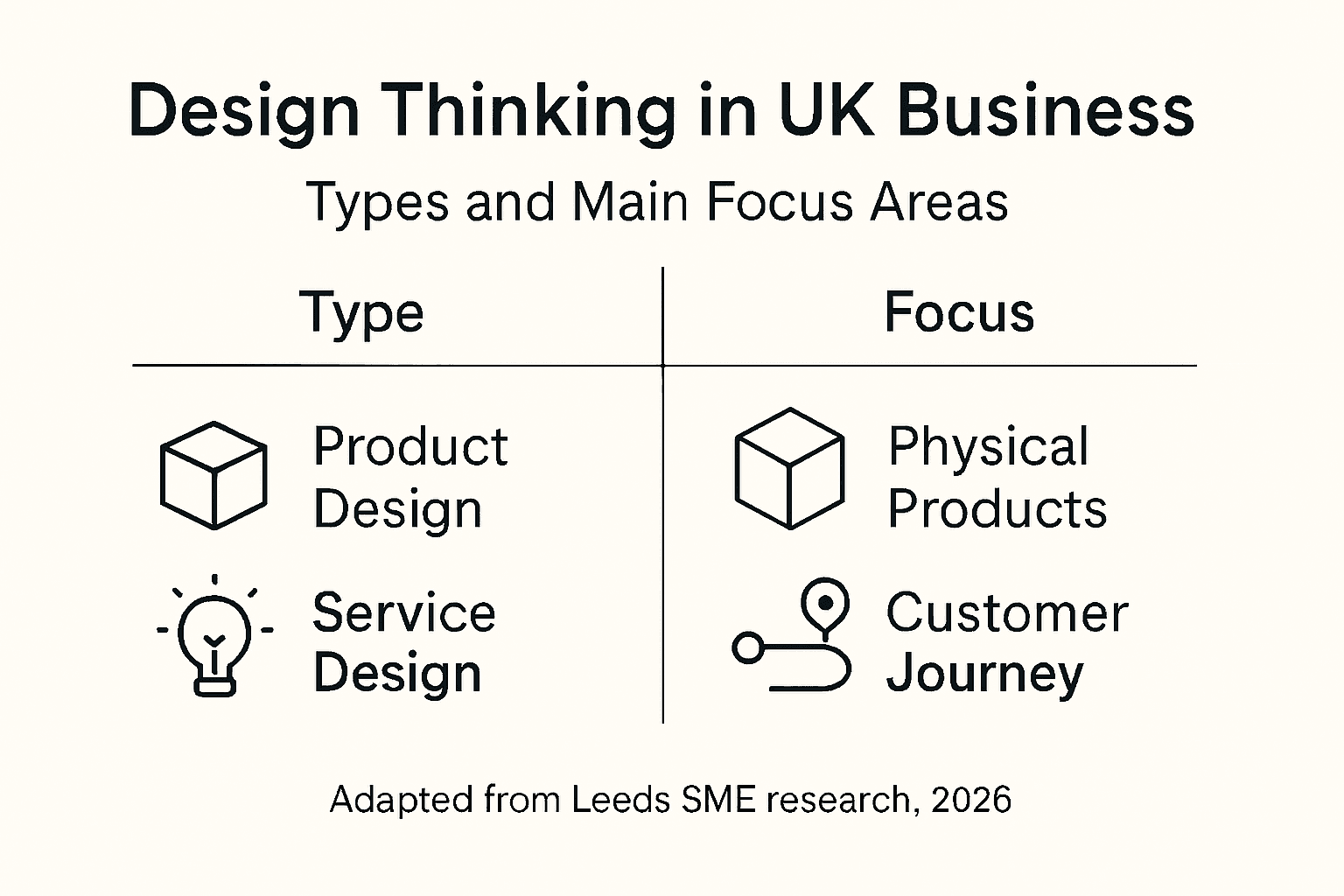
Product design thinking focuses on creating or improving physical or digital products that customers use. This is what most people picture when they think of design thinking: understanding user pain points, prototyping solutions, and testing with real users before launch. A Leeds technology company wanting to redesign their software interface would use this approach, observing how customers struggle with current features, defining the core frustrations, ideating interface improvements, building prototypes, and testing with actual users. Service design thinking takes the same principles but applies them to the entire customer journey and internal operations. Rather than just the product itself, you’re designing how customers interact with your entire business. A Leeds hospitality business might use service design thinking to map every touchpoint a customer experiences, from booking to arrival to departure, identifying friction points and opportunities at each stage. Strategic innovation thinking works at a higher level, helping organisations rethink their entire business model or market positioning. This is where design thinking meets business strategy. A Leeds manufacturing firm might use this to ask fundamental questions like: Are we solving the right problem for the right customers? Should we be entering new markets? What new services could complement our core offering? Brand and experience design thinking concentrates on how customers perceive and connect with your business. This overlaps significantly with how design influences business growth and trust, shaping everything from visual identity to tone of voice to customer interactions. The principle remains consistent across all these types: start with genuine understanding of people, define real problems clearly, generate creative solutions, test them quickly, and refine based on feedback.
The practical difference between these types matters for your team’s focus. If you’re launching a new product, product design thinking keeps your attention on user needs and feature validation. If you’re trying to reduce customer complaints or improve retention, service design thinking helps you see the whole picture rather than just fixing individual complaints. If you’re questioning whether your current business model still works, strategic innovation thinking forces uncomfortable but necessary conversations. Many successful UK businesses apply different types simultaneously. A Leeds retail company might use product design thinking to improve their online shopping experience, service design thinking to streamline the returns process, and strategic innovation thinking to explore whether a subscription model makes sense for their market. The human-centred innovation approaches emphasised in UK professional development training recognise that organisations rarely solve one type of problem alone. Your challenge is matching the right type to your current priority.
What makes this relevant now for Leeds businesses is that your competitors aren’t all equally skilled at applying design thinking. Some are still using outdated problem-solving methods. Others understand the concept but don’t know which type to apply when. Businesses that master multiple types of design thinking create competitive advantages because they solve problems at different levels simultaneously. They improve individual products, streamline entire customer journeys, and adapt their strategy faster than competitors stuck in traditional planning cycles. Starting with one type, building confidence and capability, then expanding to others creates a sustainable advantage. You don’t need to master everything immediately, but recognising that different business challenges need different applications of design thinking helps you pick your starting point wisely.
To clarify where each type of design thinking applies best, see the table below:
| Type of Design Thinking | Main Focus | Typical Business Challenge | Example UK Application |
|---|---|---|---|
| Product Design | Physical/digital products | User feature frustration | Software interface refresh |
| Service Design | Whole customer journey | Retention/complaints | Hospitality touchpoint mapping |
| Strategic Innovation | Business model/strategy | Entering new markets | Exploring subscription model |
| Brand & Experience | Customer perception | Loyalty/brand trust | Rebranding for authenticity |
Pro tip: Identify one specific business problem you face right now and decide which type of design thinking addresses it: is it a product issue (product design), a customer experience problem (service design), a strategic question (innovation), or a brand perception challenge (experience design)? That clarity ensures your first design thinking project targets the right problem with the right approach.
How Design Thinking Drives Brand Connection
Your brand isn’t what you say it is. It’s what your customers experience, feel, and remember about interacting with your business. Design thinking transforms how you build that experience because it forces you to stop guessing and start genuinely understanding what matters to your customers. Most businesses develop their brand identity in isolation, creating logos, messaging, and visual guidelines based on internal assumptions about their market. Design thinking flips this entirely by putting your actual customers at the centre of brand development. You observe how they discover your business, what frustrations they encounter, what they value most, and what would make them genuinely loyal. This insight becomes the foundation for every brand decision, creating authentic connections rather than superficial ones.
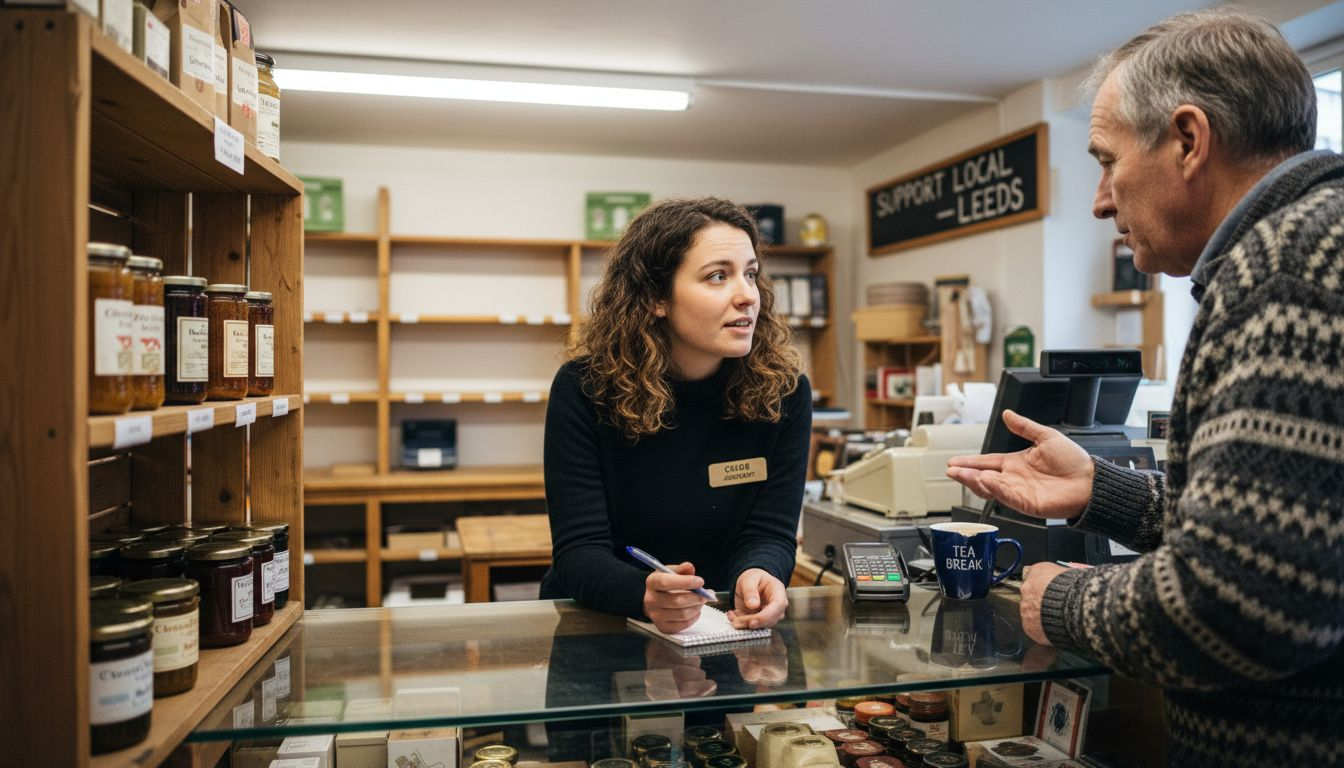
The mechanism is straightforward but powerful. Through consumer ethnography and empathy research, design thinking helps you identify not just what customers want but why they want it. A Leeds coffee shop owner might assume customers choose based on coffee quality. But through observing and interviewing actual visitors, they discover customers value feeling part of a community and having space to work or meet. That insight reshapes everything: the seating layout, the wifi quality, the barista interactions, even the music selection. Suddenly the brand becomes about community and belonging rather than just excellent coffee. Every design decision reinforces this genuine understanding. The menu board design, the customer service training, the social media content, the loyalty programme all communicate and reinforce the same core brand truth. This consistency builds trust because customers experience what you claim to stand for, not contradictions between your marketing and reality. Authentic brand experiences built on user understanding create stronger emotional connections than brands that don’t bother investigating what their customers actually need.
For your Leeds business, this approach directly impacts how customers perceive your brand and whether they return. Consider a local accountancy firm. Traditional branding might focus on credentials and professional appearance. But through design thinking conversations with small business owners, they discover the real pain is confusion about tax deadlines and feeling overwhelmed by complicated explanations. The brand pivots to become “clarity and peace of mind.” They redesign their website to simplify complex information. They create monthly email alerts for common deadlines. They train staff to use plain English instead of jargon. They develop visual materials that make tax information less intimidating. Customers now associate the brand with someone who genuinely understands their stress and removes it. That’s not a marketing claim; it’s a lived experience. They become loyal because the brand actually solves their real problem, not the problem the accountants assumed they had. This approach also reduces risk because you’re testing your brand assumptions with real customers before investing heavily. If your positioning is wrong, you discover it quickly and adjust rather than launching a full rebrand campaign based on faulty assumptions.
Design thinking in brand building also supports sustainable competitive advantage through continuous innovation. Your competitors can copy your logo. They can replicate your tagline. But they can’t copy the deep customer understanding that drives your brand decisions if that understanding is alive and evolving. By continuously engaging with customers, identifying emerging needs, and refining your brand experience, you stay ahead because you’re solving problems customers don’t even know yet that they have. The brand becomes a living thing that adapts and grows rather than a static identity locked in place when you launched it five years ago. For Leeds businesses competing with larger national brands, this adaptive, customer-focused approach creates genuine differentiation that money alone can’t buy.
Pro tip: Choose one aspect of your brand this week—perhaps your customer service process, your visual identity, or your messaging—and spend three hours observing and interviewing five customers about their actual experience with that aspect versus what you think they experience. The gaps you discover are where design thinking creates immediate brand improvement.
Risks, Costs and Common Pitfalls for SMEs
Design thinking sounds straightforward in theory. In practice, Leeds SMEs often stumble when trying to implement it because the risks are real and the costs can spiral quickly if you’re not careful. Understanding these pitfalls before you start prevents expensive mistakes and wasted effort. The good news is that most pitfalls are avoidable once you recognise them. The challenge is that many businesses jump into design thinking without understanding what actually makes it work, treating it as a trendy methodology rather than a fundamental shift in how you approach problems.
The most common and costly mistake is rushing through the empathy and research phases. This sounds counterintuitive because everyone wants results fast. But when SMEs compress these early stages, they miss the actual problem and build solutions to the wrong challenge. A Leeds marketing agency once spent six weeks redesigning their proposal process because they assumed clients wanted faster turnarounds. After implementing their redesign, they discovered clients actually wanted clearer communication about project scope. The agency had solved the wrong problem, wasted resources, and customers weren’t satisfied because the real issue remained unaddressed. Insufficient user research limiting empathy and understanding directly causes solutions that don’t resonate with customers. Spending adequate time interviewing customers, observing their workflows, and genuinely understanding their frustrations feels like it slows you down initially. In reality, it saves months of wasted development later. Budget for proper research time upfront rather than learning expensively that your assumptions were wrong.
Second, inadequate cross-functional collaboration creates narrow solutions that don’t address interconnected problems. If your design thinking project includes only product developers or only customer-facing staff, you’re missing perspectives that would reveal hidden issues. A Leeds manufacturing firm attempted design thinking improvement to their order process by gathering only their sales team. They didn’t include operations staff, so the “improved” process looked good from a sales perspective but created chaos in fulfillment. The solution failed because it wasn’t truly collaborative. SMEs often skip collaboration because it seems slower and messier. Coordinating across departments takes time. Different perspectives create disagreement. But that friction is where genuine insight lives. The third major pitfall is failing to iterate adequately, treating prototyping as a one-off exercise rather than a cycle. You build something, test it once, and either launch or abandon it. Real design thinking requires multiple iterations where you learn from each test and refine. This feels expensive initially, but it’s far cheaper than launching a full solution that misses the mark.
Cost management for SMEs requires strategic thinking. You don’t need to hire expensive external consultants or invest in elaborate research facilities. Start small. Pick one genuine problem. Allocate one team member part-time to genuinely understand customer needs through interviews and observation. Build a rough prototype quickly and inexpensively, even if it’s imperfect. Test with five to ten actual customers. Learn. Adjust. That entire cycle might take four to six weeks and cost minimal money if you’re using internal resources. Multidisciplinary collaboration and human-centred focus with appropriate resource allocation matter more than having perfect processes or external expertise. Many successful SMEs start design thinking projects with minimal investment, prove the value through measurable results, then expand from there. You also mitigate costs by protecting your team from the cultural pitfall where design thinking becomes another meeting-heavy initiative that slows decisions rather than accelerating them. Keep process lightweight. Avoid creating extensive documentation that nobody reads. Focus on rapid learning and action.
The final risk worth highlighting is misalignment between strategy, culture, and implementation. You can’t introduce design thinking as a one-off project if your company culture still rewards quick decisions over customer understanding or punishes people for testing ideas that fail. If your leadership measures success only by immediate revenue rather than customer satisfaction improvements, design thinking will feel like a waste. Building the culture shift alongside the methodology matters more than the methodology itself. Start with leaders who genuinely believe in the approach. Celebrate learning from test failures rather than hiding them. Measure different metrics temporarily to reflect what design thinking improves. These cultural shifts take longer than the process itself but create sustainable change.
Pro tip: Before starting a design thinking project, write down three assumptions you’re making about your customer problem. Then spend two hours talking to actual customers about whether those assumptions are correct. If you’re wrong about even one, you’ve already saved yourself the cost of solving the wrong problem.
Comparing Design Thinking to Traditional Problem-Solving
Your Leeds business probably uses traditional problem-solving already. When something breaks, you identify what’s wrong, analyse why it happened, and fix it. When sales drop, you examine data, identify the cause, and implement a solution. This linear, analytical approach works well for clearly defined problems where the issue is obvious and the solution is relatively straightforward. But it falls apart when facing complex, ambiguous challenges where the problem itself is unclear or multiple interconnected factors create the difficulty. Understanding the difference between these two approaches helps you recognise when each one works best and when you need to switch strategies.
Traditional problem-solving assumes you can precisely define the problem upfront. You gather data, analyse it logically, and find the single optimal solution. This method prioritises efficiency, predictability, and risk minimisation because you’re working from expert knowledge and proven approaches. A Leeds accountancy firm using traditional problem-solving might notice clients miss tax deadlines. They analyse the data, identify that clients forget to mark calendars, and implement a solution: send email reminders. Problem solved. This approach works fine for operational issues where the root cause is clear and measurable. However, iterative, human-centred approaches embracing ambiguity and empathy handle messy, complex challenges differently. Design thinking starts by acknowledging that you don’t fully understand the problem yet. Instead of assuming clients forget deadlines, you’d spend time understanding why. Maybe they forget because the deadline language in tax documents is confusing. Maybe they procrastinate because the process feels overwhelming. Maybe they’re managing multiple advisers and unclear who’s responsible. Each of these requires a different solution. Traditional analysis might miss these nuances because it focuses on what can be measured easily.
The practical difference shows up in how you respond to unexpected outcomes. Traditional problem-solving follows a linear sequence: define, analyse, decide, implement, monitor. If something goes wrong during implementation, you troubleshoot and get back on track. Design thinking is iterative and intentionally embraces experimentation. You define a hypothesis, build a rough prototype, test it with real users, learn what didn’t work, and refine based on feedback. Then you repeat. A Leeds retail business using traditional thinking might redesign their store layout based on consultant analysis and foot traffic patterns. They implement it fully, discover customers don’t shop the redesigned areas, and must start over. The same business using design thinking might create the redesign in one section first, observe customer behaviour, adjust based on what they observe, then roll it out widely. They learn as they go rather than discovering mistakes after full implementation. Design thinking emphasises empathy-driven exploration, co-creation, and repeated prototyping specifically because real solutions emerge through dialogue with users, not pure analysis.
Neither approach is inherently superior. You need both. Use traditional problem-solving for operational efficiency questions: How can we process invoices faster? What’s our optimal staffing level? Where should we locate our new office? These have measurable factors and expert solutions. Use design thinking for innovation, customer experience, and strategic questions: How should we compete in a changing market? Why are customers choosing competitors? What new services would genuinely solve our clients’ problems? These questions have no obviously correct answer and require understanding human needs, not just data analysis. Most Leeds businesses succeed by knowing which tool fits which problem. A manufacturing company might use traditional problem-solving to optimise their production line but design thinking to understand why customers defect to competitors. A service business might analyse operational costs traditionally but use design thinking to reshape their customer onboarding experience. The confusion happens when businesses apply the wrong methodology. You can’t design-think your way to a faster invoice process. You can’t analyse your way to understanding what your customers actually value.
The practical implication for your business is this: if you’re solving problems where the issue is clear, measurements are reliable, and an expert best practice exists, traditional problem-solving gets you results faster and more efficiently. But if you’re facing complex challenges, uncertain customer needs, or competitive pressure requiring innovation, design thinking uncovers insights that pure analysis misses. Many Leeds businesses find they’re defaulting to traditional thinking because it feels logical and controllable. Design thinking feels messier because it involves uncertainty and customer conversations instead of clean data. That discomfort is exactly where the advantage lies. Your competitors doing traditional analysis will optimise the same solutions everyone else pursues. Your business using design thinking discovers opportunities competitors haven’t imagined yet.
Here is a side-by-side view comparing design thinking and traditional problem-solving:
| Aspect | Design Thinking Approach | Traditional Problem-Solving |
|---|---|---|
| Process Structure | Iterative and non-linear | Linear and sequential |
| Problem Definition | Emerges through discovery | Defined at the outset |
| User Involvement | High, ongoing feedback | Limited to initial data |
| Ideal Context | Complex, ambiguous problems | Clear, well-defined issues |
| Outcome Evaluation | Based on user reactions | Based on efficiency metrics |
Pro tip: This week, identify one business problem you’re currently trying to solve. Ask yourself: is the root cause clear and measurable, or is it ambiguous and tied to human behaviour and preferences? That answer tells you whether to apply traditional problem-solving (use analysis and expert solutions) or design thinking (talk to customers and prototype alternatives).
Unlock the Power of Design Thinking to Elevate Your Leeds Business
Design thinking offers a transformative approach to solving customer challenges through empathy, iteration, and genuine understanding. If your Leeds business feels stuck solving the wrong problems or struggling to connect deeply with your audience, it is time to rethink how you build your brand and customer experience. At Kukoocreative, we have spent over a decade helping business owners like you craft designs that do much more than look good — they build authentic connections rooted in the insights that design thinking uncovers.
Don’t let assumptions and outdated methods hold you back. Whether you need a refreshed logo, a compelling website, or a complete brand makeover that reflects the true needs of your customers, our designs help you stand out in a competitive market. Discover how we apply human-centred design principles to create impactful visuals and strategic brand messaging that drive real business results. Take the next step with us today by visiting our homepage and learn how to start connecting with the people who matter most.
Frequently Asked Questions
What are the key principles of design thinking?
The key principles of design thinking include human-centredness, collaborative thinking, visual thinking, and a focus on experimentation over perfection. These principles help businesses align their solutions with actual user needs and ensure effective collaboration among team members.
How can design thinking benefit my business in 2026?
Design thinking can benefit your business by enabling you to understand customer needs better, reduce wasted effort on undesirable solutions, and foster stronger connections with customers. It helps identify unique opportunities that can provide competitive advantages.
What are the different types of design thinking?
The different types of design thinking include product design thinking, which focuses on improving products; service design thinking, which looks at the entire customer journey; strategic innovation thinking, which addresses overarching business strategy; and brand and experience design thinking, which shapes customer perception and connection to your brand.
How do I implement design thinking in my business?
To implement design thinking, start by identifying a specific customer pain point, gather a diverse team, conduct empathetic research to understand the issue, define the problem using customer language, brainstorm ideas, prototypically test solutions, and continuously iterate based on feedback.
Recommended
- Sustainable Branding: Enhancing Recognition for Leeds Businesses
- Logo Refresh in 2025 – Why Leeds Businesses Benefit
- Scalable Branding: Boosting Creative Business Growth
- Brand Recognition: How It Impacts Small Businesses
- 7 Smart Ways to Find Inspiration for Merch Designs – Custom T-Shirts and Printed Merch in Utah | Pulse Merch