
TL;DR:
- A strong About Us page quickly answers who you are, why clients can trust you, and what makes you different.
- It should include a clear opening statement, authentic photos, a relevant brand story, credible proof, and a focused call to action, all within 400 to 600 words.
Your About Us page is a concise, strategic overview of your business that answers three questions every visitor asks: who are you, why should I trust you, and what makes you different? Most small business owners treat it as an afterthought. That is a costly mistake. A well-crafted About Us page reduces the risk a potential client feels before making contact, builds genuine credibility, and often determines whether a visitor becomes an enquiry. This guide walks you through exactly how to build an about us page that works hard for your business, from the first sentence to the final call to action.
What key elements must a compelling About Us page include?
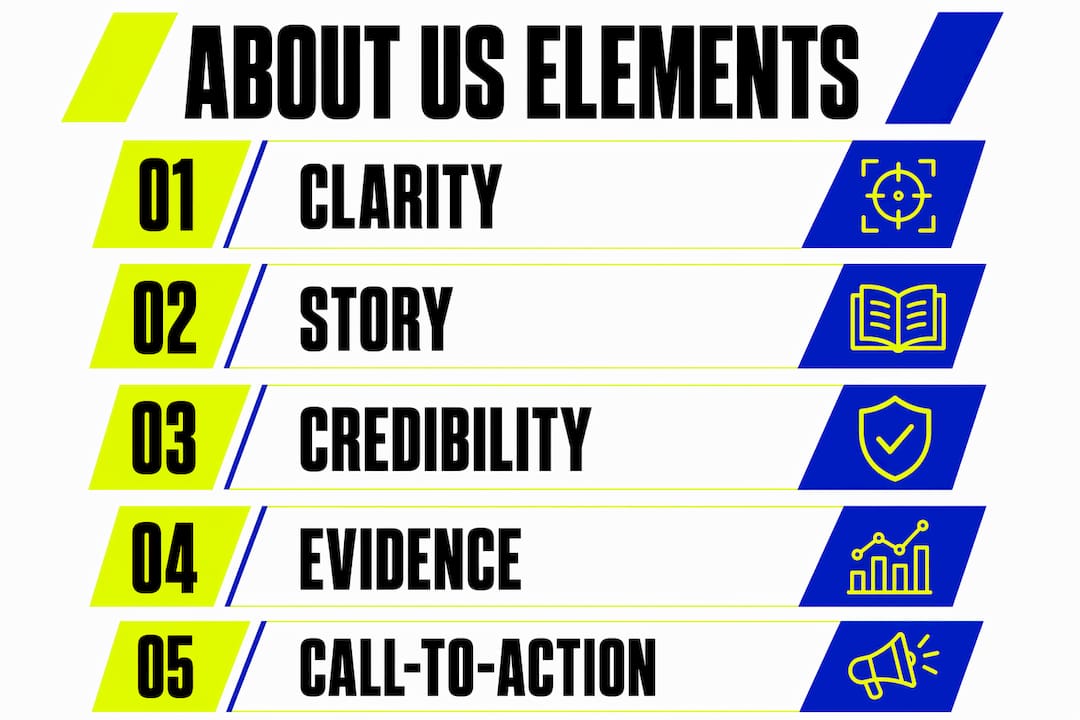
An effective About Us page answers three core questions within 30 seconds: who you are, why visitors should trust you, and what makes you different. That is not a lot of time. Every element on the page must earn its place.
The essential components are:
- A clear opening statement. Name your business, describe what you do, and state the market or geography you serve. Do this within 50 words. Visitors should not have to scroll to understand your offer.
- A relevant brand story. Your origin story only matters if it connects directly to a customer benefit. “We started this business because we struggled with X ourselves” is far more compelling than a timeline of company milestones.
- Credibility signals. These include methodology explanations, professional credentials, industry accreditations, and client testimonials. UK customers expect professional credentials and local references, particularly in service businesses. A solicitor displaying Law Society membership, or a designer showing verified client results, builds trust before a word of sales copy appears.
- Real photos of real people. Visitors want to see the humans behind the brand. Authentic, professional photos placed near the top of the page boost credibility and emotional engagement far more than stock imagery ever will.
- A clear next step. Every About Us page needs a call to action. The best ones are qualification-based, inviting only the right prospects to get in touch. This reduces wasted enquiries and attracts clients who are already a good fit.
Think of these five elements as the skeleton. Without any one of them, the page loses structural integrity.
How to structure your About Us page for maximum impact
Structure determines whether a visitor reads on or clicks away. The order of information matters as much as the information itself.
- Open with immediate clarity. Your first paragraph should state your name, your service, and your geographic focus. Keep it under 50 words. This is not the place for a warm-up.
- Place photos near the top. Human faces create connection before text does. A professionally designed visual identity, including authentic team photos and consistent branding, sets the trust tone before a visitor reads a single sentence.
- Follow with your story. Connect your origin to the outcome you create for clients. Explain why you started, what problem you saw, and how your approach addresses it. Keep this section tight and purposeful.
- Present your methodology with specificity. A detailed methodology section that explains what you do differently, why it matters, and what clients experience lets visitors self-qualify and build trust in your expertise. Vague process descriptions do the opposite.
- End with a qualifying call to action. Define the type of client you work best with, then invite them to make contact. Qualification-based calls to action improve engagement and reduce time wasted on poor-fit enquiries.
Pro Tip: Keep your About Us page to between 400 and 600 words. That length is enough to answer every key question without losing the reader’s attention.
This structure works because it mirrors how trust is built in person: first impressions, then context, then evidence, then invitation.

Which storytelling techniques build authentic brand trust?
Evidence-based storytelling converts visitors. Vague claims do not. The difference between “we deliver results” and “we improved a manufacturing client’s close rate from 12% to 31% in eight weeks” is the difference between a claim and a proof point.
Customers also respond to language that mirrors their own experience. When your About Us page describes a problem using the exact words your clients use to describe it, they feel understood. That feeling of being understood is what prompts an enquiry. You can learn this language from client feedback, discovery calls, and reviews.
“Specificity drives trust, justifies pricing, and distinguishes businesses. Generic ‘we pride ourselves’ statements are ineffective. Explaining precisely how you work and what clients should expect is what builds confidence.”
The most credible About Us pages select three compelling, verifiable case studies or awards rather than listing every project or credential. Three strong proof points land harder than twenty mediocre ones. This approach also helps visitors absorb information without feeling overwhelmed.
Social proof works best when it is specific and attributed. “Fantastic service” tells a visitor nothing. “Kukoocreative redesigned our brand and we won a new contract within six weeks” tells them everything. Use storytelling in your design to make these proof points feel natural rather than boastful.
Common mistakes to avoid when building an About Us page
Most About Us pages fail for the same predictable reasons. Recognising these pitfalls saves you time and protects your credibility.
- Treating it as an autobiography. Your history is only relevant if it explains why you are the right choice for the client. Cut anything that does not serve that purpose.
- Using corporate jargon and generic platitudes. Phrases like “we pride ourselves on excellence” or “passionate about what we do” appear on thousands of pages. They say nothing specific and fail to build trust or justify pricing.
- Listing too many credentials. Selecting only your strongest, most relevant proof points creates more impact than exhaustive lists. Visitors scan, they do not study.
- Using stock images. Stock photos signal inauthenticity. Real photos of real people, even taken on a good smartphone, outperform polished stock imagery every time.
- No clear call to action. An About Us page without a next step leaves visitors with nowhere to go. That is a missed opportunity every time someone reads to the end.
Pro Tip: Read your About Us page aloud. If any sentence sounds like it could belong to any business in your sector, rewrite it until it could only belong to yours.
Avoiding these mistakes is not complicated. It requires honesty about what your page is actually for: winning the right clients, not impressing everyone.
How to maintain and optimise your About Us page over time
An About Us page is not a one-time task. It needs regular attention as your business grows and your positioning sharpens.
- Review it every six months. Remove outdated references, update credentials, and check that your story still reflects your current offer and client base.
- Add new testimonials and achievements. Fresh social proof keeps the page credible. A testimonial from three years ago carries less weight than one from last month.
- Align with your evolving brand positioning. If your brand recognition strategy shifts, your About Us page must reflect that. Inconsistency between your page and your wider marketing confuses visitors.
- Apply SEO best practices. Use relevant keywords naturally, add schema markup for your organisation or owner, and include internal links to service pages to help the page rank for branded and trust-based queries.
- Use analytics to refine content. Check how long visitors spend on the page and where they go next. If most leave without clicking anything, your call to action needs work. If they scroll past the midpoint, your opening is doing its job.
Treating your About Us page as a living document, rather than a finished product, keeps it working as your business evolves. Pair this habit with prospect segmentation thinking to ensure your page speaks directly to your most valuable audience.
Key takeaways
A well-built About Us page is the single most effective trust asset a small business can publish, combining clear identity, specific proof, and a qualifying call to action.
| Point | Details |
|---|---|
| Open with immediate clarity | State your name, service, and geography within the first 50 words. |
| Use real photos | Authentic team photos near the top build emotional connection before text is read. |
| Replace claims with proof | Specific case studies and verifiable results outperform generic statements every time. |
| Keep it focused | Aim for 400–600 words and select only your three strongest proof points. |
| Maintain it regularly | Review every six months, update testimonials, and apply SEO best practices throughout. |
What I have learned from years of About Us pages
Here is something most guides will not tell you: the About Us page is where entrepreneurs reveal exactly how confident they are in their own offer. The businesses that write vague, self-congratulatory pages are almost always the ones that struggle to articulate their value in a sales conversation too. The page is a mirror.
The clients I have worked with who saw the biggest results from updating their About Us page were not the ones who added more content. They were the ones who cut ruthlessly and got specific. One client removed a 400-word company history section, replaced it with two client results and a clear methodology paragraph, and saw their enquiry rate improve noticeably within weeks. Specificity did that, not volume.
The other thing I see constantly is the fear of being too direct. Entrepreneurs worry that a qualifying call to action will put people off. The opposite is true. Telling visitors exactly who you work best with, and why, attracts better clients and repels the ones who would waste your time. That is not exclusion. That is confidence.
Your About Us page is a credibility asset. Treat it with the same care you give your pricing page or your service descriptions. It deserves that attention, and your business will benefit from it.
— Kukoo
How Kukoocreative can help you build a credible brand presence
Building a compelling About Us page is part of a bigger picture: your entire brand identity needs to work together to win trust and attract the right clients.
At Kukoocreative, we have spent over a decade helping business owners create designs and content that build genuine brand recognition. From visual identity creation to web design, we bring together storytelling, design, and strategy to make sure your About Us page, and every other part of your brand, speaks with confidence. If you want a brand presence that reflects the quality of your work, we would love to help. Get in touch with the Kukoocreative team to find out how we can support your next project.
FAQ
How long should an About Us page be?
An effective About Us page is 400–600 words. That length answers every key visitor question without losing their attention.
What should I put in my About Us page?
Include a clear opening statement, a relevant brand story, credibility signals such as testimonials or credentials, real photos of your team, and a qualifying call to action.
Should I use stock photos on my About Us page?
Real photos of real people always outperform stock images. Authentic photos build connection and trust far more effectively, even when taken on a smartphone rather than by a professional photographer.
How do I make my About Us page rank on Google?
Use relevant keywords naturally throughout the page, add schema markup for your organisation, and include internal links to your service pages. These SEO best practices help the page rank for branded and trust-based search queries.
How often should I update my About Us page?
Review and update your About Us page every six months. Add new testimonials, remove outdated references, and align the content with any changes to your brand positioning or service offer.