
TL;DR:
- A brand style guide consolidates visual and verbal rules to ensure consistent business representation. It enhances recognition, builds trust, and simplifies material production by providing clear, accessible instructions. Small businesses should keep guides concise, regularly update them, and actively promote their use across all brand touchpoints.
Your brand is not just a logo. That misconception holds back countless small businesses across the UK, leaving them with inconsistent marketing materials, confused customers, and missed opportunities to build real recognition. A brand style guide is the document that brings everything together, from the exact shade of your primary colour to the tone of voice you use on social media. Whether you are starting from scratch or refining what you already have, understanding what a style guide is and how to build one is one of the most valuable investments you can make in your business.
Table of Contents
- What is a style guide and why does it matter?
- Key elements inside a style guide
- How small businesses build effective style guides
- Style guides in action: Maintaining brand consistency
- Strategy versus guidelines: Avoiding common mistakes
- Our perspective: Creating style guides that actually work
- Next steps: Build your style guide with Kukoo Creative
- Frequently asked questions
Key Takeaways
| Point | Details |
|---|---|
| Consistency creates trust | A style guide ensures your branding is uniform, helping build recognition and customer confidence. |
| Keep guidelines clear and concise | Even a brief guide covering main branding elements prevents costly mistakes and confusion. |
| Practical steps drive results | Build your style guide with actionable rules and real usage examples for maximum impact. |
| Strategy and guidelines are distinct | Understand the ‘why’ behind your brand, but don’t substitute it for clear ‘how’ instructions. |
| Update as your business grows | Review and refresh your style guide regularly to reflect changes in your brand assets and direction. |
What is a style guide and why does it matter?
A style guide is essentially your brand’s rulebook. As defined by branding experts, “a brand style guide specifies the rules for how a brand’s identity should be presented, covering visual and often verbal elements so materials stay consistent across every touchpoint.” In plain terms, it tells anyone working on your brand exactly how it should look, sound, and feel.
Think about the businesses you recognise immediately. Their consistency is no accident. Brand guidelines are described as practical blueprints that help ensure uniform appearance across platforms, building recognition and trust over time. That trust is earned through repetition, and repetition requires rules.
For UK small businesses, consistency matters even more than you might expect. You may have fewer touchpoints than a large corporation, but every interaction carries greater weight. A flyer that looks different from your website, or a social post that uses the wrong font, chips away at credibility. Customers notice, even when they cannot pinpoint exactly why something feels off.
“Consistency is not about being boring. It is about being reliable. And reliability builds the kind of trust that turns customers into advocates.”
A well-structured brand guideline guide does not need to be a 50-page document. Even a short, clear reference covering your core visual and verbal rules will do the job. The key is that it exists, it is accessible, and everyone involved in your brand uses it. From freelance designers to in-house staff, your style guide is what keeps your business identity protected across every piece of communication you produce.
Pro Tip: Start with just three non-negotiables: your logo rules, your colour palette, and your tone of voice. Once those are documented, adding more elements becomes straightforward.
Key elements inside a style guide
So what actually goes inside a style guide? The answer depends on the size of your business and the variety of materials you produce, but there are core elements that every UK small business should cover.
A well-structured style guide functions as an internal rulebook for applying brand identity, with common examples including logo usage, colour palettes, typography, imagery, and tone of voice. Let us look at what each of those means in practice:
- Logo usage rules: Where your logo can appear, minimum sizes, clear space requirements, and which versions (colour, black and white, reversed) are acceptable. Equally important: what you should never do, such as stretching, recolouring, or placing the logo on a clashing background.
- Colour palette: Your primary and secondary colours with exact HEX codes for digital use and Pantone or CMYK references for print. Without these specifics, “navy blue” means something different to every designer you work with.
- Typography: Your chosen fonts, where each is used (headings versus body text), and acceptable alternatives if your primary font is unavailable.
- Imagery guidelines: The style of photography or illustration that fits your brand, including mood, composition, and any visual themes to avoid.
- Tone of voice: How your brand speaks. Is it warm and conversational, or formal and authoritative? What words do you favour, and which ones do you avoid? This applies to website copy, emails, social posts, and even how you answer the phone.
Looking at visual branding examples across industries shows how even subtle differences in font choice or image style create vastly different brand perceptions. The same principle applies to business card branding, where your physical collateral must match your digital presence precisely.
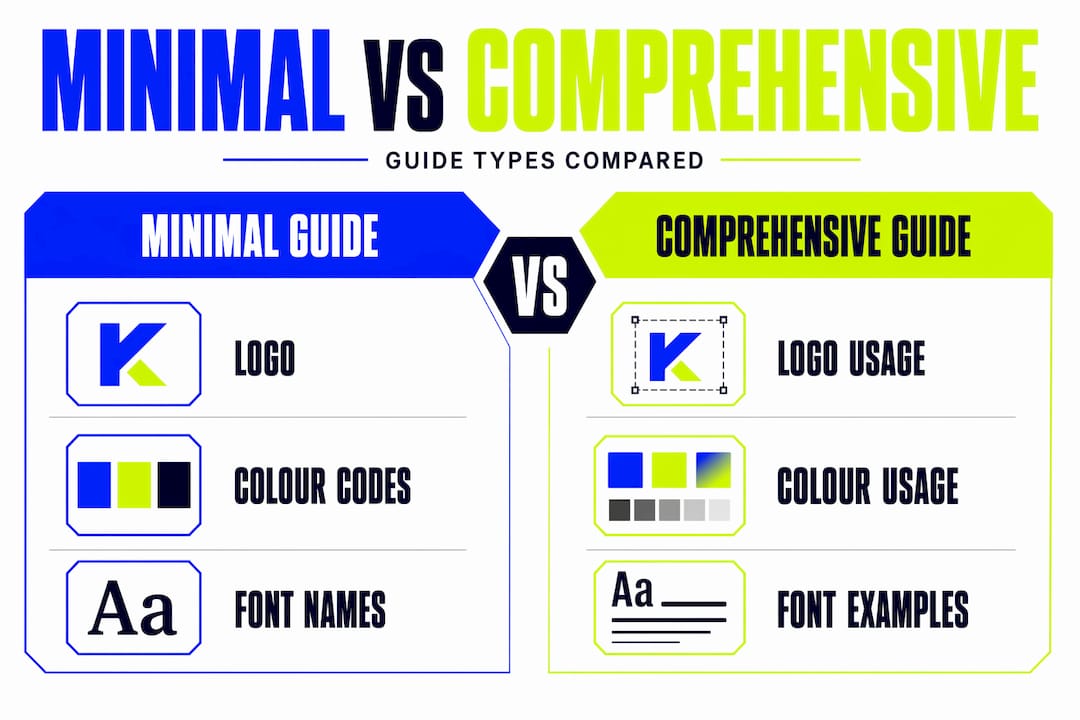
Here is a useful comparison to illustrate the difference between a minimal and a comprehensive style guide:
| Element | Minimal guide | Comprehensive guide |
|---|---|---|
| Logo | Basic usage rules | Full usage with misuse examples |
| Colour | 2 to 3 HEX codes | Primary, secondary, tertiary with print references |
| Typography | One font family | Heading, body, accent fonts with sizing rules |
| Imagery | Brief description | Mood board with do/don’t examples |
| Tone of voice | A few adjectives | Detailed writing principles with sample copy |
| Length | 1 to 3 pages | 10 to 20+ pages |
Pro Tip: Add real usage examples to every section of your style guide. Showing a correctly branded email header or a properly formatted social post removes ambiguity and makes the rules easy to apply without back-and-forth questions.
How small businesses build effective style guides
Building a style guide does not need to be overwhelming. In fact, for small businesses, keeping it lean works well, provided it includes enough concrete rules like exact colour references and logo and typography usage to prevent your brand from drifting over time.
Here is a practical step-by-step approach:
- Audit what you already have. Gather every piece of branded material: your logo files, website screenshots, printed leaflets, social media headers, and email signatures. Look for inconsistencies. You will likely find more than you expect.
- Define your visual identity. Confirm your logo (and its variants), lock in your colour codes, and choose your fonts. If these feel unclear or dated, this is the moment to refine them.
- Articulate your tone of voice. Write down three to five words that describe how your brand speaks. Then add practical examples: a sentence you would write and a sentence you would never write.
- Document with examples. For every rule, include a visual or written example. “Do this, not that” comparisons are particularly effective.
- Share and test it. Give your guide to a designer or team member who has not worked on your brand before. If they can produce on-brand materials without asking questions, your guide is working.
This consistency workflow guide walks through the process in more detail, and this step-by-step approach for businesses offers even more granular guidance if you are working through your guidelines for the first time.
For a quick reference on what to include and how long each section should be, here is a practical table:
| Section | Recommended content | Suggested length |
|---|---|---|
| Logo usage | Variants, sizing, spacing, do/don’t | Half a page |
| Colour palette | HEX, CMYK, Pantone codes | Quarter of a page |
| Typography | Font names, hierarchy, sizing | Quarter of a page |
| Imagery | Style notes, example images | Half a page |
| Tone of voice | Key words, sample copy, rules | Half to one page |
The step-by-step branding framework is a useful reference for ensuring your physical materials align with your digital guidelines, particularly when designing print collateral.
Pro Tip: Always use specific font names and HEX codes rather than descriptions. “Coral pink” is subjective. “#E8735A” is not.
Style guides in action: Maintaining brand consistency
Having a style guide is one thing. Using it consistently is where the real value lies. Think about all the places your brand appears: your website, social media profiles, email newsletters, business cards, brochures, vehicle signage, and packaging. Each of those touchpoints is an opportunity to either reinforce your brand or confuse your audience.

Brand guidelines are most effective when they are treated as living documents shared actively with everyone who touches your brand. This includes your in-house team, any freelance designers, print suppliers, and marketing agencies you work with.
Consider these tangible benefits of maintaining consistent branding through a well-used style guide:
- Faster production of materials. When rules are clear, designers spend less time asking questions and more time creating.
- Reduced errors and off-brand output. Inconsistencies become obvious immediately when checked against a documented guide.
- Stronger customer recognition. Repeated, consistent exposure to your brand builds familiarity and trust.
- Smoother onboarding of new staff or suppliers. A style guide eliminates the need for lengthy briefings every time someone new joins the team.
- More efficient rebrands or updates. When you evolve your visual identity, a style guide gives you a clear baseline to update rather than starting from scratch.
“A brand without guidelines is like a franchise without a recipe. You might get something edible, but you’ll never get consistency.”
Insights from experienced branding agency professionals consistently highlight that small businesses who invest in clear guidelines spend less time on corrections and revisions, saving both time and money over the long term. These branding workflow tips offer practical advice on maintaining that consistency across physical print materials as well.
Strategy versus guidelines: Avoiding common mistakes
One of the most common mistakes UK small business owners make is conflating brand strategy with brand guidelines. They are related but distinct, and confusing the two can leave you with a guide that looks polished but lacks real purpose.
Brand strategy expert Etienne Aubert Bonn notes that guidelines should translate strategic intent into specific visual and verbal rules. Without that connection, you risk creating guidelines that are either lifeless and too rigid, or visually consistent without any deeper meaning.
Here is how to distinguish them clearly:
- Brand strategy answers “why.” It covers your mission, values, target audience, brand positioning, and the emotional response you want to create. It is the thinking behind your brand.
- Brand guidelines answer “how.” They translate the strategy into actionable rules: which colours to use, how the logo is placed, what words you choose, and how images are styled.
Both are necessary. A strategy without guidelines stays in a drawer. Guidelines without strategy produce a brand that looks neat but feels hollow.
Common pitfalls to avoid when building your style guide:
- Making it too rigid. Guidelines that allow no flexibility frustrate designers and quickly become ignored.
- Making it too vague. Rules without specifics (“use professional-looking images”) are useless.
- Creating it and never sharing it. A style guide only works if it is actively distributed and referenced.
- Failing to update it. Brands evolve. A guide that reflects your brand from three years ago will cause as many problems as having no guide at all.
“The best brand guidelines I have seen do one thing brilliantly: they make it easy to do the right thing and hard to do the wrong thing.”
This branding consistency resource is worth revisiting once you have your strategy and guidelines clearly separated. It will help you build habits and workflows that keep your brand on track day to day.
Our perspective: Creating style guides that actually work
Here is something we have observed after working with small businesses across the UK for over a decade. Most style guide failures come not from poor design, but from poor adoption. A beautifully designed 20-page document that sits in a shared folder and never gets opened is worth nothing. A single printed A4 sheet pinned above someone’s desk and referred to daily is priceless.
The businesses we see build the strongest brands are not the ones with the most elaborate guidelines. They are the ones whose teams actually use what they have. That means keeping the guide visually clear, practically focused, and genuinely accessible to non-designers. If your team member needs to be a creative professional to understand your style guide, you have written it for the wrong audience.
There is also a tendency among small business owners to treat a style guide as a one-off project. Create it, tick the box, and move on. The reality is that your brand should evolve as your business grows, and your style guide needs to reflect that. Schedule a review every six to twelve months. Update it when you launch a new product line, refresh your website, or expand into new markets.
The most effective style guides we have helped create share three qualities: they are visual rather than wordy, they include real examples from actual branded materials, and they are short enough that people actually read them. Our complete guide to brand guidelines gives you a thorough framework to follow if you want to build something that lasts.
Pro Tip: Set a calendar reminder every six months to review your style guide. Check whether the rules still reflect how your brand actually looks and sounds. Update anything that has drifted.
Next steps: Build your style guide with Kukoo Creative
You now have a clear picture of what a style guide is, what it should contain, and how to make it work for your business. The next step is putting that knowledge into action.

At Kukoo Creative, we have spent over a decade helping UK small businesses build brands that are credible, consistent, and genuinely memorable. From crafting logos that make a lasting impression, as explored in our guide on logo design impact, to developing full brand recognition strategies that work across every channel, we bring creative expertise and practical know-how to every project. If you are ready to create or refine your style guide, our team will guide you through the process step by step. Explore our brand assets guide and get in touch to start building a brand that people recognise, trust, and remember.
Frequently asked questions
Can a style guide be just one page?
For small businesses, a single page can work well if it clearly covers the essentials: logo rules, colour codes, fonts, and tone of voice. As style guide guidance confirms, keeping it lean is fine as long as the rules are concrete enough to prevent inconsistency.
What if my brand evolves, how do I update the guide?
Review your style guide whenever you launch new campaigns, update your logo, or introduce new brand assets, and update the rules and visual examples to match. Treat it as a living document rather than a finished project.
How often should I share my style guide with staff or partners?
Share your style guide with every designer, marketer, or print supplier you work with, at the start of each project. Practical brand blueprints build recognition and trust precisely because they are used consistently, not stored away.
What is the difference between “brand guidelines” and “style guide”?
The two terms are often used interchangeably, but brand guidelines can also encompass broader strategic thinking about your mission and positioning. As noted by brand experts, the distinction between strategy and guidelines matters because one informs your “why” and the other defines your “how.”
Should I include physical asset rules like business cards in my style guide?
Absolutely. Physical materials like business cards, letterheads, and printed brochures are just as important as digital assets. Consistent brand guidelines that span both print and digital ensure your brand looks unified wherever customers encounter it.