
TL;DR:
- Poor UX can silently reduce revenue and damage customer trust despite a visually appealing website.
- Treating UX as a continuous business function, not just a design detail, significantly improves conversions and retention.
- Investing in strategic UX practices and clear communication can deliver measurable growth for UK businesses.
Your website might look fantastic, but if customers are struggling to find what they need, you are losing revenue quietly, every single day. Why UX matters is a question every UK business owner should be asking, yet most still treat user experience (UX) as a design preference rather than a business function. The truth is, poor UX erodes trust, kills conversions, and hands your customers directly to competitors. This guide will show you what UX actually means for your bottom line, how it shapes brand loyalty, and what you can start doing about it right now.
Table of Contents
- What user experience really means for your business
- How UX drives your key metrics: conversions, retention and brand loyalty
- Managing user experience as a continuous business function
- The evolving role of UX design in shaping business strategy
- Practical ways UK business owners can improve user experience now
- Why treating UX as a strategic asset is still overlooked: an insider’s view
- Boost your business with professional UX and design services
- Frequently asked questions
Key Takeaways
| Point | Details |
|---|---|
| UX drives key metrics | Effective UX design can increase your conversion rates and retention significantly, directly impacting business growth. |
| UX is a continuous function | Managing UX as an ongoing process with measurement and iteration yields better, long-lasting improvements. |
| UX reduces friction | Removing obstacles in user journeys makes it easier for customers to engage and complete actions on your site. |
| UX links to business strategy | Modern UX design integrates user needs with business goals, becoming a strategic asset rather than just a visual enhancement. |
| Clear UX communication wins buy-in | Defining how UX changes affect business KPIs helps secure stakeholder support and faster decision-making. |
What user experience really means for your business
Most people hear “UX” and picture colour palettes or button styles. That is a costly misunderstanding. User experience covers every single moment a customer has with your website or digital product, from the first click to the final purchase confirmation. It is the journey, the clarity, the logic, and the emotional response that your site creates.
Think of it this way. When a customer lands on your site and cannot find your contact details within five seconds, they leave. When your checkout process has too many steps, they abandon their basket. These are not design problems. They are business problems.
Good UX means:
- Clear navigation so users find what they need without thinking too hard
- Logical page structure that guides visitors naturally towards a desired action
- Minimal friction at every step, especially on mobile devices
- Consistent visual language that builds confidence and reduces confusion
- Fast load times that respect the user’s time and attention
When you treat UX as a core business discipline rather than an afterthought, the results are measurable. UX improvements can raise conversion rates by up to 400% and are associated with 42% better retention. That is not a small gain; it is the difference between a thriving business and one that plateaus.
Understanding web usability is often the first practical step. When usability is poor, every other part of your marketing funnel suffers, because you are pouring customers into a leaking bucket.
With a clear understanding of what UX actually means, we can now explore why it matters so deeply for your business outcomes.
How UX drives your key metrics: conversions, retention and brand loyalty
Numbers cut through assumptions. When you understand exactly how UX influences conversion rates, retention, and loyalty, the investment case becomes straightforward.
Up to 400% increase in conversion rates and 42% improvement in retention are directly linked to treating UX as a business function, not a side project.
Those figures are not theoretical. They reflect what happens when businesses stop making assumptions about their users and start designing around actual needs and behaviours. Conversion rates and retention improve dramatically when friction is removed from the customer journey.
Here is why each metric matters:
- Conversions: Every extra click, confusing label, or slow-loading page is a conversion killer. Remove the friction, and more visitors complete the actions you want.
- Retention: Customers who enjoy using your website return. Repeat customers cost far less to retain than new ones cost to acquire.
- Brand loyalty: A positive, consistent experience makes customers feel understood. That emotional connection is what turns a buyer into an advocate.
Small friction points compound. One unclear call-to-action button might seem minor, but multiplied across thousands of monthly visitors, it represents a measurable revenue leak. The role of design in business is not cosmetic; it is financial.
| UX maturity level | Typical conversion impact | Retention improvement |
|---|---|---|
| No UX consideration | Baseline | Baseline |
| Basic UX improvements | +50 to +100% | +10 to +15% |
| UX as business function | Up to +400% | Up to +42% |

The shift from basic UX to treating it as an ongoing function is where the real gains emerge. Businesses that invest in human-centric design consistently outperform those that treat it as a one-off task.
Understanding that UX impacts outcomes, let’s explore how to manage UX as an ongoing function rather than a one-off task.
Managing user experience as a continuous business function
UX is not a project with a start and end date. It is a practice that requires regular measurement, honest reflection, and willingness to change based on what you learn. The businesses that excel at UX treat it like any other critical business function: they monitor it, review it, and improve it continually.
Here is a practical approach to making that happen:
- Set clear UX metrics upfront. Before you make any changes, define what success looks like. Task completion rates, bounce rates, and time on page are good starting points.
- Run usability tests regularly. Watch real users attempt to complete tasks on your site. You will be surprised by what they struggle with.
- Conduct post-release UX postmortems. After launching a new page or feature, hold a structured review. UX postmortems help teams learn systematically from successes and failures, improving decision-making and connecting research to outcomes.
- Map UX metrics to business KPIs. If you can show that a navigation improvement lifted checkout completions by 15%, stakeholders will support the next improvement without hesitation.
- Iterate in short cycles. Small, frequent improvements beat large, infrequent redesigns. Test, learn, apply.
Pro Tip: Use self-assessment strategies to evaluate your UX posture honestly. Many business owners discover their biggest friction points are ones they had simply stopped noticing.
Connecting your user interface design decisions to clear business outcomes is what elevates UX from a creative task to a commercial discipline. When your next web change is backed by evidence and connected to revenue, getting internal approval becomes far easier.
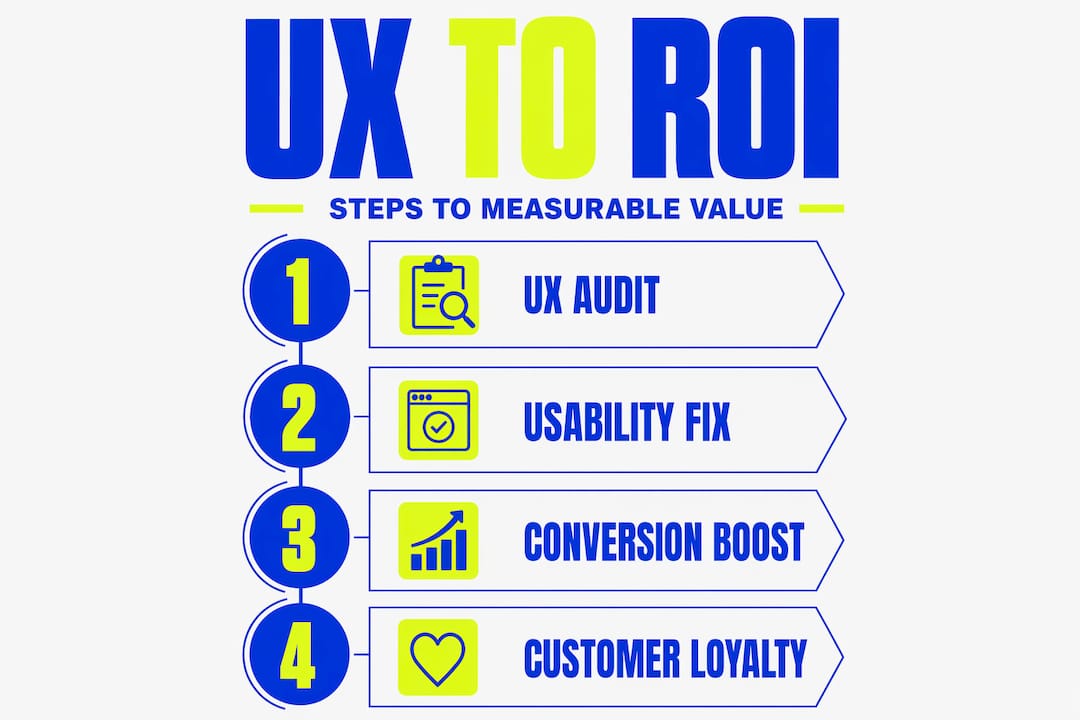
Now that managing UX responsibly is understood, let’s look at how the evolving role of UX designers supports business strategy and growth.
The evolving role of UX design in shaping business strategy
UX designers are no longer just the people who make things look user-friendly. Today, they are strategic partners who influence what gets built, why it gets built, and how it connects to business growth. If you are working with a designer or agency, you should expect this level of thinking.
Modern UX practice has shifted significantly. UX has evolved into a multidisciplinary practice that connects user needs, business goals, and technology to drive measurable outcomes. That means your UX decisions should be informed by real data, cross-team input, and a clear understanding of your commercial objectives.
Key characteristics of this evolved approach include:
- Data storytelling: UX designers now present research findings as business cases, linking user behaviour to revenue impact
- Cross-functional collaboration: The best UX work happens when designers work alongside sales, customer service, and marketing teams
- Ethical AI integration: AI tools can accelerate UX research and pattern analysis, but human judgement remains essential for nuanced, values-led decisions
- Strategic influence: UX teams now shape product roadmaps, not just individual page layouts
“User experience is not a feature. It is the foundation your entire customer relationship is built upon.”
Understanding the role of design from a strategic viewpoint, rather than a purely visual one, gives UK business owners a clear competitive advantage. Your competitors who still think of design as decoration are leaving significant revenue on the table.
With an understanding of UX’s strategic importance, let’s explore actionable steps you can take right now to improve your own customer experience.
Practical ways UK business owners can improve user experience now
You do not need a large budget or a dedicated team to start improving UX. Some of the most impactful changes are also the simplest. The key is to focus on the journeys that matter most to your customers and work outward from there.
Reducing friction in core user journeys is the fastest route to better engagement and loyalty. Start here:
- Simplify your main navigation. If a visitor cannot find your core services in under five seconds, restructure your menu immediately.
- Shorten your contact and checkout forms. Every unnecessary field is a reason to abandon the process.
- Improve your mobile experience. Over 60% of UK web traffic is mobile. If your site is clunky on a phone, you are already losing customers.
- Add clear calls to action. Every page should have one obvious next step for the visitor.
- Check your page speed. Use a free tool to measure load time. Anything over three seconds costs you visitors.
Pro Tip: Involve real users early. You can run a simple usability test with five customers over a video call. Ask them to complete a specific task on your website while thinking aloud. In under an hour, you will have more actionable insight than weeks of internal debate can produce.
| UX improvement | Primary benefit | Implementation effort |
|---|---|---|
| Simplified navigation | Reduces abandonment | Low |
| Mobile optimisation | Broadens reach | Medium |
| Faster load times | Improves engagement | Medium |
| Accessibility improvements | Wider audience, legal compliance | Medium |
| Clearer calls to action | Increases conversions | Low |
Investing in web page design that genuinely serves your users is one of the highest-return activities a UK business owner can pursue.
Having seen what actions to take, let’s consider a fresh perspective on why treating UX seriously is still misunderstood within so many organisations.
Why treating UX as a strategic asset is still overlooked: an insider’s view
Here is something that most UX articles will not tell you. The biggest barrier to good UX is not budget or technical skill. It is communication. Specifically, it is the gap between what UX research reveals and what decision-makers actually act upon.
We have seen this pattern repeatedly. A business invests in proper UX research, the findings are strong, and then the insights sit in a slide deck while the old website limps along unchanged. Even rigorous UX research can be ignored if it is not communicated well or timed appropriately. Defining a clear causal chain to business metrics is what actually secures buy-in.
The solution is to reframe UX findings in the language of the people who control the budget. Your CFO does not care that your navigation is confusing. They do care that fixing it is projected to recover £40,000 in annual abandoned checkout revenue. That reframing changes everything.
A few principles we believe every UK business owner should internalise:
- Connect UX problems to revenue loss, not just user frustration
- Time your UX proposals around business planning cycles, not design sprints
- Use postmortems after every major site change to build an evidence trail over time
- View UX as a multiplier across the entire customer journey, not a fix applied to one page
Investing in user interface design insights is far more persuasive when you can show stakeholders a clear line from UX investment to commercial outcome. That is where the real change happens.
Boost your business with professional UX and design services
If this article has made one thing clear, it is that great UX is not accidental. It is the result of intentional, informed decisions made by people who understand both design and business.
At Kukoo Creative, we have spent over a decade helping UK business owners build websites and visual identities that genuinely connect with customers. Our approach combines clear web design process thinking with an understanding of what makes users engage, return, and buy. Whether you need a full website overhaul or a sharper visual identity to complement your UX, we are here to help. You can explore our work in our design portfolio and see the results for yourself.
Working with us, you can expect:
- Expert UX and web design tailored specifically for UK businesses
- A structured process that removes guesswork and reduces risk
- Visual identity services that strengthen brand loyalty alongside UX improvements
- A genuine partnership focused on your commercial goals
Frequently asked questions
What exactly is user experience (UX) in web design?
User experience (UX) refers to how users interact with and perceive a website or digital product, including usability, clarity, and the overall journey from start to finish. As UX design defines how a person navigates a system, understands it, and completes actions without confusion or pressure, it covers far more than visual appearance.
How does good UX improve business metrics like conversions?
Good UX reduces friction and confusion, making it easier for customers to complete desired actions. UX improvements can raise conversion rates by up to 400% and improve retention by around 42%, representing a significant commercial gain for any business.
Why should UX be treated as a continuous process rather than a one-off project?
Treating UX as ongoing allows businesses to measure, learn, and iterate, using methods like postmortems to refine experiences and improve outcomes over time. NN/G recommends UX postmortems to systematically learn from what succeeded or failed and connect research to real business results.
Can small businesses in the UK benefit from investing in UX?
Absolutely. Improving UX helps small UK businesses build trust, increase customer satisfaction, and boost sales without requiring enormous budgets. Good UX helps small businesses by boosting sales, making customers happier, and building a strong brand far faster than traditional marketing alone.