
TL;DR:
- A unique selling point explains why customers choose your business over competitors and builds loyalty.
- Developing a clear, provable USP helps accelerate sales and shifts focus from price to value.
A unique selling point is defined as the specific factor, or combination of factors, that sets your business apart from competitors in a way that genuinely matters to your customers. Also known as a unique selling proposition (USP), this concept sits at the heart of every credible marketing and sales strategy. Without one, your business competes on price alone. With a strong USP, you give buyers a clear reason to choose you, and keep choosing you, long after the first sale.
How does a unique selling point influence business growth?
A clear USP accelerates buyer decisions by acting as a mental shortcut. When a prospect immediately understands why your business is the right fit, they spend less time comparing and more time committing. Research shows that clear differentiation helps buyers process purchasing decisions 20–30% faster by instantly recognising the fit of a solution. That speed translates directly into shorter sales cycles and lower acquisition costs.
The second major impact is on pricing. Businesses with a well-articulated USP shift the customer conversation from cost to value. When a buyer understands what makes your offer distinct, price becomes one factor among many rather than the deciding factor. This is the difference between defending your rates and confidently stating them.
“A true USP is evidence-backed and emotionally resonant, reflecting how a client feels after working with you. It is often captured in the pivotal moment when a prospect says, ‘You just get us.’”
The Sales Doctor
That emotional resonance is not a soft concept. It is the mechanism that turns one-time buyers into loyal advocates. A USP that connects on both a rational and emotional level builds the kind of trust that no discount can replicate.
Pro Tip: Use your USP as a filter at the top of your sales funnel. When your proposition is clear enough, wrong-fit prospects disqualify themselves before you spend time on a call. That is not lost business. That is saved time.
What are the common types of unique selling points?
USPs rarely fit a single mould. Most effective propositions combine multiple factors rather than relying on one characteristic alone. Understanding the main categories helps you identify where your natural strengths already lie.
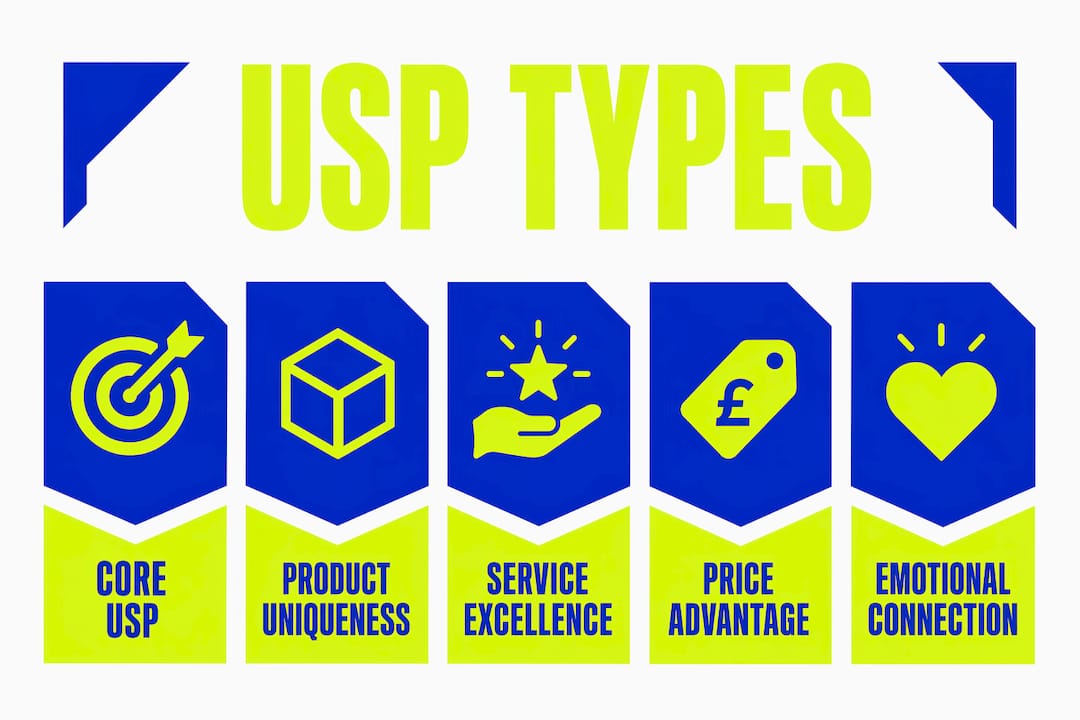
| USP category | Typical focus | Example application |
|---|---|---|
| Product uniqueness | A feature or quality no competitor offers | A patented ingredient, proprietary method, or exclusive range |
| Cost leadership | Best price or strongest value for money | Price-match guarantees or transparent flat-rate pricing |
| Specialised expertise | Deep knowledge in a narrow field | A consultant who works exclusively with one industry sector |
| Customer experience | How the service feels, not just what it delivers | Dedicated account managers, same-day responses, or onboarding support |
| Customer support | Reassurance through guarantees and policies | Strong return policies, extended warranties, or service-level agreements |
The most durable USPs sit across two or more of these categories. A business that offers specialised expertise and a distinctive customer experience is far harder to replicate than one competing on price alone. Unique product features, best-price guarantees, and curated specialist ranges all demonstrate how different businesses anchor their proposition to what their customers value most.
One framework worth applying here is the “painkiller versus vitamin” test. Painkiller USPs solve mission-critical problems. Vitamin USPs are pleasant but optional. Investors and customers alike respond far more strongly to painkillers. If your USP does not solve a real, felt problem, it is a vitamin, and vitamins get cut when budgets tighten.
How do you identify and develop a strong USP?
The most common mistake business owners make is writing their USP from the inside out. They describe what they do rather than what their customer gains. A strong proposition starts with the customer’s world, not your own.
Start by asking the right questions:
- What problem does your customer have before they find you, and how does life change after?
- What do your best clients say about you that you would never say about yourself?
- Which part of your service do clients mention most in testimonials or referrals?
- Where do competitors consistently fall short, and do you genuinely fill that gap?
- What would your ideal client lose if you closed tomorrow?
The answers to these questions reveal your USP far more reliably than any internal brainstorm. Aligning your proposition to specific customer pain points is what makes it relevant and compelling rather than generic.
Once you have a draft proposition, make it provable. A USP that cannot be backed by evidence is just a claim. Gather testimonials, case studies, data, or measurable outcomes that demonstrate the value you describe. USPs must be proven with data or social proof, not just assertions. A statement like “we respond within two hours” is far stronger than “we offer great customer service.”

You also need to be honest about what you are not. Defining your unique value means accepting that your proposition will not appeal to everyone. That is not a weakness. It is a sign that your USP is specific enough to mean something. Explore branding strategies that stand out to see how specificity creates stronger brand recognition than broad appeals.
Pro Tip: Test your USP with five existing clients before you publish it anywhere. Ask them whether it sounds like the reason they chose you. If they hesitate, revise it. Their instinct is more reliable than your assumptions.
How to communicate your USP across your business
A USP is not a tagline. It is a strategic filter that should shape every customer interaction, from your website headline to the way your team answers the phone. An effective USP saves significant time by naturally qualifying leads before formal conversations begin. That only happens when the proposition is visible and consistent across every touchpoint.
Apply your USP across these key areas:
- Website and marketing assets. Your USP should appear in your homepage headline, your about page, and your service descriptions. Visitors should understand your distinct value within seconds of arriving.
- Sales conversations. Train your team to open with the USP rather than a feature list. Lead with the outcome the client will experience, then explain how you deliver it.
- Proposals and quotes. Reinforce the proposition in writing. A proposal that echoes the USP the client heard in conversation builds confidence and reduces doubt.
- Hiring and onboarding. Your USP tells new team members what the business stands for. It sets the standard for how every client interaction should feel.
- Client communications. Every email, report, or update is an opportunity to demonstrate the USP in action rather than just stating it.
Consistency is what transforms a proposition from a marketing phrase into a genuine brand truth. When your visual branding and your verbal messaging say the same thing, clients feel it. That alignment is what makes a USP credible rather than aspirational. Personal branding works the same way. Articulating your USP through consistent personal branding signals builds authority and trust over time.
Key takeaways
A strong unique selling proposition is the single most effective tool for shifting customer conversations from price to value and accelerating growth.
| Point | Details |
|---|---|
| Define from the customer’s perspective | Base your USP on what clients gain, not what you do. |
| Make it provable | Back every claim with testimonials, data, or measurable outcomes. |
| Apply it as a strategic filter | A clear USP qualifies leads early and repels wrong-fit prospects. |
| Embed it across all touchpoints | Consistency across website, sales, and service makes the USP credible. |
| Combine multiple USP categories | Propositions built on two or more strengths are harder to replicate. |
Why most USPs fail to do their job
Working with business owners over many years, I have noticed the same pattern repeatedly. A business owner writes a USP, publishes it on their website, and then never thinks about it again. The proposition sits in a header, disconnected from how the team actually works and how clients actually feel.
The deeper problem is that most USPs are written to impress rather than to connect. They use words like “quality,” “passion,” and “excellence” because those words feel safe. They feel safe because they say nothing specific enough to be challenged. And that is exactly the problem. A USP that cannot be challenged cannot be believed.
The businesses I have seen grow fastest are the ones willing to be specific to the point of discomfort. They say things like “we only work with professional services firms with fewer than 50 people” or “we guarantee a first draft within 48 hours or you do not pay.” Those statements repel some people. They attract exactly the right ones.
The other mistake I see constantly is confusing a USP with an aspiration. “We want to be the most trusted name in our industry” is a goal, not a proposition. A real USP describes something you already deliver, not something you hope to become. Honest evaluation through the customer’s eyes, not your own, is the only reliable way to find it.
— Kukoo
How Kukoocreative helps you express your USP with confidence
Knowing your unique selling proposition is one thing. Expressing it visually and verbally, in a way that stops the right people in their tracks, is where most businesses need support.
At Kukoocreative, we have spent over a decade helping business owners translate their distinct value into brand assets that work. From logo design to full website builds, every project starts with understanding what makes your business genuinely different. We then build the visual and verbal identity that communicates that difference at every touchpoint. Your logo design is often the first impression a prospect gets of your USP. Make it count. Get in touch with Kukoocreative and let us help you build a brand that says exactly the right thing to exactly the right people.
FAQ
What is a unique selling point in simple terms?
A unique selling point is the specific reason a customer chooses your business over every alternative. It is the distinct value you offer that competitors do not, or cannot, match.
What is the difference between a USP and a slogan?
A slogan is a short phrase used in marketing. A USP is the underlying truth that a slogan may express. A slogan without a genuine USP behind it is just words.
How do I know if my USP is strong enough?
A strong USP is specific, provable, and immediately meaningful to your ideal client. If your best clients would not describe your business using the words in your USP, revise it.
Can a small business have a USP?
Small businesses often have stronger USPs than large ones because they can specialise more deeply, respond faster, and build genuine personal relationships that larger competitors cannot replicate.
How often should I review my USP?
Review your USP whenever your market shifts, your client base changes, or your offer evolves. A proposition that was accurate two years ago may no longer reflect what you actually deliver or who you best serve.