
TL;DR:
- Customer personas are detailed profiles built from real data that help businesses create personalized marketing strategies. They improve engagement, lead quality, and sales by aligning messaging and channels with customer goals, frustrations, and language. Regularly updating and including JTBD insights enhances campaign effectiveness and reduces wasted spend.
Customer personas are defined as semi-fictional profiles of your ideal customers, built from real data about behaviour, goals, and motivations. The role of customer personas is to shift your marketing from broad, generic messaging to precise, personalised communication that actually converts. Businesses that treat personas as living research tools rather than one-off documents consistently see stronger engagement and better quality leads. The ITSMA research body found that data-driven personas yield 73% higher engagement and 56% better-quality leads. Those figures alone make the case for taking persona development seriously.

What is the role of customer personas in driving marketing results?
Customer personas replace guesswork with evidence. When you know exactly who you are speaking to, every marketing decision, from ad copy to channel selection, becomes sharper and more deliberate. Personalisation removes friction and meets buyer expectations for tailored experiences, which directly improves conversion rates. Generic campaigns waste budget; persona-driven campaigns spend it where it counts.
The buyer persona, the industry’s standard term for what marketers often call a customer persona, is not a demographic sketch. It is a composite profile that captures goals, frustrations, preferred communication channels, and the language your customers actually use. That last point matters more than most marketers realise. When your copy mirrors the words your customers use to describe their own problems, trust builds faster and objections shrink.
Personas also create internal alignment. Sales teams, content writers, and paid media specialists all work from the same picture of the customer. That consistency produces a coherent brand experience across every touchpoint, which compounds over time into stronger brand recognition.
How do you create effective, data-driven customer personas?
Effective personas come from two data streams working together: quantitative and qualitative. Neither alone is sufficient.
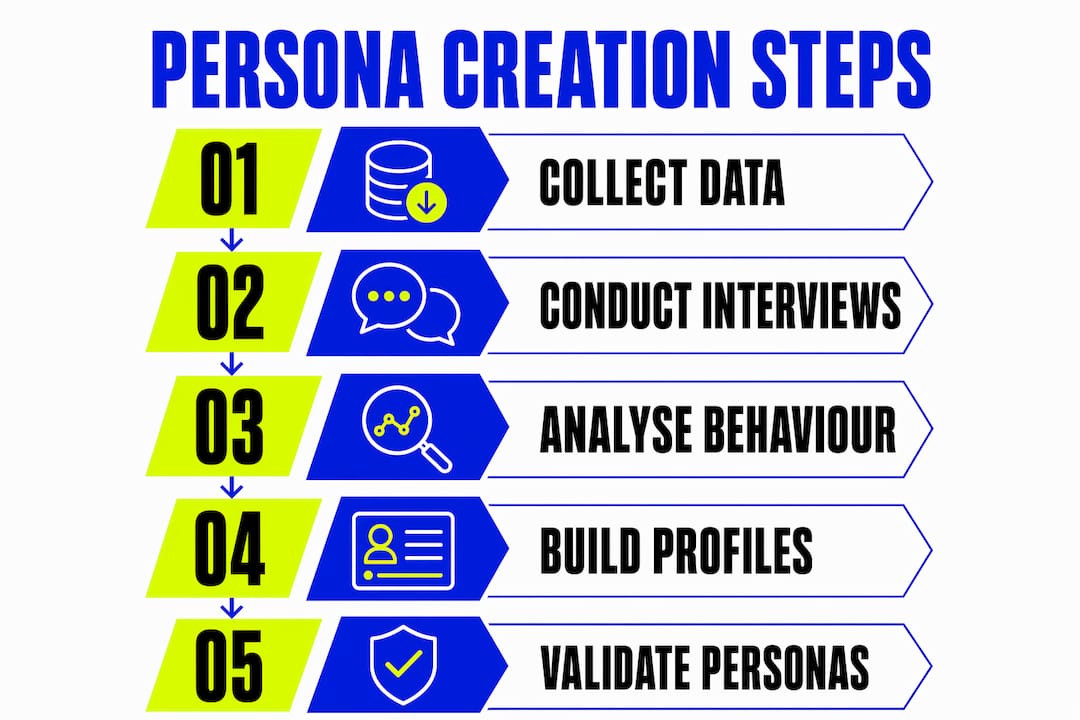
Quantitative data tells you what is happening. Qualitative data tells you why. Data sources include purchase history, CRM records, web analytics, and customer surveys. Qualitative insight comes from interviews, support transcripts, and sales call recordings. The combination gives you a profile grounded in real behaviour, not assumption.
The six core steps for building a persona are:
- Gather demographic and firmographic data from your CRM and analytics platforms to establish baseline audience characteristics.
- Conduct customer interviews with five to ten existing clients to capture goals, frustrations, and the language they use naturally.
- Analyse behavioural patterns across your website, email campaigns, and purchase history to identify what actions your best customers take.
- Map pain points and motivations by grouping interview themes into recurring problems and desired outcomes.
- Build the persona profile using a named, fictional character that represents the segment, complete with goals, objections, and preferred channels.
- Validate and update the persona against real sales outcomes and campaign performance at least once per year.
Most businesses make one critical error at step two. They skip real interviews and build personas from internal assumptions. Fictional rather than research-based personas miss the raw customer language that drives conversion. A customer who says “I need my website to look credible before I can charge premium prices” gives you copy gold that no spreadsheet will surface.
Pro Tip: Limit yourself to one or two detailed personas rather than building five or six broad ones. Persona bloat dilutes focus and makes it harder for your team to apply the insight consistently.
What are Jobs-to-Be-Done theory and negative personas?
Standard demographic personas describe who your customer is. Jobs-to-Be-Done (JTBD) theory describes what your customer is trying to accomplish and why they chose your product to help them do it. The distinction matters enormously in B2B markets, where demographics account for only around 15% of buying decisions. Motivation and evaluation criteria drive the rest.
A JTBD-enriched persona goes beyond “Marketing Manager, aged 35–44, based in Leeds.” It captures the underlying job: “I need to prove marketing ROI to my board before the next budget cycle.” That framing changes your messaging, your content topics, and even your pricing page. JTBD insights add motivational context to decision-making that demographics alone cannot provide.
Negative personas are equally powerful, and far more overlooked. A negative persona defines who you are not trying to reach: the prospect who churns quickly, demands excessive support, or simply cannot afford your service. Identifying who not to target is critical for cutting wasted ad spend and improving campaign efficiency. Many marketers skip this step entirely, which is why their cost per acquisition stays stubbornly high.
| Persona type | Focus | Primary benefit |
|---|---|---|
| Standard persona | Demographics and behaviour | Clarifies who to target |
| JTBD persona | Motivations and goals | Improves message relevance |
| Negative persona | Disqualifying characteristics | Reduces wasted marketing spend |
Pro Tip: When building a buyer persona for a B2B audience, map each stakeholder in the buying committee separately. Decision-makers, technical validators, and end users all have different jobs to be done and different objections to address.
How do you apply customer personas across marketing channels?
Personas produce their greatest return when they are embedded across every channel, not filed away after a workshop. Integrating personas into all marketing channels produces consistent messaging that aligns with the language and preferences your customers already have.
Here is how persona insight translates into channel-specific action:
- SEO: Use the exact phrases your persona uses to describe their problems as keyword targets. A persona who says “I can’t get my website to rank” tells you to target “why my website isn’t ranking” rather than “SEO optimisation services.”
- Email marketing: Segment your list by persona and tailor subject lines, offers, and content depth to each profile. A technical validator needs proof and data; a business owner needs outcomes and cost.
- PPC: Write ad copy in your persona’s language and exclude negative persona characteristics using audience targeting and negative keyword lists.
- Content creation: Map content topics to the buyer journey stage your persona occupies. Awareness-stage personas need educational content; decision-stage personas need case studies and comparisons.
- Sales alignment: Share persona profiles with your sales team so they open conversations using the same language and priorities your marketing has already established.
Personas align sales and marketing teams, improving lead quality and shortening sales cycles. That alignment is one of the most underrated customer persona benefits in the industry.
| Channel | Persona application | Outcome |
|---|---|---|
| SEO | Persona language as keyword input | Higher relevance, better rankings |
| Segmentation by persona profile | Improved open and click rates | |
| PPC | Persona-matched copy and exclusions | Lower cost per acquisition |
| Content | Journey-stage mapping | Stronger engagement at each stage |
| Sales | Shared persona briefings | Shorter sales cycles |
For consistent messaging across channels, personas must be the shared foundation that every team works from, not a document that lives only in the marketing department.
How do you keep customer personas accurate and relevant over time?
Personas are dynamic tools, not documents you create once and forget. Markets shift, customer priorities change, and your product evolves. A persona built in 2023 may actively mislead your 2026 campaigns if it has never been reviewed.
Personas require annual review and validation against campaign data and sales feedback to stay accurate. The process does not need to be a full rebuild each time. A structured review takes the existing profile and tests each assumption against recent evidence.
Practical steps for ongoing persona maintenance:
- Review campaign analytics quarterly to check whether your persona’s assumed channel preferences still match actual engagement patterns.
- Debrief your sales team monthly to capture new objections, questions, and language patterns emerging from live conversations.
- Run a short customer survey annually to validate that the goals and frustrations in your persona still reflect your current customer base.
- Update persona profiles after major product changes or market events that could shift who your ideal customer is.
- Test persona assumptions against real sales outcomes to confirm that the customers you are attracting match the profiles you have built.
Cross-team collaboration keeps personas grounded. Marketing alone cannot maintain an accurate picture of the customer. Sales, customer success, and product teams all hold pieces of the puzzle. A monthly persona review meeting with representatives from each function takes thirty minutes and prevents months of misaligned messaging.
Pro Tip: Validate persona accuracy by comparing your persona’s described pain points against the actual reasons customers cite for buying. If the two diverge, your persona needs updating before your next campaign launches.
Key takeaways
Customer personas built from real data, enriched with JTBD motivations, and embedded across every marketing channel produce measurably better engagement, lead quality, and sales alignment than generic audience targeting.
| Point | Details |
|---|---|
| Define personas from real data | Use CRM records, interviews, and behavioural analytics rather than internal assumptions. |
| Limit persona volume | One or two detailed profiles outperform five or six broad ones for campaign focus. |
| Add JTBD motivation layers | Capture what customers are trying to achieve, not just who they are demographically. |
| Build negative personas | Define who you are not targeting to cut wasted spend and improve acquisition efficiency. |
| Review personas annually | Validate profiles against campaign data and sales feedback to keep messaging accurate. |
Why I think most businesses underuse their personas
The most common mistake I see is not failing to create personas. It is creating them and then leaving them in a slide deck. Teams spend a day in a workshop, produce a beautifully formatted profile, and then write their next campaign from gut instinct anyway. The persona never makes it into the briefing document, the keyword list, or the email subject line.
The second mistake is building personas around a single decision-maker when the actual buying process involves four or five people. B2B buying committees include champions, economic buyers, technical validators, end users, and gatekeepers. Each has a different job to be done and a different objection to overcome. A single persona cannot serve all of them. Mapping each role separately feels like more work upfront, but it cuts the number of stalled deals significantly.
The third mistake is treating qualitative data as a nice-to-have. The exact words a customer uses in an interview are worth more than any demographic report. When you hear a client say “I felt embarrassed showing my old logo to potential customers,” that sentence belongs in your persona verbatim. It will write your next headline for you.
Personas only earn their keep when they are connected to measurable outcomes. Link every persona to a conversion goal, a cost per lead target, or a sales cycle length. When you can show that persona-aligned campaigns outperform generic ones on those metrics, the whole organisation starts taking the work seriously. That is when human-centric design thinking and persona strategy start compounding into real competitive advantage.
— Kukoo
How Kukoocreative helps you put personas to work in your brand
Understanding your customer is only half the equation. The other half is expressing that understanding through design and messaging that your audience immediately recognises and trusts. At Kukoocreative, we have spent over a decade helping business owners translate customer insight into brand recognition that converts. Every logo, website, and visual identity we create starts with a clear picture of who the client is trying to reach and what that person needs to feel confident enough to buy.
If you are ready to build a brand that speaks directly to your best customers, our branding and design services are built around exactly that kind of persona-driven thinking. Let’s create something your customers will recognise, trust, and choose.
FAQ
What is the role of customer personas in marketing?
Customer personas define who you are targeting so that every marketing decision, from copy to channel selection, is grounded in real customer behaviour rather than assumption. They shift marketing from generic to personalised, which improves both engagement and conversion rates.
How many customer personas should a business create?
Most businesses perform better with one or two detailed personas than with five or six broad ones. Limiting persona volume keeps your team focused and prevents diluted, inconsistent messaging across campaigns.
What is the difference between a buyer persona and a negative persona?
A buyer persona describes your ideal customer and guides who to target. A negative persona describes the characteristics of prospects you should not pursue, helping you cut wasted spend and improve campaign efficiency.
How often should customer personas be updated?
Personas should be reviewed and validated at least once per year, using campaign analytics, sales feedback, and fresh customer interviews to check that the profile still reflects your current best customers.
What is Jobs-to-Be-Done theory and why does it improve personas?
Jobs-to-Be-Done (JTBD) theory focuses on the underlying motivation behind a purchase rather than demographic characteristics alone. Adding JTBD insight to a persona makes your messaging more relevant because it addresses what the customer is actually trying to achieve, not just who they are.