
TL;DR:
- Small businesses can improve Google rankings with a clear, ongoing SEO strategy and minimal budget.
- Optimizing local keywords, website elements, and business listings boosts local visibility and attracts nearby customers.
- Consistent content, backlinking, and regular profile management build authority and sustain long-term growth.
You’ve built a fantastic business, but your website is sitting on page three of Google, invisible to the very customers searching for you right now. It’s one of the most common frustrations we hear from UK small business owners, and it’s completely fixable. SEO, which stands for search engine optimisation, levels the playing field. You don’t need a massive budget or a full marketing team. What you do need is a clear, step-by-step roadmap and the confidence to follow it. This guide gives you exactly that, walking you through every stage from setup to authority building so you can attract more local customers and grow with purpose.
Table of Contents
- Essential prerequisites and tools for SEO success
- Step 1: Find the right local keywords for your audience
- Step 2: Optimise your website for search engines
- Step 3: Master local SEO and business listings
- Step 4: Earn authority through content and links
- Our perspective: why most small business SEO efforts stall
- Ready to grow your online presence?
- Frequently asked questions
Key Takeaways
| Point | Details |
|---|---|
| Start with local keywords | Focus on long-tail and location-based phrases to attract ready-to-buy local customers. |
| On-page and technical fixes matter | Small tweaks to titles, meta tags, and mobile speed improve your site’s rank and user experience. |
| Google Business Profile is essential | Optimise your listing and respond to reviews quickly for maximum local visibility and trust. |
| Content and links build authority | Create valuable local content and earn links from trusted sources to boost your Google rankings. |
Essential prerequisites and tools for SEO success
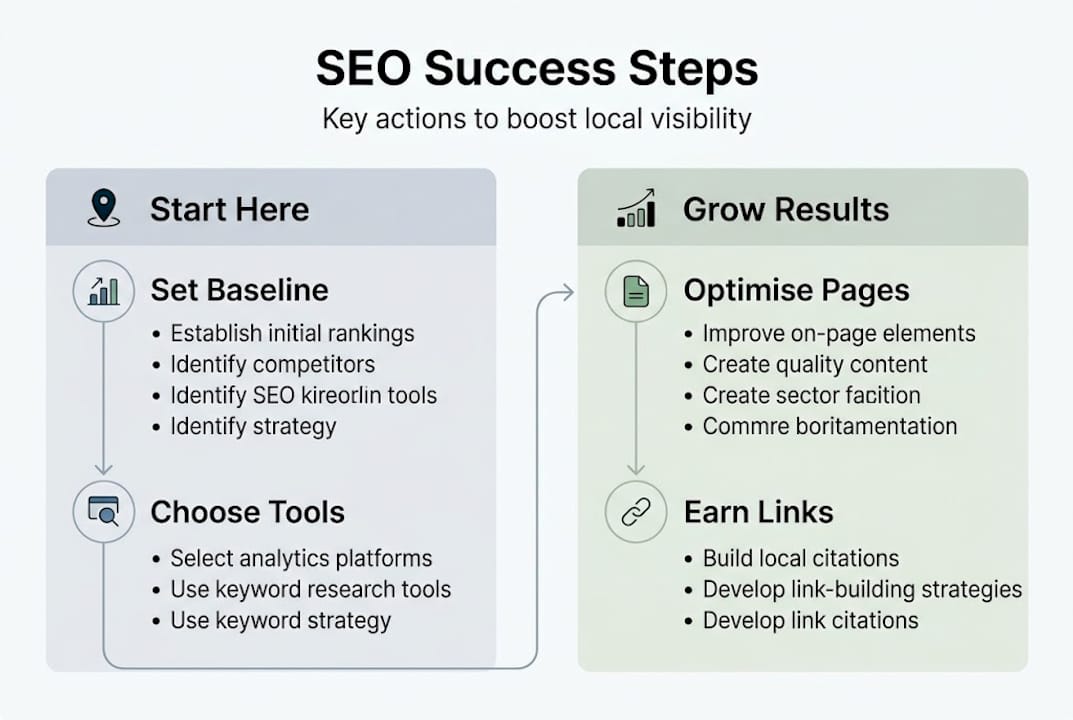
With the big picture in mind, let’s start with the tools and groundwork needed before diving into the practical steps. Getting prepared properly saves you weeks of rework later.
Before you touch a single page on your website, gather these essentials:
- Website access: CMS login (WordPress, Wix, Squarespace, or similar)
- Google accounts: Google Analytics 4 (GA4), Google Search Console (GSC), and Google Business Profile
- Business details: Your full NAP (name, address, phone number) written consistently
- Branding assets: Logo files, brand colours, and approved imagery
Once you have those ready, choose your tools. You don’t need to spend a penny to get started. Free tools like GA4, GSC, and Keyword Planner are ideal starting points for small businesses beginning their SEO journey. For more advanced tracking, paid tools like Semrush or Ahrefs offer deeper insights once you’re ready to invest.
| Tool | Cost | Best for |
|---|---|---|
| Google Analytics 4 | Free | Traffic and behaviour tracking |
| Google Search Console | Free | Rankings and indexing issues |
| Google Keyword Planner | Free | Keyword research |
| Semrush | Paid | Competitor and audit analysis |
| Screaming Frog | Free/Paid | Technical site crawls |
Setting a baseline is crucial. Before making any changes, record your current organic traffic, average keyword rankings, and conversion rate. These numbers tell you what’s actually working three months from now. We also recommend exploring the best local SEO tools to find options tailored to UK businesses. You can find broader SEO for Small Business resources to complement your toolkit.
Pro Tip: Set up your Google Business Profile on day one and commit to responding to every customer review within 24 hours. Google rewards active, engaged profiles with better local visibility.
Step 1: Find the right local keywords for your audience
Once your toolkit is in place, the first execution step is targeting keywords your customers are actually searching. Guessing won’t cut it. Research will.
Keywords fall into three useful categories:
- Primary keywords: Your core service (e.g. “plumber in Manchester”)
- Secondary keywords: Related terms (e.g. “boiler repair” or “emergency plumber”)
- Long-tail local keywords: Specific phrases (e.g. “affordable boiler repair in Salford”)
To research effectively, open Google’s Keyword Planner and type in your main service. Note search volumes and competition levels. Then visit two or three competitor websites and look at the language they use in headings and page titles. That’s free intelligence you can act on immediately.
Focusing on long-tail, location-based keywords powers local search visibility for UK small businesses. These phrases face less competition and attract buyers who are much closer to making a decision.
Be careful about keyword stuffing. Google penalises pages that cram keywords unnaturally into content. Write for people first and search engines second.
| Strategy | Competition | Best use |
|---|---|---|
| Broad keyword | Very high | Brand awareness pages |
| Niche keyword | Medium | Service category pages |
| Hyper-local keyword | Low | Town or neighbourhood pages |
Think about how generative search insights are shifting what people type into search engines. Conversational, question-based searches are on the rise, so include natural language phrases in your content. When structuring your website, organise pages around these keyword groups to signal clear topic relevance to Google.
Pro Tip: Add a location modifier to every key service page. “Graphic design services” becomes “graphic design services in Leeds.” It’s a small change with a significant impact on local rankings.
Step 2: Optimise your website for search engines
With your keywords in hand, the next move is getting your website pages search-friendly and technically sound. This is where many small business websites quietly lose rankings without their owners realising it.
Start with on-page elements:
- Title tags should be under 60 characters, meta descriptions under 155 characters, and H1/H2 tags must use primary keywords naturally
- Each page needs one unique H1 tag containing your primary keyword
- Internal links connect related pages and help Google understand your site structure
- Image alt text should describe the image and include relevant keywords where natural
Next, tackle technical SEO:
- Site speed: Slow pages cost you rankings and customers
- Mobile-friendliness: Test every page on a phone, not just a desktop
- HTTPS: Google flags non-secure sites, which destroys visitor trust
- XML sitemap: Submit yours via Google Search Console so Google indexes you faster
- Schema markup: Structured data helps Google display rich snippets like star ratings
Stat to know: Mobile site speed remains 30% behind desktop average in the UK, directly impacting rankings. If your mobile pages load slowly, you’re already at a disadvantage.
Avoid these common pitfalls: duplicate content across location pages, inconsistent NAP details, and thin pages with fewer than 300 words. Each one quietly erodes your authority. For hands-on guidance, our team can help you improve site rankings with a structured approach. You’ll also find that writing effective web copy goes hand-in-hand with strong on-page SEO.
Pro Tip: Run your key pages through Google PageSpeed Insights for free. It produces a prioritised list of fixes you can action today, no developer needed for most of them.
Step 3: Master local SEO and business listings
Beyond your homepage, dominating local search requires active management of your business’s online presence. This is where small businesses can genuinely outperform larger national competitors.

46% of all searches have local intent. That means nearly half of everything people search for on Google is location-related. Your Google Business Profile is your single most powerful tool for capturing that traffic.
Here’s what a fully optimised profile looks like:
- Business name, address, and phone number exactly matching your website
- A complete list of services with descriptions
- High-quality photos of your premises, team, and work
- Accurate business hours, including holiday hours
- Regular posts about offers, events, or news
Consistency is non-negotiable. Your NAP must be identical across every listing, including Yell, Thomson Local, Yelp, and your own website. Even minor differences, such as “St.” versus “Street,” confuse Google and dilute your local rankings.
“We updated our Google Business Profile with fresh photos and started replying to every review. Within two months, our calls from Google doubled.” A real outcome from a small business that took local SEO seriously.
For more detailed business listing tips, explore how directories and citations build trust with Google. Pair that with your broader top local marketing strategies to create a joined-up local presence.
Pro Tip: Assign one person in your team to monitor and respond to reviews daily. A business that replies promptly signals trustworthiness to both Google and potential customers.
Step 4: Earn authority through content and links
Solid site foundations and local reach now set the stage for building trust and increasing your domain’s authority. This is the long game, and it’s where the biggest rewards live.
Content clusters are your friend. Group pages around a central theme, such as a main “plumbing services” page supported by blog posts on boiler maintenance, pipe repairs, and local water quality. This structure tells Google you are the go-to expert in your field.
For link building, focus on quality over quantity:
- Local associations: Chambers of commerce, trade bodies, and local business networks
- Partners and suppliers: Ask for a mention on their websites
- Local press: Write a comment piece or share a story about your community involvement
- Industry directories: Relevant, reputable listings carry real weight
Prioritising Experience, Expertise, Authoritativeness, and Trustworthiness is central in 2026, and link-building from reputable local sources is key to demonstrating all four. Google calls this EEAT, and it rewards businesses that prove their credibility through real, verifiable signals.
Avoid any temptation to buy links or post on irrelevant directories. These tactics can trigger manual penalties that take months to recover from. The FSB SEO tips resource is an excellent starting point for understanding ethical link-building. Showcasing team backgrounds, client testimonials, and case studies also strengthens your EEAT profile considerably. Read more about how the benefits of professional branding support your online authority signals.
Pro Tip: Create a local guide, such as “The best independent shops in Bristol,” or a community story relevant to your industry. These pieces attract natural links from local blogs, councils, and news sites without any outreach needed.
Our perspective: why most small business SEO efforts stall
We’ve worked with hundreds of UK small business owners over the past decade, and the pattern is consistent. Business owners start strong, fix their titles and meta descriptions, claim their Google Business Profile, and then stop. They wait for results that feel too slow, lose momentum, and quietly abandon the process.
Here’s the uncomfortable truth: SEO is not a one-off project. It is an ongoing commitment, closer to customer service than a website redesign. The businesses we see thriving in local search treat their content, listings, and links as living assets that need regular attention.
The other mistake we see is chasing rankings for the wrong keywords. A florist in York doesn’t need to rank for “flowers UK.” She needs to rank for “wedding florist in York” and “same-day bouquet delivery York.” Hyper-local specificity consistently outperforms broad ambition for small business websites.
Finally, stop separating SEO from your brand. A credible brand presence, strong visuals, and consistent messaging make every SEO signal stronger. When visitors land on your site and feel an instant sense of trust and quality, they stay longer, engage more, and convert. Those behavioural signals feed directly back into your rankings. Your brand and your SEO strategy should be building each other up, not running on separate tracks.
Ready to grow your online presence?
If this guide has shown you where the gaps are in your current approach, you’re already ahead of most of your competitors. The steps above are actionable, but they work best when your website and brand are set up to convert the traffic you attract.
At Kukoo Creative, we’ve spent over a decade helping UK small businesses build credible, search-friendly websites that people genuinely want to use. From website design and copywriting to Google rankings and local SEO strategy, we bring everything together under one roof. Whether you’re starting from scratch or refreshing an existing site, we’d love to be the partner that helps you build your success story online. Get in touch today and let’s talk about what’s possible for your business.
Frequently asked questions
How long does it take to see SEO results for a small business?
SEO typically takes 6 to 12 months for meaningful results, as improvements compound gradually over time. Unlike paid advertising, the gains you build through SEO continue to grow even after you stop actively investing.
What are the top free SEO tools UK business owners can use?
Google Analytics 4, Google Search Console, and Keyword Planner are the best free tools for starting local SEO efforts. Tracking organic traffic and keyword rankings from the beginning helps you measure what’s working.
Why does my business not appear in local Google searches?
Common reasons include an incomplete Google Business Profile, inconsistent NAP details across directories, or a lack of local keywords on your pages. Consistent citations in UK directories like Yell and Thomson Local are a quick win worth addressing immediately.
Is it bad to have too many similar location pages?
Yes. Thin or duplicate location pages can hurt your rankings and are penalised by Google. Each location page should offer unique, genuinely useful content relevant to that specific area.