
What does client onboarding actually involve?
Client onboarding is the structured process of welcoming new clients into your business while laying the legal and relational foundations for everything that follows. Get it right, and you set the tone for a confident, productive partnership. Get it wrong, and you risk losing clients before the real work even begins.
In the UK, onboarding carries a dual responsibility. On one side, there is the operational setup: collecting client data, signing contracts, setting expectations, and integrating clients into your systems. On the other, there are firm legal obligations that must be satisfied before work commences.
UK businesses must comply with three key frameworks:
- Money Laundering Regulations 2017 — requiring identity verification and Know Your Customer (KYC) checks before engaging clients in regulated sectors
- GDPR — governing how you collect, store, and process personal data, with explicit consent required at intake
- Consumer Rights Act — obliging businesses to provide clear, transparent terms before any service agreement is signed
Beyond compliance, a well-run onboarding process typically includes conflict of interest checks, engagement letter execution, risk assessment, payment setup, and a structured welcome that tells the client exactly what to expect next. Each of these steps reduces friction and builds confidence from day one.
Why client onboarding matters for UK businesses today

Poor onboarding is the top predictor of early client churn in professional services. That is not a minor operational footnote. It means the quality of your onboarding process directly determines whether clients stay or quietly disappear after the first few weeks.
The importance of client onboarding goes well beyond a good first impression. Here is what is genuinely at stake:
- Retention starts at intake. Clients who experience a clear, professional onboarding process feel reassured they made the right choice. Those who face confusion, repeated requests for the same information, or long silences start questioning it.
- Compliance failures carry real penalties. Neglecting AML checks, GDPR consent, or transparent contractual terms under the Consumer Rights Act exposes your firm to regulatory sanctions. These are not theoretical risks.
- Time-to-first-value drives loyalty. Firms that automate onboarding reduce administrative hours and get clients to their first meaningful outcome faster, which directly boosts retention.
- Brand reputation is shaped early. A clunky, paper-heavy process signals disorganisation. A polished, digital experience immediately reinforces confidence in your capabilities.
- Profitability follows trust. Clients who feel well-supported from the start are far more receptive to additional services over time.
The startup checklist for UK businesses makes a similar point: getting your compliance and client processes right from the outset protects your reputation and your bottom line.
How the 4 C’s framework shapes effective onboarding
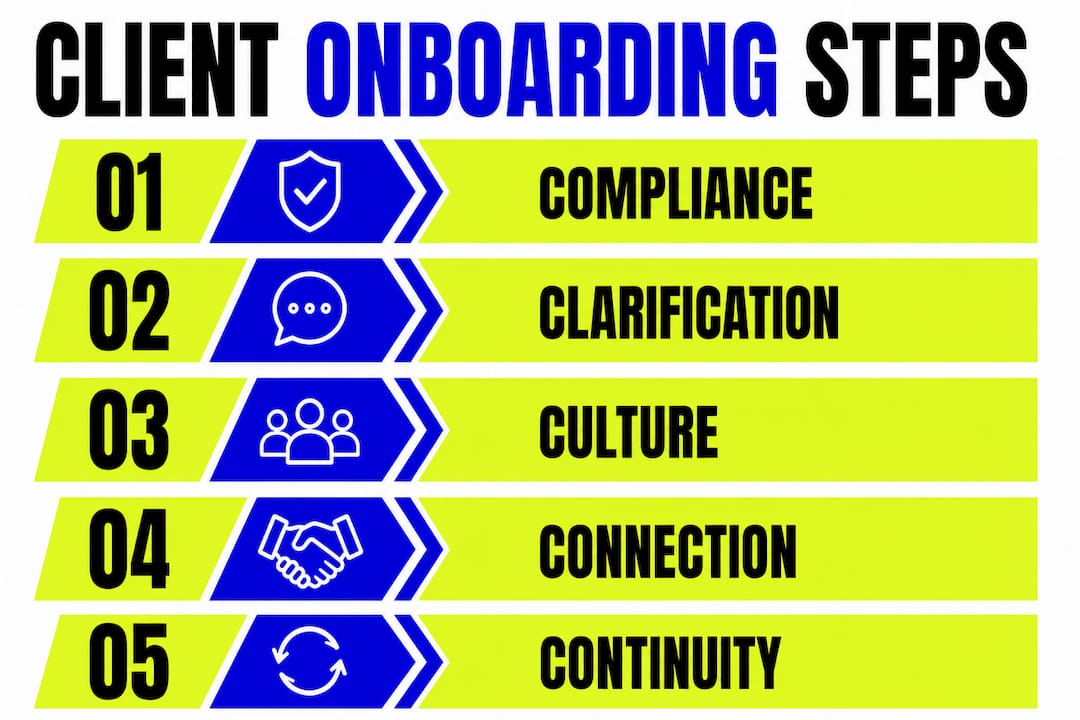
The 4 C’s of onboarding give UK businesses a practical structure that balances legal protection with a genuinely positive client experience. Each “C” addresses a distinct layer of the process.
Compliance covers the legal and regulatory requirements that must be met before work begins. In the UK, this means KYC and AML checks under the Money Laundering Regulations 2017, GDPR-compliant data collection, and transparent terms under the Consumer Rights Act. Embedding compliance into the front end of onboarding prevents the administrative friction that comes from siloed, post-hoc checks. Clients who receive a single, well-designed intake form rather than a series of disconnected requests experience a far smoother process.
Clarification is about setting expectations clearly and early. This means defining scope, fees, timelines, communication preferences, and what success looks like for the client. Skipping this step creates misalignment that is expensive to correct later.

Culture introduces the client to how your business operates. Your values, your working style, your team structure. This is where the relationship moves from transactional to collaborative, and where clients begin to feel genuinely welcomed rather than processed.
Connection is the practical integration layer: provisioning system access, setting up shared workspaces, assigning account contacts, and creating the project or file structure the client will use. Done well, it signals organisation and care.
Pro Tip: Treat compliance as a front-end design challenge, not a back-office task. When your intake form is built to collect KYC documents, GDPR consent, and conflict checks in one clean flow, clients experience it as professionalism rather than bureaucracy. Siloed compliance checks sent separately signal unprofessionalism and create redundant requests.
When you use the 4 C’s to structure client onboarding for trust, you create a process that satisfies regulators and impresses clients at the same time.
What does a client onboarding officer actually do?
The client onboarding officer is the person who holds the compliance and relationship threads together. In UK professional services firms, particularly law firms and financial services businesses, this role is increasingly formalised and carries genuine operational weight.
At its core, the role is a hybrid of risk management and client support. Onboarding officers combine KYC and AML responsibilities with the day-to-day task of making clients feel supported through the intake process. That dual focus is what makes the role so valuable: it prevents compliance failures while preserving the client experience.
Key responsibilities typically include:
- Conducting due diligence and KYC/KYB checks on new clients and related parties
- Running sanctions, PEP, and adverse media screening
- Preparing client risk assessments and Customer Due Diligence (CDD) packs
- Investigating and managing conflicts of interest
- Acting as the internal subject matter expert on onboarding compliance
- Maintaining audit trails and documenting decisions in client files
- Providing guidance to colleagues on SRA Standards, AML regulations, and sanctions regimes
The skills that make someone excellent in this role go beyond technical knowledge. Strong analytical ability, clear written and verbal communication, and the confidence to make decisions autonomously are all critical. A dual focus on compliance and client support helps maintain both operational efficiency and the firm’s reputation for integrity.
For regulated professions looking to balance legal rigour with a positive client experience, Marzipan’s approach for regulated professions offers a useful perspective on structuring compliance without sacrificing quality.
How does strong onboarding improve client retention?
Onboarding is the inflection point where clients decide whether their initial decision to work with you was the right one. A confident, well-structured experience reinforces that decision. A disorganised one plants doubt that rarely goes away.
Poor onboarding is the leading driver of early client churn in professional services. The first few weeks after a client signs are the most critical window for demonstrating value and building trust. Miss that window, and retention becomes an uphill battle.
Here is what genuinely moves the needle on retention:
- Early wins. Clients need to see proof of value quickly. Whether that is a completed compliance check, a delivered first report, or a well-run kickoff call, early tangible outcomes reinforce confidence.
- Proactive communication. Silence after signing is one of the fastest ways to lose a client. Regular, structured updates during onboarding signal that you are organised and invested.
- Training and guidance. Clients who understand how to work with you, what to expect, and how to get the most from the relationship are more engaged and less likely to churn.
- Automation for consistency. Automating onboarding reduces errors, speeds up time-to-first-value, and ensures every client receives the same quality of experience regardless of which team member handles the intake.
Client satisfaction alone is not enough. Retention improves when onboarding proactively invests in client success through structured communication, clear milestones, and early demonstrations of competence. A strong onboarding process boosts retention and client lifetime value in ways that no amount of reactive account management can replicate.
How Kukoocreative connects onboarding with brand building
The first impression a client forms during onboarding is not just about your process. It is about your brand. Every document they receive, every email they open, every portal they log into either reinforces your credibility or quietly undermines it.
Kukoocreative has spent over a decade helping UK business owners build brand identities that work hard across every client touchpoint, including onboarding. A branded welcome pack, a visually consistent engagement letter, a well-designed client portal: these are not cosmetic extras. They are signals that tell your client you are serious, professional, and worth trusting.
Here is how to align your onboarding materials with your brand identity:
- Use consistent visual language. Your onboarding documents, email templates, and digital forms should share the same colour palette, typography, and logo placement as your website and marketing materials.
- Write in your brand voice. A welcome email that sounds warm and confident sets a very different tone from one that reads like a legal notice. Match the register to the relationship you want to build.
- Design for clarity. Well-structured intake forms and checklists reduce client anxiety and signal competence. Poor layout creates confusion before the work has even started.
- Reinforce your values. If your brand stands for creativity, transparency, or precision, let that show in how you communicate during onboarding. Clients notice when words and actions align.
Pro Tip: Use your onboarding sequence as a storytelling opportunity. A short, well-designed welcome guide that explains your process, introduces your team, and sets out what success looks like does three things at once: it reduces client anxiety, it reinforces your brand personality, and it creates the conditions for genuine advocacy later. Clients who feel genuinely welcomed become your best referrers.
Strong visual brand identity shapes how clients perceive your business from the very first interaction. If your onboarding materials do not reflect the quality of your work, you are leaving trust on the table. Kukoocreative can help you build onboarding assets that make the right impression every time.
The 5 C’s of onboarding: going one step further
The 4 C’s framework covered above gives you a solid foundation. The 5 C’s model extends it by adding a fifth dimension that many UK businesses overlook: Continuation.
The first four C’s (Compliance, Clarification, Culture, and Connection) address what happens during the formal onboarding window. Continuation addresses what happens after it closes. Onboarding should not be treated as a one-time event that ends when the engagement letter is signed. It is better understood as a lifecycle, with the first 2–4 weeks representing the critical first-value milestone phase that determines long-term retention.
In practice, Continuation means:
- Scheduling a structured check-in at the end of the formal onboarding period to confirm the client feels settled and supported
- Setting up ongoing monitoring processes (particularly for regulated firms with AML obligations)
- Transitioning smoothly from onboarding mode to relationship management mode, with clear handoffs and documented client preferences
- Using onboarding data to personalise future communications and service recommendations
The 5 C’s model is particularly relevant for UK professional services firms where regulatory monitoring does not stop at intake. Ongoing KYC reviews, sanctions rescreening, and risk reassessment are all part of the compliance picture, and they need to be built into the client lifecycle from the start.
Together, the five elements create an onboarding process that is not just a checklist but a genuine foundation for a long-term, trust-based client relationship.
Key takeaways
Effective client onboarding in the UK requires compliance with the Money Laundering Regulations 2017, GDPR, and the Consumer Rights Act, combined with a structured client experience that builds trust and drives long-term retention.
| Point | Details |
|---|---|
| Compliance is non-optional | UK onboarding must satisfy KYC, AML, GDPR, and Consumer Rights Act obligations before work begins. |
| Poor onboarding drives churn | Poor onboarding is the top predictor of early client churn in professional services. |
| The 4 C’s provide structure | Compliance, Clarification, Culture, and Connection balance legal demands with a positive client experience. |
| Automation improves consistency | Firms that automate onboarding reduce administrative hours and improve time-to-first-value, boosting retention. |
| Brand identity matters at intake | Consistent, well-designed onboarding materials reinforce credibility and set the tone for the entire client relationship. |