
Many Leeds business owners believe a logo is one fixed image used everywhere, but the reality is far more dynamic. As digital platforms multiply, keeping your brand instantly recognisable has become a real challenge. A responsive logo system creates related variations that adapt beautifully across devices, helping your business stay clear and consistent on everything from mobile phones to printed flyers. Consistent visual identity is key to attracting trust and standing out in competitive creative sectors.
Table of Contents
- Defining Responsive Logos and Common Myths
- Types of Responsive Logo Variations for 2026
- How Responsive Logos Enhance Brand Recognition
- Real-World Benefits for Leeds Small Businesses
- Mistakes to Avoid with Responsive Logo Design
Key Takeaways
| Point | Details |
|---|---|
| Responsive logos consist of multiple variations | They adapt to different contexts, preserving brand identity while enhancing clarity and user experience. |
| Consistent branding builds trust and recognition | A unified logo presence across platforms strengthens brand familiarity and customer confidence. |
| Testing across devices is essential | Proper cross-device testing ensures logos maintain visibility and recognisability in all applications. |
| Plan before designing variations | Assess all contexts your logo will appear in to inform effective responsive logo design. |
Defining Responsive Logos and Common Myths
Responsive logos are fundamentally different from what most Leeds business owners assume. They’re not simply smaller versions of your main logo squeezed onto mobile screens. Instead, responsive logos adapt their composition across different digital environments, scaling and restructuring themselves whilst maintaining your brand’s core identity. Think of it like how a restaurant menu changes format between a printed version and a smartphone display—the content remains yours, but the presentation transforms to suit the medium.
Let’s clear up the biggest myths straight away. The most common misconception is that a responsive logo is just one static design that shrinks and grows. In reality, you’re working with a family of related logo variations designed specifically for different contexts. Your full horizontal logo might work beautifully on a desktop website. However, that same design becomes illegible when compressed into a social media profile picture or a 16×16 favicon. Responsive design solves this by creating purpose-built versions—a stacked version, a single-letter mark, a simplified icon—each optimised for its specific use. They’re all recognisably yours. Yet each one functions independently in its own environment.
Another myth worth debunking: responsive logos require constant redesigning or indicate that your original logo was flawed. That’s simply not true. A well-executed responsive logo system shows strategic thinking and professional maturity. You’re acknowledging that digital channels have changed how people encounter your brand. A Leeds creative agency, a digital marketing consultancy, a local craft brewery—each benefits from having logo variations that work across Instagram stories, Google Business profiles, email signatures, and printed materials. Your brand identity remains consistent, but its expression becomes smarter.
The technical reality is straightforward. Your responsive logo system gives you multiple versions of one core mark, each crafted for particular applications. Some versions simplify details that disappear at small sizes. Others remove text elements that become unreadable. The best systems include clear guidelines about when to use each version—something that protects your brand consistency across all touchpoints. This isn’t complexity for complexity’s sake. It’s practical design that respects both your brand and your audience’s user experience.
Here is a comparison of common myths versus the realities of responsive logo design:
| Misconception | Reality | Business Impact |
|---|---|---|
| One static logo resizes for all uses | Multiple tailored variations needed | Better clarity across devices |
| Redesigning means initial logo failed | Adaptation shows strategic branding | Demonstrates professionalism |
| Variations weaken brand identity | Smart adaptation maintains recognition | Increases audience trust |
Pro tip: Start by auditing where your logo appears right now—your website, social media, printed materials, email signatures, favicon. Notice which applications feel cramped or unclear. These are precisely the places where responsive logo variations would make the biggest difference to how potential customers perceive your brand.
Types of Responsive Logo Variations for 2026
When you design a responsive logo system, you’re not starting from scratch. You’re working within established logo categories and creating variations that work across platforms. Eight main logo types exist—wordmarks, lettermarks, pictorial marks, abstract marks, mascots, emblems, combination marks, and letters inside shapes. Each category serves different purposes, and understanding which one suits your Leeds business is crucial before you build responsive versions.
Wordmarks and lettermarks translate beautifully into responsive systems. A wordmark uses your business name as the logo itself. When you shrink it down for mobile, the text becomes your primary concern. You might create a simplified version that uses fewer letterforms or a bold, condensed variation. Lettermarks take this further by using just one or two letters. Your initials become your icon. For a Leeds design studio or consultancy, a single bold letter works perfectly as a favicon or profile picture, then expands into your full lettermark on larger screens. Pictorial marks—think a recognisable symbol or icon representing your business—work differently. They’re naturally scalable because they’re already simplified visual elements. The responsive challenge here isn’t about making them smaller. It’s ensuring they remain recognisable and distinctive when placed next to other small icons in crowded app interfaces.

Abstract marks and combination marks require more strategic thinking. An abstract mark is a unique geometric shape or pattern that represents your brand. When designing responsive versions, you simplify colour palettes or remove intricate details that disappear at small sizes. Combination marks blend text with imagery. These are common for established Leeds businesses because they communicate both visually and verbally. Your responsive system might show the full combination mark on your website, the icon alone on social media, and just the lettermark in your email signature. Mascots work similarly to pictorial marks but with personality. A mascot character needs consistent proportions across sizes, so your responsive variations maintain the character’s essential features whilst adjusting details.
This summary outlines key responsive logo types and their best suited applications:
| Logo Type | Ideal Use Case | Notable Benefit |
|---|---|---|
| Wordmark | Website headers, signage | Strong name recognition |
| Lettermark | Favicons, app icons | Maximum clarity at small sizes |
| Pictorial Mark | Mobile apps, social profiles | Immediate visual impact |
| Combination Mark | Printed materials, digital headers | Versatile for multiple contexts |
Practical Applications for Your Business
The 2026 trend emphasises logos that balance clarity with versatility. Your responsive logo system should include at least three versions. First, your primary logo—the full, detailed version for your website header. Second, a stacked or secondary version for narrower spaces like email signatures. Third, an icon or mark for tiny applications like favicons and social media profile pictures. If you’re updating your existing business logo, consider which of these eight types best represents your brand identity and build your responsive variations accordingly.
Pro tip: Test each logo variation at actual size on the devices your customers use—check how your favicon appears in a browser tab, how your profile picture reads on mobile, and how your full logo looks on desktop. What reads clearly on your designer’s monitor might become muddy at thumbnail size, revealing where you need to adjust your responsive system.
How Responsive Logos Enhance Brand Recognition
Brand recognition isn’t about having a logo. It’s about having a logo that appears consistently wherever your customers encounter you. Responsive logos enhance brand recognition by adapting across diverse interfaces while maintaining visual consistency. When a potential customer sees your logo on your website, then recognises the same mark on their Instagram feed, then spots it again on a leaflet at a local networking event in Leeds, something powerful happens in their mind. That logo becomes familiar. Trustworthy. Real. A static logo that works beautifully on desktop but turns into an unreadable mess on mobile fractures that experience. Responsive logos eliminate that friction.
Consider how Leeds customers move between devices throughout their day. They check your social media on their phone during breakfast. They visit your website on their desktop at work. They see your email signature on their tablet in the evening. They might encounter your printed materials at a trade show. With a non-responsive logo, each touchpoint looks slightly different. Your favicon is blurry. Your email signature feels cramped. Your social media profile picture is illegible. Your customers notice these inconsistencies consciously or unconsciously. They question whether the experience is professional. A responsive logo system ensures that every version of your mark looks intentional and polished, no matter the context. This consistency builds recognition faster because your brain processes familiar patterns more easily.
The recognition boost works deeper than just visual consistency. When your logo appears in multiple forms across platforms, your brain builds stronger associative pathways. Psychologically, exposure through varied contexts increases brand recall more effectively than repeated exposure to a single format. A Leeds creative agency that maintains a bold icon on social media, a lettermark in email signatures, and a full combination mark on their website creates multiple memory anchors. Customers remember the icon. They remember the initials. They remember the full version. Each variation reinforces the others. The role of logos in branding extends beyond aesthetics into cognitive psychology and user experience design.
This multimodal recognisability also means your brand remains visible and memorable in contexts where a static logo would fail. Tiny favicons in browser tabs need to work differently than large header logos. Social media profile pictures operate in crowded feeds of similar-sized circles. Email templates demand legibility at specific widths. Responsive logos solve each challenge uniquely whilst maintaining your core identity. The result is a brand that feels present, professional, and recognisable everywhere your Leeds customers look.
Pro tip: Track where your customers interact with your brand most frequently over the next two weeks. Are they clicking your email links on mobile? Visiting your profile from social media? Checking your website on desktop? Build your responsive logo variations in order of these real usage patterns, starting with the platforms where your audience spends the most time.
Real-World Benefits for Leeds Small Businesses
Let’s talk about what this actually means for your Leeds business. You’re running a tight operation. Your budget is limited. Your time is stretched. A responsive logo system might sound like an extra expense, but it’s actually the opposite. Responsive logos enhance brand recognition through consistent visual identity across all the platforms where your customers already are. This consistency builds trust faster than anything else you can control. When someone sees your logo on your Instagram post, recognises it in their email inbox, and finds it again on your website, your brand feels legitimate. Professional. Worth their money.
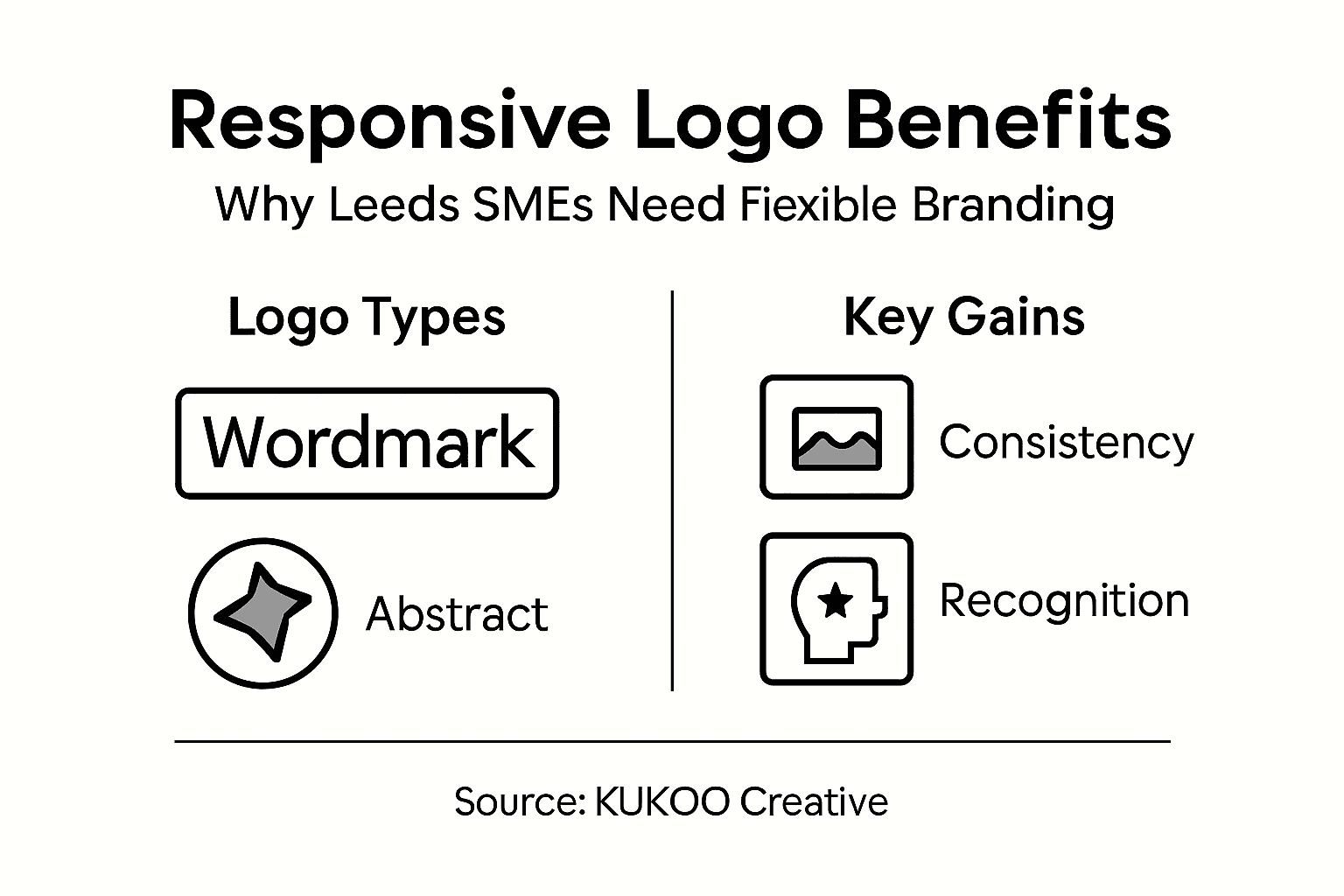
Consider a practical example from the Leeds creative sector. A graphic design studio launches with a single static logo. It looks beautiful on their website. But on Instagram, where they post portfolio work, the logo shrinks to a tiny profile picture and becomes illegible. Their email signature crops awkwardly. Their business card looks cramped. Potential clients notice these small inconsistencies. They might not consciously think about it, but the experience feels slightly off. Now imagine that same studio with a responsive system. A bold icon works perfectly as a social media profile picture. A lettermark fits beautifully in email signatures. The full combination mark dominates their website header. Every touchpoint feels intentional and professional. That’s the difference between looking like a hobby and looking like a business.
Responsive logos also give you flexibility in how you market yourself. A local Leeds cafe can use a simplified icon in sponsored Instagram posts where space is tight, then deploy the full logo on their website menu boards. A consulting firm can use initials in email signatures, a badge version on their LinkedIn profile, and a detailed mark in printed proposals. This adaptability means you’re not forcing the same design into contexts where it doesn’t work. You’re not making customers squint at tiny text. You’re not dealing with distorted proportions. Instead, each platform gets a version optimised for how people actually use it. This flexibility becomes especially valuable as you grow and encounter new marketing opportunities you hadn’t anticipated when you first invested in your branding.
Future-Proofing Your Brand
Branding technology evolves quickly. New platforms emerge. Screen sizes change. If your logo can’t adapt, you’re constantly redesigning. A responsive logo system built properly grows with you. When the next social media platform launches, you already have multiple logo versions to experiment with. When technology shifts toward different screen ratios or display types, your system adapts because it was designed to be flexible from the start. For a Leeds small business, this future-proofing matters because it extends the lifespan of your investment. You’re not redesigning your logo every two years. You’re building a system that remains relevant regardless of how digital platforms evolve.
Pro tip: Document exactly where each logo variation appears in your business right now. Website header, email signature, social media profiles, business cards, printed materials, favicon, app icon. Once you map these spaces, you’ll see the gaps where your current logo struggles, revealing exactly which responsive variations would deliver the biggest impact for your specific business.
Mistakes to Avoid with Responsive Logo Design
Building a responsive logo system sounds straightforward until you actually start the process. Most Leeds business owners make the same mistakes, usually without realising it until their logo looks wrong on a customer’s phone. The biggest culprit is skipping proper testing across actual devices. You might design your logo variations on a high-resolution monitor, think everything looks perfect, then discover the icon becomes a blur on a mobile phone or looks stretched on a tablet. Neglecting cross-device testing degrades user experience and damages how customers perceive your brand. You need to test on real devices, not just browser emulators. Check your favicon in actual browser tabs. View your social media logo at full size on an actual phone screen. This isn’t pedantic. It’s the difference between a logo that works and a logo that frustrates your customers.
Another common mistake is creating logo variations that lose your brand identity at smaller sizes. You strip away details to make the mark fit, but you strip away so much that it no longer looks like your brand. A Leeds design agency might simplify their logo for mobile and accidentally lose the distinctive element that makes it recognisable. The solution isn’t to cram all the detail back in. It’s to simplify intelligently, keeping only the elements that define your mark. Your simplified icon should still feel unmistakably yours. Test this by showing all your logo variations to someone unfamiliar with your brand. Can they connect the icon back to the full version? If not, you’ve simplified too aggressively. Also avoid the temptation to make tiny adjustments across every variation. Maintain consistency in stroke weight, colour values, and proportions across all versions. Small inconsistencies compound and make your entire system look amateurish. A professional logo system should feel like a unified family, not a collection of random variations.
Load time is another mistake that catches businesses off guard. A logo file that works on your website might be too large for email clients or slow down your social media loading times. Optimise your logo files specifically for each use case. Your website might use a detailed SVG. Your email signature needs a lightweight PNG. Your favicon requires a completely different format. Many businesses also fail to account for how logos appear on various backgrounds. Your logo might look stunning on your white website header but disappear against certain user backgrounds or become muddy on coloured email templates. Test your logo against different backgrounds, both light and dark. Some responsive logos include a version with a protective border or background shape specifically to ensure visibility in unpredictable contexts.
Planning Before You Design
The biggest mistake happens before you even start designing. You don’t plan which contexts your logo needs to work in. Create a detailed list of everywhere your logo appears. Email signature, website header, social media profiles, favicon, business card, printed letterhead, promotional materials, app icon, LinkedIn banner. For each context, note the dimensions and the constraints. Only then design your responsive variations with real-world constraints in mind.
Pro tip: Before investing in responsive logo design, screenshot every place your current logo appears and measure the actual pixel dimensions. You’ll discover the real constraints you’re working within instead of guessing. These measurements become your brief for your designer and prevent expensive revisions later.
Elevate Your Brand with Expert Responsive Logo Design
Many Leeds businesses struggle with keeping their logos clear and recognisable across all digital platforms. The key challenge is creating a responsive logo system that adapts with ease—from detailed website headers to tiny favicons—without losing the essence of your brand. Whether it is managing legibility on mobile devices or maintaining consistency in email signatures and social media, smart responsive logo design solves these problems by creating multiple tailored variations that build trust and professional credibility.
At KUKOO Creative, we understand these specific challenges and goals because we have been partnering with businesses for over a decade to deliver impactful designs. Our approach ensures your responsive logo not only looks polished everywhere but also future-proofs your brand identity as digital platforms evolve. Embrace clarity and versatility now with a design system that works for every touchpoint.
Discover how our expert team can help you create a responsive logo system customised for your Leeds business. See why updating your business logo and building consistent brand recognition matter. Visit our main website to start your transformation and learn why professional logos make all the difference.
Ready to make your logo work smarter across all platforms
Connect with KUKOO Creative today. Let us build a responsive logo solution tailored for your unique brand. The time to act is now to ensure your Leeds business stands out clearly and confidently wherever your customers see you.
Frequently Asked Questions
What are responsive logos?
Responsive logos are variations of your main logo that adapt their composition for different digital environments, ensuring brand identity while maintaining clarity across various applications.
Why do I need a responsive logo system for my business?
A responsive logo system helps maintain brand consistency across devices and platforms, enhancing recognition and professionalism. It ensures that your logo looks clear and intentional, no matter where customers encounter it.
How many variations should my responsive logo system include?
Your responsive logo system should include at least three versions: a primary logo for your website header, a secondary version for narrower spaces like email signatures, and a small icon for applications like favicons and social media profile pictures.
How can responsive logos improve brand recognition?
Responsive logos enhance brand recognition by providing consistent visual identity across various channels. A recognisable logo that adapts well to different formats makes it easier for customers to remember your brand as they interact with it in multiple contexts.