
Minimalist design is often misunderstood. Many business owners assume it simply means stripping everything back until almost nothing remains. In reality, it is one of the most strategic and deliberate approaches to branding available. When done well, it communicates confidence, builds trust, and makes your brand instantly recognisable. For UK businesses competing in crowded digital and physical markets, that kind of clarity is not a luxury. It is a genuine competitive advantage. This guide walks you through the principles, comparisons, strategies, and pitfalls so you can make informed decisions about your own brand.
Table of Contents
- Understanding minimalist design: Origins and philosophy
- Core principles of minimalist design
- Minimalist design vs maximalist and hybrid approaches
- Building a minimalist brand: Strategies and process
- Pitfalls and best practices for UK business branding
- Elevate your UK brand with minimalist expertise
- Frequently asked questions
Key Takeaways
| Point | Details |
|---|---|
| Strategic simplicity | Minimalist design eliminates excess to highlight key brand values and boost clarity. |
| Brand trust and adaptability | Minimalism fosters premium perception and adapts efficiently for digital-first UK markets. |
| Pitfall awareness | Avoid trend fatigue and coldness by pairing minimalism with storytelling and user testing. |
| Practical application | Building a minimalist brand requires clear messaging, strict curation, and consistent testing. |
| Custom approach | Hybrid and sector-specific solutions ensure minimalist design aligns with UK business goals. |
Understanding minimalist design: Origins and philosophy
Minimalism did not emerge from a desire to do less. It grew from a serious intellectual and artistic movement. Minimalist design emphasises simplicity, functionality, and the elimination of excess elements, with roots in the Bauhaus movement and 1960s art. Bauhaus designers believed that form should follow function. Every visual element had to earn its place. That philosophy translated directly into branding and business visuals over the following decades.
The core idea is purposeful removal. You are not taking things away because you ran out of ideas. You are removing everything that does not serve a clear purpose, so that what remains carries full weight.
“Less is more” is not a design trend. It is a discipline that demands you know exactly what your brand stands for before you decide what to show.
For UK businesses, this matters enormously. Consumers are increasingly sceptical of brands that feel cluttered or inconsistent. A well-structured branding consistency workflow built on minimalist principles signals professionalism and reliability from the very first impression.
Key philosophical pillars of minimalist design include:
- Functionality first: every element must serve a purpose
- Clarity over decoration: remove anything that distracts
- Intentional simplicity: simplicity is earned, not accidental
- Visual hierarchy: guide the viewer’s eye without confusion
- Timelessness: avoid trends that date quickly
These pillars are not abstract ideals. They are practical tools you can apply directly to your branding services decisions today.
Core principles of minimalist design
Understanding the philosophy is one thing. Knowing what minimalist design actually looks like in practice is another. The core principles include simplicity and functionality, natural and refined materials, neutral colour palettes, clean lines, geometric shapes, ample white space, and a strong focus on negative space.
Let us break those down for branding specifically:
- Colour palette: typically white, grey, black, or one carefully chosen accent colour. Neutral tones communicate calm and authority.
- Typography: clean, sans-serif fonts that are easy to read at any size. No decorative flourishes unless they carry meaning.
- White space: the empty areas around your logo, text, and imagery are not wasted space. They create breathing room and draw attention to what matters.
- Negative space: the clever use of background space to imply shapes or meaning, adding depth without adding clutter.
- Geometric shapes: simple, repeated forms that feel structured and trustworthy.
- Scalability: a minimalist logo works on a business card, a billboard, and a mobile screen without losing impact.
Stat: Minimalist branding consistently enhances premium perception and adaptability across digital UK markets, making it particularly effective for businesses targeting mobile-first audiences.
For a deeper look at why this matters for your business, explore the minimalist branding benefits that UK brands are already experiencing. You might also be surprised by the professional logo impact a well-executed minimalist mark can have on customer trust.
Minimalist design vs maximalist and hybrid approaches
Now that you understand the core principles, it helps to see how minimalism sits alongside other design philosophies. Not every brand should be minimalist. Knowing the differences helps you choose with confidence.
Minimalism offers clarity, calm, and trust, while maximalism provides vibrancy, emotion, and abundance. Hybrid approaches balance both, and minimalism is sometimes criticised as cold, though it is widely praised for its efficiency and sustainability.
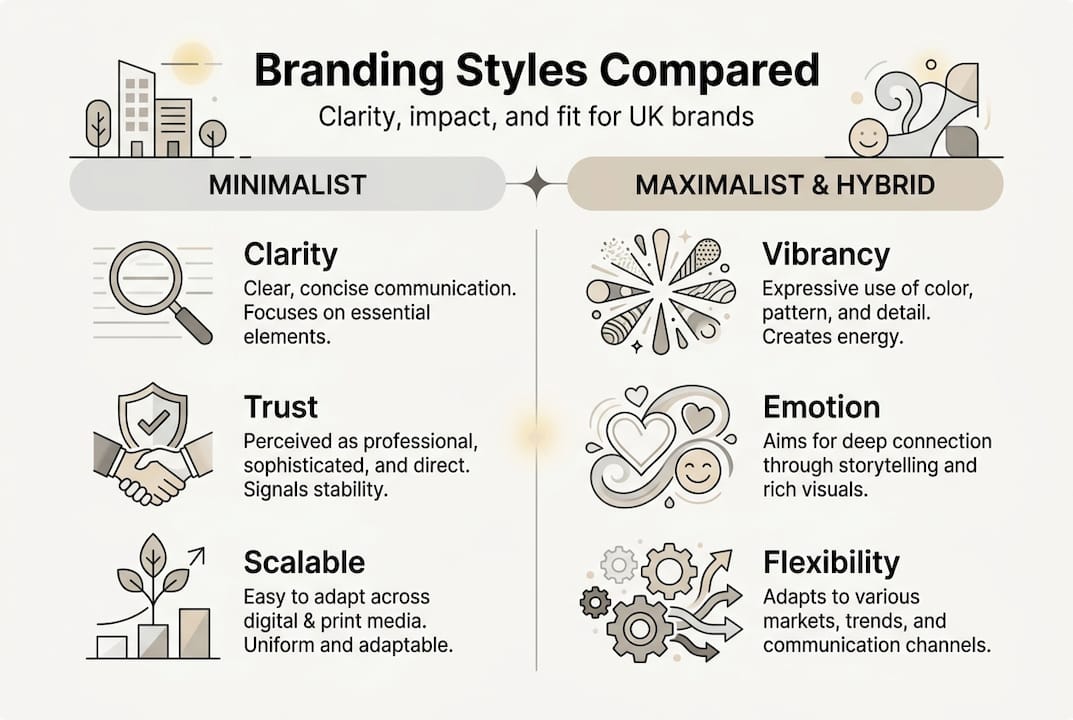
| Approach | Strengths | Weaknesses | Best suited for |
|---|---|---|---|
| Minimalism | Clarity, trust, scalability | Can feel cold or bland | Tech, luxury, professional services |
| Maximalism | Energy, emotion, memorability | Can overwhelm or confuse | Entertainment, fashion, food and drink |
| Hybrid | Flexibility, emotional warmth | Harder to execute consistently | Creative agencies, lifestyle brands |
The table above is a starting point, not a rulebook. A luxury food brand might use minimalist structure with rich, warm photography. A tech startup might use bold colour within a clean layout. Context always drives the decision.
Pro Tip: Before committing to any design approach, audit your sector and your target audience. Look at your three closest competitors. If they all use minimalism, a thoughtful hybrid might help you stand out. If they are all maximalist, clean simplicity could be your differentiator.
Avoiding the wrong approach from the start saves significant time and money. Review common branding mistakes that UK SMEs make, and consider mapping out your visual branding workflow before committing to a direction.
Building a minimalist brand: Strategies and process
Knowing what minimalism is and why it works is only half the journey. Here is how to actually build it into your brand.
Start with your core brand message, ruthlessly remove non-essentials, use a limited colour palette of one to three colours, apply clean typography, ensure scalability across all formats, and test for recognition and usability at every stage.
Follow this process step by step:
- Define your core values and message. What does your business stand for? What single idea should your brand communicate? Write it in one sentence.
- Audit your existing brand. List every visual element you currently use. Ask: does this serve the core message? If not, remove it.
- Choose your colour palette. Limit yourself to a maximum of three colours. One primary, one secondary, one accent if needed.
- Select your typography. One or two font families maximum. Ensure they are legible at small sizes and on screens.
- Design your signature element. This might be a unique geometric shape, a distinctive logo mark, or a specific use of negative space that makes your brand instantly recognisable.
- Test scalability. Your brand must work on a mobile screen, a printed brochure, a social media profile, and a shop sign. Test all of them.
- Implement consistently. Apply your brand across every touchpoint without deviation.
Implement via a subtractive process: define core values and your message first, curate signature elements carefully, ensure consistency across all channels, and pair with storytelling for emotional connection, particularly in luxury and tech sectors.

| Stage | Action | Outcome |
|---|---|---|
| Discovery | Define values and message | Clear brand foundation |
| Audit | Remove non-essential elements | Focused visual identity |
| Design | Colour, type, signature element | Cohesive brand assets |
| Testing | Scalability and usability checks | Reliable performance |
| Launch | Consistent implementation | Strong brand recognition |
For inspiration, browse branding examples from agencies that have applied these principles effectively. If your business operates primarily online, our digital branding tips offer practical guidance tailored to UK digital markets.
Pitfalls and best practices for UK business branding
Minimalism is powerful, but it is not foolproof. There are real risks that UK business owners need to watch for.
Pitfalls include trend saturation leading to sameness, emotional coldness, and usability drops when essential context is removed. The solution is to prioritise intent, test for context, and consider hybrid approaches where appropriate.
Here are the most common mistakes and how to avoid them:
- Trend fatigue: when every brand in your sector looks the same, minimalism stops being distinctive. Audit your competitors regularly.
- Emotional coldness: a brand that feels too stripped back can feel impersonal. Add warmth through photography, copywriting tone, or a carefully chosen accent colour.
- Removing too much: usability suffers when you remove elements that users actually need. Navigation labels, contact details, and calls to action must remain clear and accessible.
- Ignoring cultural fit: what reads as clean and premium in one UK sector may feel cold or uninviting in another. A family-run bakery and a fintech startup have very different audiences.
- Inconsistent application: minimalism only works when it is applied consistently. One cluttered social media post can undermine months of careful brand building.
UK business owners should audit for cultural fit and test their designs to avoid blandness in competitive sectors.
Pro Tip: Always design with intent. Every element you keep should have a reason to be there. Every element you remove should be a conscious decision, not an afterthought. Then test your brand with real members of your target audience before you launch.
For tailored guidance on navigating these challenges, our minimalist strategy guidance covers the specific considerations UK businesses face.
Elevate your UK brand with minimalist expertise
Applying minimalist design principles with precision takes experience. It is the difference between a brand that feels effortlessly clear and one that simply feels empty. When your visual identity is built on genuine intent and strategic simplicity, it builds recognition, earns trust, and connects with the right people.
At Kukoo Creative, we have spent over a decade helping UK business owners transform their ideas into brand assets that genuinely work. Whether you are starting from scratch or refining an existing identity, we bring the expertise to make minimalism work for your specific market. Explore how logo design can anchor your minimalist brand, browse our branding portfolio to see what is possible, and discover our full range of digital branding solutions built for UK businesses ready to grow.
Frequently asked questions
How does minimalist design help UK businesses stand out?
Minimalist design creates clarity and trust, making your brand memorable and easy to recognise across digital and mobile platforms. Minimalist branding enhances premium perception and adaptability, which is particularly valuable in the UK’s competitive digital market.
What are the common pitfalls of minimalist branding?
The most common pitfalls are trend saturation, emotional coldness, and usability issues when essential elements are removed. Pitfalls to avoid include designing without clear intent and failing to test your brand with your actual audience before launch.
Should all UK businesses adopt a minimalist approach?
Not necessarily. Minimalism suits luxury, tech, and professional services particularly well, but it may not fit every sector. Hybrids balance both minimalist efficiency and maximalist warmth, offering a strong middle ground for brands that need emotional appeal alongside clarity.
How can I implement minimalist design in my brand?
Start with your core brand message, remove anything that does not serve it, and limit yourself to one to three colours with clean typography. Ruthlessly remove non-essentials, ensure your design scales across all formats, and test for clarity and usability before you go live.