Finding a way to truly stand out in Leeds means more than just clever advertising. Many small business owners are surprised to learn that a distinct brand voice can transform their customer relationships, building trust and recognition that lasts. Understanding the myths and practicalities behind brand voice will help you craft a consistent and authentic communication style, strengthening your identity in a competitive market.
Table of Contents
- Brand Voice Defined And Common Myths
- Distinct Types Of Brand Voice In UK Business
- Brand Voice Versus Brand Tone Explained
- Key Features Of An Effective Brand Voice
- Embedding Brand Voice For Lasting Impact
- Risks Of Inconsistency And Mistakes To Avoid
Key Takeaways
| Point | Details |
|---|---|
| Understanding Brand Voice | Brand voice is essential for creating emotional connections with your audience and should reflect your organisation’s core values. |
| Myth Debunking | Common myths about brand voice can hinder effective communication; it’s not merely about language but encompasses overall strategy and adaptability. |
| Consistency Matters | Maintaining a consistent brand voice across channels is vital for building trust and recognition with your audience. |
| Flexibility in Tone | While brand voice remains steady, tone should be adaptable to different contexts and audience needs for effective communication. |
Brand voice defined and common myths
Brand voice represents the personality and emotional tone a company communicates through its language, messaging, and overall communication style. It goes far beyond mere corporate communication – it’s a strategic narrative tool that connects businesses with their audience on a deeper, more meaningful level.
At its core, brand voice is about consistency and authenticity. A cultural-philosophical exploration of brand voice reveals that it’s not just about selling products, but creating emotional connections with your audience. Companies in Leeds need to understand that brand voice isn’t a superficial marketing trick, but a profound method of establishing trust and recognition.
Common myths about brand voice often mislead businesses. Let’s debunk the most prevalent misconceptions:
- Myth 1: Brand voice is just about using fancy language
- Myth 2: One voice fits all communication channels
- Myth 3: Brand voice is only for large corporations
- Myth 4: Once established, brand voice never changes
These myths can significantly limit a company’s communication strategy. In reality, brand voice is nuanced, adaptive, and deeply rooted in an organisation’s core values and identity. It requires careful crafting and continuous refinement.
Practical considerations for developing an authentic brand voice include:
- Understanding your target audience’s communication preferences
- Aligning your language with your brand’s core values
- Maintaining consistency across all communication platforms
- Regularly reviewing and updating your brand voice strategy
Pro tip: Conduct periodic brand voice audits to ensure your communication remains authentic and resonates with your intended audience.
Distinct types of brand voice in UK business
Understanding the nuanced landscape of brand voice requires recognising the diverse communication styles prevalent in UK business contexts. Different industries and company sizes demand unique approaches to brand messaging, making voice selection a strategic decision. Branding strategy considerations play a crucial role in determining the most appropriate communication tone.
UK businesses typically employ several distinct brand voice types:
- Professional and Corporate: Formal, precise language common in finance, legal, and consulting sectors
- Conversational and Approachable: Informal, friendly tone used by tech startups and creative agencies
- Innovative and Dynamic: Energetic, forward-thinking communication style for entrepreneurial businesses
- Compassionate and Purpose-Driven: Empathetic language focusing on social responsibility and community impact
- Technical and Authoritative: Detailed, expert-level communication for specialist industries
Each brand voice type carries unique characteristics that reflect an organisation’s culture, values, and target audience. The key is selecting a voice that feels genuine and resonates with your specific customer base in Leeds and beyond.
The following table summarises how different UK industries typically approach brand voice selection:
| Industry Sector | Common Brand Voice Style | Typical Audience Expectation |
|---|---|---|
| Finance & Legal | Formal and authoritative | Professional, trustworthy guidance |
| Creative & Tech Startups | Conversational and innovative | Friendly, accessible solutions |
| Social Enterprises | Compassionate and inclusive | Community-focused communication |
| Specialist Engineering | Technical and precise | Expert advice, clarity and detail |
The effectiveness of a brand voice depends on consistent application across all communication channels. Small businesses and large corporations alike must maintain a coherent narrative that builds trust and establishes memorable brand personality.
Factors influencing brand voice selection include:
- Target audience demographics
- Industry sector expectations
- Company core values
- Competitive landscape
- Long-term brand positioning goals
Pro tip: Conduct customer research and create a comprehensive brand voice style guide to ensure consistent communication across all platforms.
Brand voice versus brand tone explained
Understanding the nuanced relationship between brand voice and brand tone is crucial for effective communication strategies in UK businesses. Brand voice and tone guidelines provide critical insights into these interconnected yet distinct communication elements.
At its core, brand voice represents the fundamental personality of an organisation – a consistent, unchanging characteristic that defines how a brand communicates. Think of it like a person’s core personality: steady, recognisable, and unique. Brand tone, by contrast, is more fluid and adaptable, representing the emotional inflection that shifts depending on specific contexts or audience needs.
Key differences between brand voice and brand tone include:
- Brand Voice: Unchanging personality
- Brand Tone: Situational emotional adaptation
- Voice: Reflects core identity
- Tone: Adjusts to communication context
- Voice: Consistent across all channels
- Tone: Varies based on audience and medium
For Leeds businesses, this means developing a consistent voice that remains authentic, while maintaining the flexibility to adjust tone appropriately. A tech startup might maintain a consistently innovative voice, but soften its tone when addressing sensitive customer service issues.
Practical application requires understanding how voice and tone interact:
- Define your core brand voice
- Create tone guidelines for different scenarios
- Train communication teams on voice-tone distinction
- Regularly audit communication materials
- Ensure emotional resonance with target audience
Pro tip: Develop a comprehensive brand communication matrix that outlines your consistent voice alongside adaptable tone variations for different platforms and situations.
Key features of an effective brand voice
Crafting an effective brand voice requires careful consideration of multiple strategic elements that resonate with your target audience. Brand messaging strategies play a critical role in developing a compelling communication approach that distinguishes your business in the competitive Leeds marketplace.
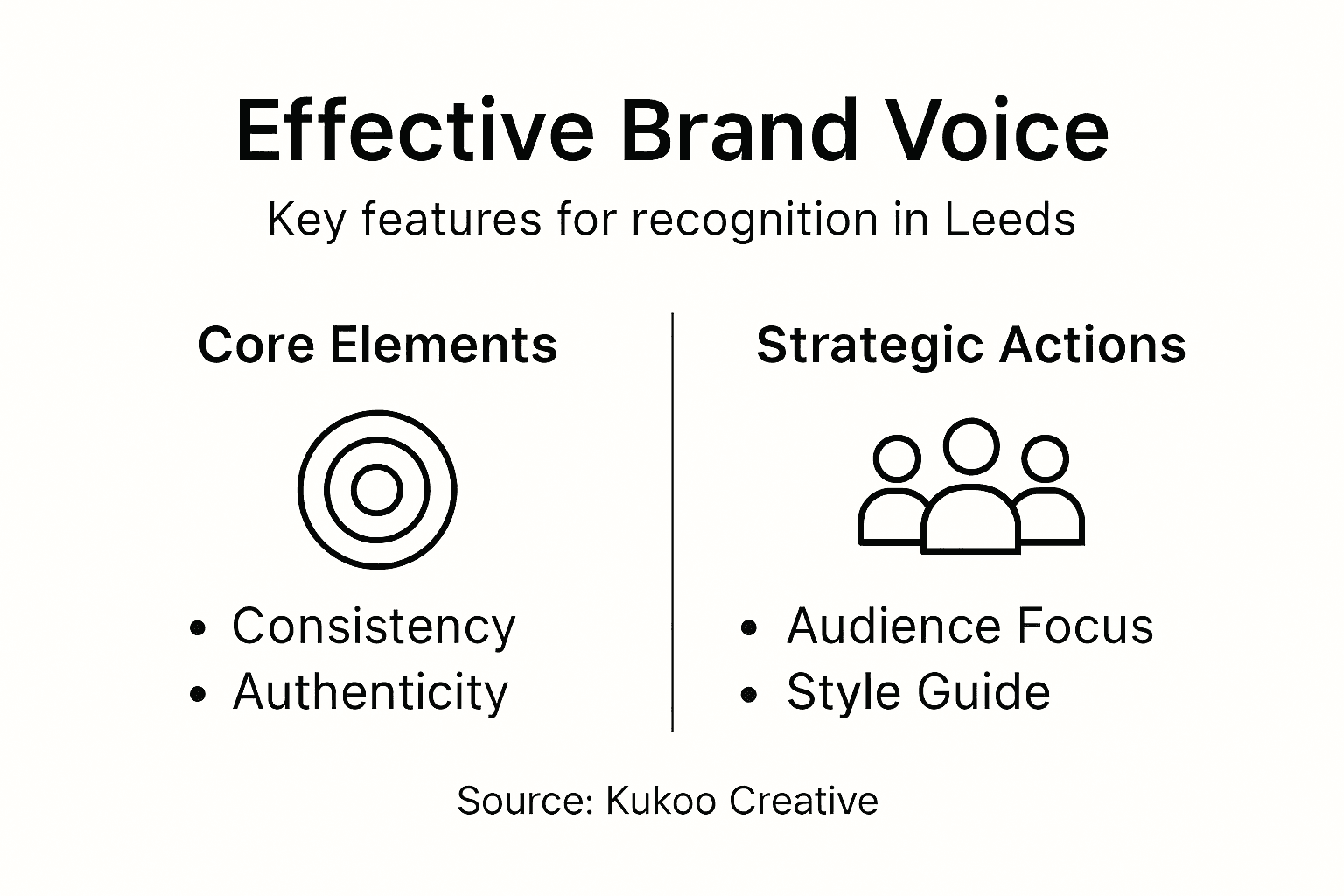
An authentic brand voice transcends mere communication – it becomes the personality through which your organisation speaks, thinks, and connects with its audience. It must be distinctive, consistent, and genuinely reflective of your company’s core values and mission.
Key characteristics of a powerful brand voice include:
- Authenticity: Genuine representation of organisational identity
- Consistency: Uniform communication across all platforms
- Clarity: Direct and understandable messaging
- Emotional Resonance: Ability to connect on a deeper level
- Differentiation: Unique positioning against competitors
Successful brand voices are not created in isolation but emerge from a deep understanding of your target audience, industry context, and organisational objectives. For Leeds businesses, this means developing a communication strategy that feels both professional and approachable, technical yet accessible.
Practical steps to develop a robust brand voice involve:
- Conduct thorough audience research
- Define core organisational values
- Develop comprehensive communication guidelines
- Create voice persona templates
- Implement regular communication audits
Pro tip: Develop a detailed brand voice style guide that captures your unique communication essence and provides clear guidelines for all team members.
Embedding brand voice for lasting impact
Embedding a brand voice that truly resonates requires a strategic, holistic approach that goes beyond superficial communication tactics. Inclusive brand voice strategies demonstrate that sustainable brand communication is rooted in authenticity, accessibility, and thoughtful representation.
Successful brand voice embedding involves creating a comprehensive framework that aligns organisational values with communication practices. This means developing a nuanced approach that transcends simple messaging and becomes an integral part of your company’s identity and culture.
Key strategies for effective brand voice embedding include:
- Comprehensive Research: Understanding audience demographics and communication preferences
- Diverse Team Involvement: Creating voice guidelines through collaborative perspectives
- Continuous Auditing: Regularly reviewing communication effectiveness
- Accessibility Focus: Ensuring communication is inclusive and understandable
- Cross-Platform Consistency: Maintaining uniform voice across all channels
For Leeds businesses, this approach means crafting a voice that feels simultaneously professional and approachable, technical yet engaging. The goal is to create a communication style that feels genuinely representative of your organisation’s unique personality and values.
Practical implementation of brand voice embedding requires:
- Develop detailed communication guidelines
- Conduct regular team training sessions
- Create voice persona templates
- Establish feedback mechanisms
- Implement periodic communication audits
Pro tip: Develop a comprehensive brand voice style guide that serves as a living document, adaptable to evolving business needs and audience expectations.
Risks of inconsistency and mistakes to avoid
Inconsistent brand voice can quickly erode customer trust and dilute organisational identity. Branding strategies for UK businesses underscore the critical importance of maintaining a unified communication approach across all touchpoints.

Brand voice inconsistency manifests through multiple channels, potentially causing significant reputation damage. When different team members or departments communicate using disparate styles, it creates confusion and undermines the perceived professionalism of an organisation.
Common risks and mistakes to be aware of include:
- Departmental Disconnection: Varying communication styles across different teams
- Personality Fragmentation: Inconsistent emotional tone in messaging
- Audience Disorientation: Confusing communication that lacks clear identity
- Credibility Erosion: Undermining organisational trustworthiness
- Communication Ineffectiveness: Reducing message impact and clarity
For Leeds businesses, maintaining brand voice consistency requires deliberate strategy and ongoing management. This means establishing clear communication protocols, conducting regular training, and creating comprehensive style guides that ensure every team member understands and embodies the brand’s core communication principles.
Here is a structured comparison of risks associated with inconsistent brand voice and their business impacts:
| Inconsistency Type | Potential Business Impact | Example Scenario |
|---|---|---|
| Messaging mismatch | Loss of customer trust | Mixed formal and informal emails |
| Tone fragmentation | Damaged professional image | Customer support uses harsh language |
| Disjointed branding | Reduced audience recognition | Varying social media personalities |
Strategic approaches to mitigating brand voice risks involve:
- Develop comprehensive communication guidelines
- Implement regular team training programmes
- Create centralised brand voice resources
- Establish review mechanisms for all external communications
- Foster a culture of consistent messaging
Pro tip: Conduct periodic brand voice audits to identify and rectify potential inconsistencies before they impact your organisation’s reputation.
Harness Your Brand Voice to Boost Recognition in Leeds
Understanding and embedding an authentic brand voice is fundamental for Leeds businesses seeking to establish trust and lasting connections with their audience. This article highlights challenges like inconsistent messaging and the need for a coherent communication strategy that resonates emotionally and reflects your core values. At Kukoo Creative, we specialise in crafting distinctive brand voices through impactful designs – from logos to websites – that align perfectly with your organisational identity while capturing the attention of your target market.
A strong brand voice is more than just words; it is a strategic asset that drives recognition and sets you apart in a competitive landscape. Let us help you translate your unique brand personality into compelling visuals and consistent messaging. Discover how our expert team collaborates with business owners to create authentic connections and elevate your presence in Leeds and beyond.
Looking to refine your brand voice and enhance your communication with memorable designs Visit Kukoo Creative and explore how our tailored branding strategy solutions can transform your business identity today

Take the next step towards building a cohesive and impactful brand voice Contact us now at Kukoo Creative to start crafting a communication style that truly represents you and resonates with your audience.
Frequently Asked Questions
What is brand voice and why is it important?
Brand voice is the personality and emotional tone a company uses in its communication. It’s essential because it helps establish trust and recognition with the audience, creating deeper connections beyond just selling products.
How can a business define its brand voice?
A business can define its brand voice by understanding its core values, identifying its target audience’s communication preferences, and ensuring consistency across all platforms while maintaining authenticity in messaging.
What are common myths about brand voice?
Common myths include the belief that brand voice is only for large corporations, or that it can be created using fancy language. In reality, brand voice must be authentic, adaptable, and rooted in the organisation’s identity.
How can companies ensure brand voice consistency?
Companies can ensure brand voice consistency by developing comprehensive communication guidelines, conducting regular training for team members, and performing periodic audits to assess and maintain the voice across all communication channels.