Most British companies underestimate the power of branding, yet studies show a strong brand can increase business value by over 20 percent. In a crowded marketplace filled with similar products and services, branding shapes customer perceptions, trust, and long-term loyalty. Understanding what brand identity really means—beyond just a logo—reveals how British businesses can create lasting reputations and stand out for all the right reasons.
Table of Contents
- Branding Defined: Identity, Reputation And Value
- Key Brand Types For Business Success
- How Branding Drives Customer Loyalty
- Branding Strategies That Fuel Growth
- Common Branding Mistakes To Avoid
Key Takeaways
| Point | Details |
|---|---|
| Brand Identity is Holistic | Effective branding goes beyond logos; it encompasses the organisation’s values, personality, and market positioning. |
| Reputation Drives Value | A strong brand reputation is built through consistent delivery, transparent communication, and understanding of customer needs. |
| Brand Types Offer Strategic Advantages | Different brand types—corporate, product, service, personal, geographical, and cultural—serve distinct purposes and should align with business goals. |
| Emotional Connection Fosters Loyalty | Creating emotional ties with customers is essential for transforming them into loyal advocates and enhancing long-term relationships. |
Branding Defined: Identity, Reputation And Value
Branding represents a strategic framework through which businesses communicate their unique essence, values, and promise to customers. At its core, brand identity encompasses far more than a simple logo or visual aesthetic – it constitutes the comprehensive representation of an organisation’s personality, purpose, and positioning in the marketplace.
According to research examining corporate branding, brands are collectively defined by customer experiences and perceptions, which means they extend beyond internal design choices into lived interactions. Corporate branding strategies in the digital era demonstrate that successful brands integrate six critical facets:
- Physique: The tangible, visual elements representing the brand
- Personality: The human-like characteristics communicating brand temperament
- Culture: The underlying values and organisational principles
- Relationship: How the brand connects and engages with customers
- Reflection: The idealised customer image the brand represents
- Self-Image: The internal perception of the brand’s identity
Beyond these elements, reputation emerges as a pivotal component of brand value. Reputation is built through consistent delivery of promises, transparent communication, and demonstrating genuine commitment to customer needs. Brand identity frameworks suggest that customers increasingly evaluate brands not just by what they sell, but by their ethical stance, social responsibility, and ability to create meaningful connections.
Pro Tip: Conduct a comprehensive brand audit annually to ensure your brand identity remains aligned with your evolving business goals and customer expectations. Review your visual elements, messaging, and customer touchpoints to maintain relevance and authenticity.
Key Brand Types For Business Success
Business branding encompasses multiple strategic approaches that enable organisations to differentiate themselves in competitive markets. Modern branding strategies reveal several distinctive brand types that businesses can leverage for growth and market positioning.
Key brand types include:
- Corporate Branding: Representing the entire organisation’s identity and reputation
- Product Branding: Focusing on specific product lines and their unique characteristics
- Service Branding: Highlighting the distinctive qualities of service offerings
- Personal Branding: Centring on individual professionals or business leaders
- Geographical Branding: Emphasising regional or local identity
- Cultural Branding: Connecting with specific cultural or demographic groups
Each brand type offers unique opportunities for businesses to communicate their value proposition. Corporate branding, for instance, creates an overarching narrative about the organisation’s mission and principles, while product branding enables companies to differentiate individual offerings within their portfolio. Service branding becomes particularly critical in industries where customer experience determines competitive advantage.
Successful brand implementation requires understanding the nuanced differences between these types and selecting an approach that aligns with the organisation’s strategic objectives. Strategic branding guide for UK businesses can provide more in-depth insights into matching brand types with business goals.
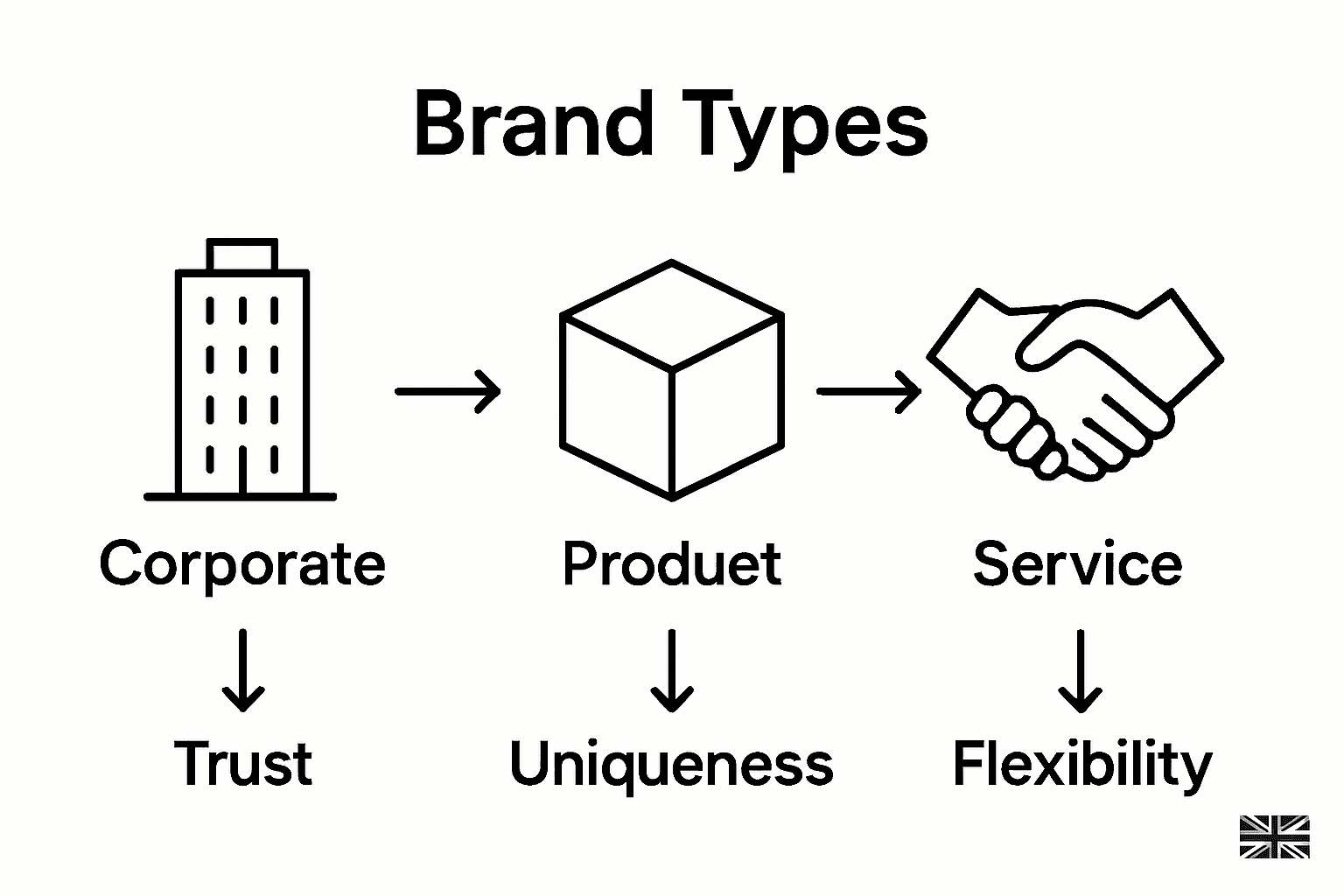
Here is a summary of brand types and their ideal business application:
| Brand Type | Typical Use Case | Distinct Advantage |
|---|---|---|
| Corporate Branding | Whole organisation | Unified message across all offerings |
| Product Branding | Individual product lines | Highlights unique features per product |
| Service Branding | Service-based industries | Emphasises customer experience |
| Personal Branding | Individuals/leaders | Builds trust through personal reputation |
| Geographical Branding | Regional or local identity | Appeals to specific location-based needs |
| Cultural Branding | Demographic/cultural groups | Connects via shared values or traditions |
Pro Tip: Conduct a comprehensive brand assessment to determine which brand type best represents your business’s unique strengths and market positioning. Regularly review and adapt your branding strategy to reflect evolving customer expectations and market dynamics.
How Branding Drives Customer Loyalty
Customer loyalty represents a complex psychological connection that goes far beyond simple transactional relationships. Research on service quality and brand loyalty reveals that emotional engagement plays a crucial role in transforming casual customers into committed brand advocates.
Brands cultivate loyalty through several strategic mechanisms:
- Creating consistent and memorable experiences
- Demonstrating genuine understanding of customer needs
- Delivering reliable and high-quality products or services
- Building emotional connections that transcend pure commercial interactions
- Establishing trust through transparent communication
Brand communities emerge as powerful platforms for fostering deep customer connections. These social networks enable customers to share experiences, participate in brand-related rituals, and develop a sense of belonging that extends beyond traditional consumer relationships. By creating spaces where customers feel valued and understood, businesses can transform transient interactions into long-term loyalty.
Emotional attachment becomes the cornerstone of sustained customer relationships. When customers perceive a brand as an extension of their personal identity, they are more likely to remain committed, recommend the brand to others, and demonstrate resilience during occasional service imperfections. Custom branding guide for business owners can provide deeper insights into developing these meaningful connections.

Pro Tip: Map your customer journey meticulously, identifying emotional touchpoints where you can create memorable interactions that reinforce brand loyalty and differentiate your business from competitors.
Branding Strategies That Fuel Growth
Strategic branding transforms businesses from commodity providers to distinctive market players. Research on corporate branding processes demonstrates that effective branding goes beyond visual aesthetics, serving as a fundamental mechanism for communicating unique value propositions and driving organisational growth.
Successful growth-oriented branding strategies include:
- Differentiation: Clearly articulating what sets your business apart
- Consistency: Maintaining uniform messaging across all customer touchpoints
- Emotional Connection: Creating narratives that resonate with target audiences
- Value Communication: Highlighting tangible benefits and unique solutions
- Adaptability: Evolving brand strategies to match market dynamics
Companies that master these strategies can effectively position themselves as market leaders. By developing a compelling brand narrative that speaks directly to customer needs, businesses can transcend traditional competitive boundaries. Small business branding tips for UK owners provide practical insights into implementing these sophisticated branding approaches.
The most successful brands understand that growth emerges from a holistic approach to brand development. This means continuously aligning visual identity, communication style, customer experience, and organisational values to create a cohesive and powerful market presence.
To clarify the impact of branding strategies, see how each element influences long-term growth:
| Strategy Element | Primary Focus | Impact on Business Growth |
|---|---|---|
| Differentiation | Unique market position | Attracts target customer segments |
| Consistency | Uniform brand messaging | Builds trust and recognition |
| Emotional Connection | Narrative and engagement | Enhances customer loyalty |
| Value Communication | Benefit-driven messaging | Increases perceived worth |
| Adaptability | Brand evolution | Maintains relevance in market |
Pro Tip: Conduct quarterly brand audits to assess how well your current branding strategies align with your business objectives and market expectations. Regularly soliciting customer feedback can provide invaluable insights for strategic refinement.
Common Branding Mistakes To Avoid
Brand integrity represents a delicate ecosystem that can be easily disrupted by strategic missteps. Understanding risks like brandjacking reveals the critical importance of protecting a company’s online identity and reputation against potential exploitation.
Common branding mistakes that businesses must carefully navigate include:
- Inconsistent Messaging: Sending mixed signals across different platforms
- Neglecting Target Audience: Failing to understand and connect with core customer segments
- Copying Competitors: Losing unique brand identity through imitation
- Ignoring Brand Evolution: Refusing to adapt to changing market dynamics
- Overcomplicating Brand Identity: Creating convoluted or unclear brand narratives
Strategic approaches to avoiding brand dilution demonstrate that businesses must be particularly cautious about creating sub-brands or alternative offerings that might undermine their primary brand equity. Brand guideline strategies can help organisations maintain a consistent and powerful brand presence.
Successful brands understand that authenticity and strategic consistency are paramount. This means developing a clear brand voice, maintaining visual and communicative coherence, and ensuring that every interaction reinforces the core brand promise. Companies must continuously audit their brand strategies, remaining vigilant against potential misalignments that could erode customer trust.
Pro Tip: Develop a comprehensive brand guideline document that serves as a definitive reference for all team members, ensuring consistent brand representation across all communication channels and touchpoints.
Elevate Your Brand To Unlock Real Growth in the UK Market
Understanding the vital role branding plays in sustainable growth is just the beginning. The true challenge lies in creating a consistent, emotionally engaging identity that connects deeply with your customers and reflects your core values in every interaction. Many UK businesses struggle with brand inconsistency and missed emotional touchpoints, which can dilute their impact and stall growth. With strategic branding elements like differentiation and adaptability, you can turn your brand into a compelling story that drives loyalty and market leadership.
At KUKOO Creative, we have over a decade of experience helping business owners like you overcome these branding challenges by crafting impactful designs—from memorable logos to user-friendly websites—that build strong brand recognition and foster genuine customer connections. Discover how our tailored solutions can refine your brand strategy and make your business stand out.
Ready to transform your brand identity and ignite growth? Visit KUKOO Creative to explore our expert services, learn more through our custom branding guide for business owners, and apply actionable small business branding tips for UK owners designed to keep your brand authentic and relevant. Take the next step now to build a brand your customers will trust and love.
Frequently Asked Questions
How does branding impact customer loyalty?
Branding fosters customer loyalty by creating emotional connections and delivering consistent, high-quality experiences that resonate with consumers. When customers identify with a brand on a personal level, they are more likely to remain loyal and advocate for it.
What are the key elements of a strong brand identity?
A strong brand identity consists of several elements, including brand physique (visual elements), personality (traits that represent the brand), culture (underlying values), and relationship (how the brand engages with customers). These components collectively communicate a brand’s essence and positioning.
Why is it important for businesses to avoid common branding mistakes?
Avoiding common branding mistakes, such as inconsistent messaging and neglecting target audiences, is crucial for maintaining brand integrity. Such missteps can dilute a brand’s identity, erode customer trust, and hinder growth potential.
How can businesses measure the effectiveness of their branding strategies?
Businesses can measure the effectiveness of their branding strategies through methods such as customer feedback, brand audits, and market analysis. Regular assessments help ensure alignment with business objectives and allow for adjustments in response to changing consumer expectations.