
TL;DR:
- Your About page is the second most visited page after your homepage and influences potential customers’ trust. A well-crafted page humanizes your brand, signals credibility, and increases customer engagement and sales. Regularly update it with authentic stories, team photos, and clear calls to action to support both trust and SEO goals.
Your About page is the single most visited page on your website after your homepage. It is the page where potential customers decide whether to trust you or click away. 65% of website visitors click on the About page specifically to learn who they are dealing with before spending money. Understanding why have an about page matters is not a design question. It is a business question. A well-crafted About page humanises your brand, signals credibility, and gives visitors the confidence to buy. For small business owners and entrepreneurs, it is one of the highest-return pages you can invest time in.
Why have an about page? the trust case for small businesses
The About page is a decision-support page. Visitors land on it when they are weighing up whether your business is legitimate, competent, and worth their money. Visitors evaluate risk and legitimacy directly from this page, which means it must communicate a clear identity and consistent professionalism.
Human psychology drives this behaviour. People buy from people they trust. Online, that trust is built through transparency. When a visitor sees a real founder story, a genuine team photo, and a clear explanation of what you stand for, their hesitation drops. When they see a blank or generic page, they leave.
The commercial impact is measurable. Visitors who view an About page before purchasing show a 15% higher average order value. That figure, highlighted by Nielsen Norman Group research, tells you something important: people who take the time to learn about your business spend more. They are more committed buyers.
Pro Tip: Add a real photo of yourself or your team to your About page. Pages with team profiles and video content generate 20% more leads than text-only pages. A face builds connection faster than any paragraph.

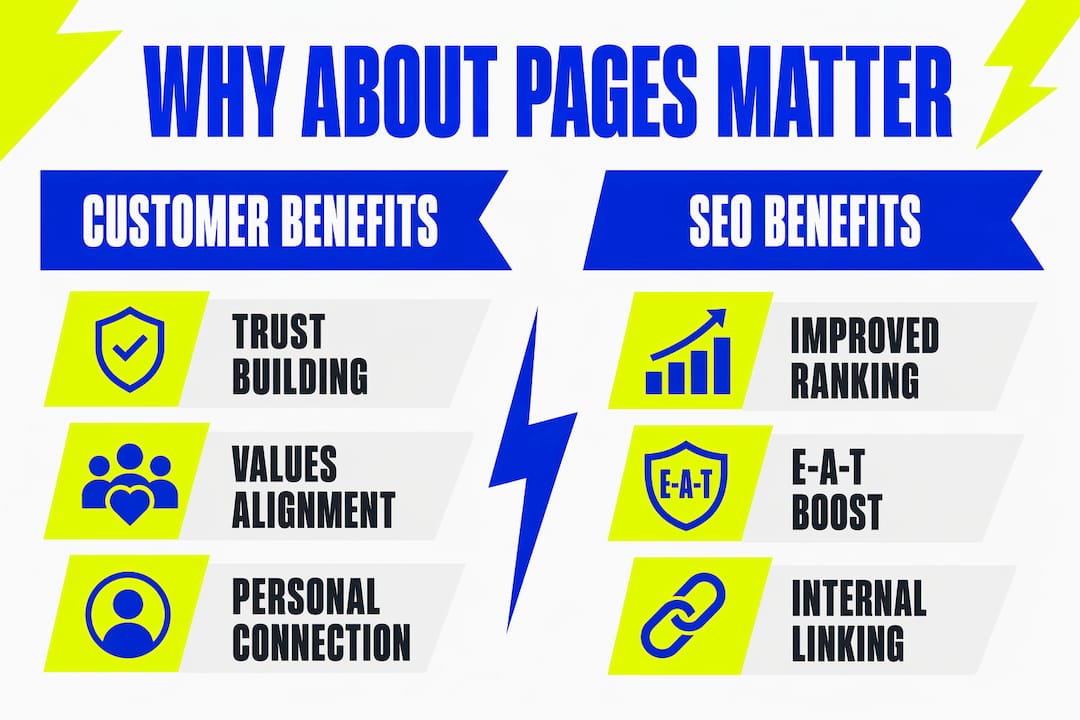
The importance of an About page also extends to values alignment. 82% of consumers prefer to buy from businesses whose values match their own. Your About page is the natural place to state what you stand for, clearly and without corporate waffle.
What to include on an effective about page
Knowing what to include on your About page separates a page that converts from one that simply exists. The goal is not to write your autobiography. The goal is to give visitors exactly what they need to feel confident choosing you.
Here are the core elements every effective About page should contain:
- Your founder’s story and the “why” behind the business. People connect with origin stories. Explain what motivated you to start, and keep it honest. Authenticity resonates far more than polished corporate language.
- A clear explanation of what you do and who you serve. Do not assume visitors already know. State your offer plainly and name the type of customer you work with.
- Your core values and mission. Keep this concise and specific. “We care about quality” means nothing. “We only use sustainably sourced materials because our founder grew up on a farm” means everything.
- Team introductions with photos and relevant credentials. A name, a face, and one line about their expertise is enough. Visitors want to see who they are dealing with, not read a full CV.
- A call to action. Every About page should guide visitors somewhere useful: your services page, a contact form, or a portfolio.
Copywriter Gill Andrews makes a point worth taking seriously: effective About pages address customer problems rather than indulging in self-absorbed history. Your story matters, but only in the context of how it benefits the person reading it. Frame every element around the visitor’s perspective, not your own.
Pro Tip: Write your About page as if you are answering the question “Why should I trust you?” rather than “Tell me about yourself.” That single shift changes the entire tone and focus.
What are the most common about page mistakes?
Most small business About pages fail for the same handful of reasons. Recognising these mistakes early saves you from publishing a page that quietly costs you customers.
Writing entirely about yourself. This is the most common error. Your business history is only relevant if it explains why you are the right choice for the customer. Every sentence should pass the “so what?” test from the reader’s point of view.
Using vague, generic statements. Phrases like “passionate about excellence” or “dedicated to delivering results” appear on thousands of websites. They say nothing specific and build no trust. Replace them with concrete facts: how long you have been trading, how many clients you have served, or a specific problem you solve.
Neglecting to update the page. Your About page should be a living asset, not a page you write once and forget. If your team has grown, your services have changed, or you have won an award, update the page. An outdated About page signals a business that is not paying attention.
Failing to connect your story to the customer’s needs. Sharing your business story authentically helps visitors decide to trust and engage. But the story must be told through the lens of what it means for them. Why does your background make you better placed to help them specifically?
Pro Tip: Read your About page aloud after writing it. If it sounds like a press release, rewrite it in the way you would explain your business to someone you met at a networking event. Conversational and clear always outperforms formal and stiff.
How does your about page support SEO and business goals?
The purpose of an About page extends well beyond storytelling. Used strategically, it becomes one of the most productive pages on your site for both search visibility and conversion.
Google’s E-A-T framework (Expertise, Authoritativeness, and Trustworthiness) places significant weight on About page content. Google values E-A-T signals from About pages that detail team credentials and company history. This means a well-written About page directly supports your search rankings, particularly for competitive local searches where trust is a deciding factor.
The table below shows how a strong About page serves two distinct audiences at once.
| Benefit for Customers | Benefit for SEO and Business Goals |
|---|---|
| Builds trust through transparency | Signals E-A-T to Google, supporting rankings |
| Reduces purchase hesitation | Increases time on site and reduces bounce rate |
| Creates emotional connection with your brand | Provides keyword-rich content for local search |
| Clarifies your offer and who you serve | Supports internal linking to key service pages |
| Gives visitors a reason to take the next step | Drives conversions through embedded calls to action |
Internal linking is particularly valuable here. Your About page naturally connects to your services, portfolio, and contact pages. Use it to guide visitors deeper into your site. A visitor who reads your story and then clicks through to your brand recognition strategy is far more likely to convert than one who bounces after a single page.
Keep your About page updated with current team information, recent achievements, and any relevant credentials. A strong About page explains not just what you do but who you are and why it matters to your audience. That combination of clarity and personality is exactly what both Google and your customers are looking for.
For practical guidance on how your overall site structure supports trust, the website design tips from Kukoocreative offer a useful companion read.
Key takeaways
An About page is a conversion tool, not a formality. Businesses that treat it as a living, customer-focused asset consistently build stronger trust and generate higher-value sales.
| Point | Details |
|---|---|
| About page drives higher spend | Visitors who view your About page before buying show 15% higher average order value. |
| Values alignment builds loyalty | 82% of consumers prefer businesses whose values match their own, making your mission statement critical. |
| Content must be customer-focused | Frame every element around what the visitor gains, not what you want to say about yourself. |
| SEO benefits are real | Google’s E-A-T framework rewards About pages with clear credentials and consistent brand messaging. |
| Keep it current | Treat your About page as a living asset and update it whenever your team, services, or achievements change. |
The uncomfortable truth about about pages
Most small business owners I speak with treat their About page as an afterthought. They write it once, usually in a rush, and never look at it again. I understand why. When you are running a business, the About page feels like the least urgent thing on your list.
But here is what I have observed over more than a decade working with business owners on their branding and websites: the About page is often the deciding factor. Not the homepage. Not the services page. The About page is where visitors make up their minds.
I have seen businesses with genuinely excellent services lose customers to competitors with weaker offerings, simply because the competitor’s About page felt more human and credible. The visitor could not see the difference in quality. They could only see the difference in trust.
The businesses that get this right share one habit. They write their About page for the reader, not for themselves. They ask “what does this person need to know to feel confident choosing us?” and they answer that question directly. They also revisit the page regularly, treating it the way they would treat a shop window: always current, always presenting the best version of the business.
If your About page is more than a year old and has not been touched, that is the place to start. Not a new logo. Not a social media campaign. Fix the page that 65% of your interested visitors are already clicking on.
— Kukoo
Ready to make your about page work harder?
Your About page deserves the same care and craft as every other part of your brand. At Kukoocreative, we have spent over a decade helping small business owners create websites and visual identities that genuinely connect with the right people. We know how to translate your story into design and copy that builds confidence from the first click.
If you are ready to build a website that reflects the quality of your business, explore our visual identity creation services or take a look at our client portfolio to see what is possible. Your About page is the heart of your online presence. Let us help you make it extraordinary.
FAQ
Why is an about page important for small businesses?
An About page is where visitors decide whether to trust your business. 65% of website visitors click on it specifically to assess credibility before making a purchase decision.
What should i include on my about page?
Include your founder’s story, a clear description of what you offer and who you serve, your core values, team photos with brief credentials, and a call to action directing visitors to your next step.
Does an about page affect SEO?
Yes. Google’s E-A-T framework rewards About pages that clearly demonstrate expertise, authoritativeness, and trustworthiness. Pages with team credentials and company history support stronger search rankings.
How often should i update my about page?
Update your About page whenever your team, services, or achievements change. Treating it as a living business asset rather than a static page keeps it credible and relevant for both visitors and search engines.
How do i make my about page convert better?
Focus on the reader rather than yourself. Address the customer’s concerns, use real photos, state your values specifically, and include a clear call to action. Pages with team profiles and video content generate significantly more leads than text-only versions.