
TL;DR:
- User experience encompasses all perceptions and emotions before, during, and after interacting with a product.
- Good UX relies on evidence-based design principles like user-centricity, consistency, and accessibility to create satisfying digital interactions.
User experience, known professionally as UX, is defined by ISO 9241 as the totality of a person’s perceptions, emotions, and responses before, during, and after interacting with a product, system, or service. That definition matters because it goes far beyond whether something “looks nice” or “works.” UX covers how a person feels throughout every touchpoint, from the moment they land on your website to the moment they complete a task and leave. For anyone building or running a digital product, understanding user experience is the difference between a product people return to and one they quietly abandon.
What is user experience design and its core principles?
User experience design is the practice of shaping every interaction a person has with a product so that it feels natural, efficient, and satisfying. Professional UX design follows an evidence-based process built around seven fundamental principles. Each one addresses a different dimension of how people interact with digital products.
- User-centricity. Design decisions must be grounded in validated user research, not internal preferences or stakeholder opinions. Evidence-based design reduces time spent debating subjective choices and leads to faster, better outcomes.
- Consistency. Predictable patterns in visuals and functionality reduce the mental effort users spend learning your product. When a button looks the same on every page, users stop thinking about the button and start focusing on their goal.
- Hierarchy. Organising information logically guides users through a product without confusion. Clear headings, grouped content, and prioritised calls to action all serve this principle.
- Context. Good UX accounts for where and how users interact with a product. A mobile user standing on a busy street has different needs from a desktop user at a desk.
- User control. Users must feel free to undo actions, go back, and navigate without fear of making irreversible mistakes. This principle builds confidence and reduces anxiety.
- Accessibility. WCAG 2.1 AA compliance requires a minimum contrast ratio of 4.5:1 and usability for people with disabilities. Failing to meet this standard harms a significant portion of your audience and introduces legal risk.
- Usability. A product is usable when people can complete their goals with minimal effort and without needing a manual.
Pro Tip: Test your product with five real users before launch. Research consistently shows that five participants uncover the majority of critical usability problems, making it one of the most cost-effective methods available.
These principles do not operate in isolation. The strongest digital products apply all seven together, treating them as a system rather than a checklist.

How does UX differ from usability, UI, and customer experience?
These four terms are frequently used interchangeably, but they describe distinct concepts. Confusing them leads to misaligned teams, wasted budgets, and products that fail users in ways nobody anticipated.
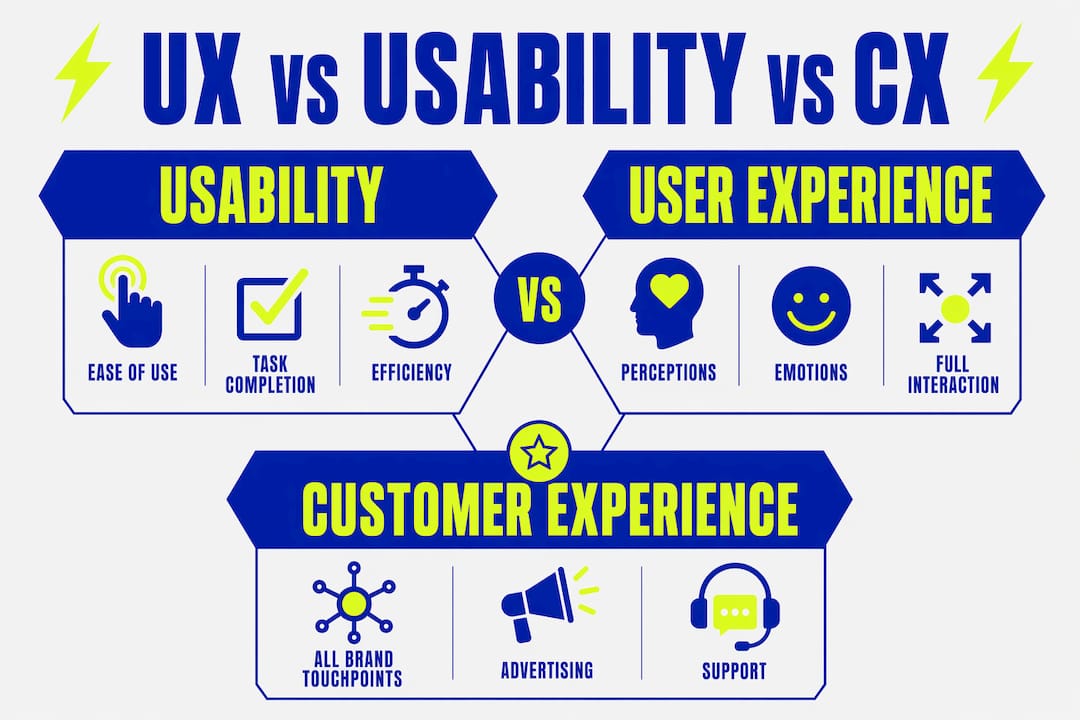
| Concept | Scope | Focus |
|---|---|---|
| Usability | Narrow | Ease of use and task completion efficiency |
| User experience (UX) | Broad | Full emotional and practical journey with a product |
| User interface (UI) | Visual layer | Buttons, colour schemes, typography, and layout |
| Customer experience (CX) | Widest | Every interaction across all brand touchpoints |
UX and UI design differ in a fundamental way. UI handles the visual look and feel: the colours, the button shapes, the typography. UX addresses the overall journey and interaction logic. A product can look beautiful and still be deeply frustrating to use. That gap is the difference between UI and UX.
Usability sits inside UX. It measures whether users can complete tasks efficiently and without errors. UX is broader. It also captures emotional and hedonic aspects of an interaction, including whether users feel pleasure or value from using a product. A product can be perfectly usable yet still feel cold, uninspiring, or forgettable.
Customer experience is the widest lens of all. CX covers every interaction a person has with a brand, including advertising, customer service calls, packaging, and in-store visits. UX is one component within CX, focused specifically on digital and product interactions. Getting your web usability right is a prerequisite for strong CX, not a substitute for it.
Why does user experience matter for business success?
Poor UX costs businesses in ways that rarely appear on a single line of a spreadsheet. Users who struggle to navigate a website leave. Users who cannot find information on a product page do not convert. Users who feel confused or frustrated do not return.
“Effective UX design is invisible. It focuses on functionality rather than aesthetics alone, enabling users to achieve their goals with minimal effort.” — UX design principles
The business case for investing in UX is direct. Better UX produces:
- Higher conversion rates, because users reach their goals without friction.
- Stronger brand loyalty, because positive experiences build trust over time.
- Lower support costs, because users who understand a product need less help.
- Reduced churn, because satisfied users have no reason to look elsewhere.
UX improves customer satisfaction by simplifying navigation, removing friction, and letting users accomplish tasks with minimal effort. That improvement compounds. A user who completes a task easily is more likely to return, recommend the product, and spend more over time.
One of the most common mistakes businesses make is prioritising aesthetics over function. A visually impressive website that confuses users is a liability, not an asset. The goal is a product that works so well users never have to think about how it works. That is the standard good UX sets.
What are the best practices for improving user experience?
Improving UX is not a one-off project. UX design is iterative, meaning it requires continuous research and testing throughout a product’s entire lifecycle. The following practices form a reliable foundation.
- Conduct iterative user research. Gather qualitative and quantitative data from real users at every stage of development. Surveys, interviews, and usability tests each reveal different types of insight. Collecting feedback without acting on it produces no improvement whatsoever.
- Run usability testing regularly. Test prototypes and live products with real users, not colleagues or stakeholders. Colleagues know the product too well to represent genuine first-time users.
- Design for accessibility from the start. Retrofitting accessibility is expensive and rarely complete. Building to WCAG 2.1 AA standards from the outset protects all users and reduces legal exposure.
- Maintain visual and functional consistency. Use a design system or style guide to keep components uniform across every screen and interaction. Inconsistency forces users to relearn the product repeatedly.
- Simplify navigation and reduce friction. Every unnecessary step between a user and their goal is a risk. Audit your user journeys regularly and remove anything that does not serve the user’s purpose. A practical website usability guide can help you identify where friction hides.
- Balance aesthetics with functionality. Visual design should support the user’s task, not compete with it. Typography, colour, and layout choices must all serve clarity first.
- Embed UX within your broader brand strategy. UX does not exist in isolation. The way your product looks, feels, and behaves must align with your brand identity. Misalignment between brand promise and product experience erodes trust quickly.
Pro Tip: Create a simple feedback loop: test with users, identify the top three friction points, fix them, then test again. This cycle, repeated every few weeks, produces more improvement than any single large redesign.
The most effective teams treat UX improvement as a permanent discipline, not a phase. Evidence-based design replaces guesswork with data, and data consistently produces better products than intuition alone.
Key takeaways
Good user experience is the result of applying consistent, evidence-based principles across every stage of a product’s design and development.
| Point | Details |
|---|---|
| UX is defined by ISO 9241 | It covers all perceptions and emotions before, during, and after product interaction. |
| UX differs from UI and usability | UI is the visual layer; usability is task efficiency; UX is the full emotional journey. |
| Poor UX has direct business costs | Friction reduces conversions, increases churn, and damages brand loyalty over time. |
| Accessibility is non-negotiable | WCAG 2.1 AA compliance protects users with disabilities and reduces legal risk. |
| Iteration drives improvement | Continuous testing and research outperform any single redesign or one-off audit. |
UX is not a phase. It is a practice.
After working in design for over a decade, the single biggest misconception I see is that UX is something you do once before launch. Teams invest in a research sprint, build the product, ship it, and move on. Then they wonder why users are dropping off six months later.
The truth is that continuous UX research replaces assumptions with real evidence throughout a product’s life. User behaviour changes. Context changes. The product itself changes. A UX process that stops at launch is not a UX process. It is a one-time audit with an expiry date.
The other trap I see constantly is the aesthetics-first approach. A client will spend weeks agonising over colour palettes and logo placement while the navigation structure is a mess nobody has tested. Beautiful design that confuses users is not good design. It is expensive decoration. The goal is always function first, then form in service of that function.
What I find genuinely exciting is how much UX overlaps with brand strategy. The way a product behaves is part of your brand. If your website is slow, confusing, or inaccessible, that is your brand to the user who experiences it. Getting UX right is not separate from building a credible, trustworthy brand. It is one of the most direct ways to do exactly that.
— Kukoo
How Kukoocreative supports your brand’s digital experience
Your website is often the first real interaction someone has with your brand. If that experience is confusing or visually inconsistent, the relationship starts on the wrong foot.
At Kukoocreative, we have spent over a decade helping business owners create visual identities that connect with the right people. From logo design to full website builds, every project is grounded in the same principles covered here: clarity, consistency, and a genuine understanding of your users. If you want a brand that works as hard as you do, take a look at our logo design service or get in touch to talk through what your business needs.
FAQ
What is user experience in simple terms?
User experience is how a person feels when using a product or service, covering every interaction from start to finish. It includes ease of use, emotional response, and whether the person achieved their goal.
What is the difference between UX and UI?
UX covers the full user journey and interaction logic, while UI focuses on the visual elements such as buttons, colours, and typography. A product can have strong UI and poor UX, or vice versa.
Why is accessibility part of user experience?
Accessibility ensures that all users, including those with disabilities, can use a product effectively. WCAG 2.1 AA is the recognised standard, requiring sufficient contrast ratios and keyboard navigability.
How do you measure user experience?
UX is measured through usability testing, user interviews, task completion rates, error rates, and satisfaction surveys. No single metric captures the full picture, so teams use a combination of methods.
How often should you review your product’s UX?
UX review should be continuous rather than periodic. Iterative testing throughout the product lifecycle produces better results than infrequent large-scale audits.