
TL;DR:
- Market positioning involves strategically shaping how your brand is perceived relative to competitors in customers’ minds. It relies on five key pillars: target audience, market category, UVP, proof points, and competitive frame. Regular review and clear internal alignment are essential to maintain a strong, differentiated market presence.
Market positioning is the strategic process of establishing a unique, favourable perception of your brand or product in customers’ minds relative to competitors. It shapes how people think about you before they even speak to your sales team. For UK business owners and marketers, getting this right is the difference between being the obvious choice and being ignored entirely. A clear market positioning strategy influences your pricing power, your messaging, and the loyalty customers feel towards your brand. This guide breaks down every component you need to build one that works.
What is market positioning and why does it matter?
Market positioning is not a tagline or a logo. It is the strategic place your brand occupies in the minds of your customers relative to every other option available to them. Think of it as a mental shortcut. When a customer needs what you offer, positioning determines whether your name surfaces first, second, or not at all.

The importance of market positioning becomes clear when you consider what it controls. A well-positioned business commands stronger pricing because customers understand the value. It generates more consistent leads because the right people self-select. It also reduces the cost of every marketing campaign because your message lands with precision rather than scatter. Pricing power, customer loyalty, and scalability all depend on occupying a clear slot in the customer’s mind.
For UK businesses competing in crowded sectors, from professional services in Leeds to e-commerce brands in Manchester, the stakes are high. Customers are bombarded with thousands of messages daily. Without a defined position, your business blends into the noise. Positioning is not a nice-to-have marketing exercise. It is the foundation of your entire commercial identity.
What are the key components of market positioning?
Effective positioning rests on five core pillars. Miss any one of them and your strategy develops gaps that competitors will exploit.
- Target audience. Who, specifically, are you serving? Not “small businesses” but “UK-based service firms with 5 to 50 employees looking to grow their client base.” The more precise, the stronger your position.
- Market category. Where does your offering sit? This is the competitive context customers use to evaluate you. Choosing the wrong category forces unfair comparisons and obscures your strengths.
- Unique value proposition (UVP). What do you deliver that no one else does, or does as well? This is the heart of your positioning.
- Proof points. What evidence supports your UVP? Case studies, testimonials, accreditations, and data all serve this role.
- Competitive frame of reference. Who are your real competitors, and how do you differ from each of them in ways that matter to your audience?
Once you have these five pillars defined, you can write an internal positioning statement. This document is not customer-facing. A positioning statement aligns your marketing, sales, and product teams so every piece of communication points in the same direction. Without it, different departments tell different stories, and customers feel the inconsistency.
Pro Tip: Write your positioning statement in one sentence using this structure: “For [target audience] who [need or problem], [brand name] is the [market category] that [UVP] because [proof point].” Pin it somewhere every team member sees it.
How does the market positioning process work in practice?
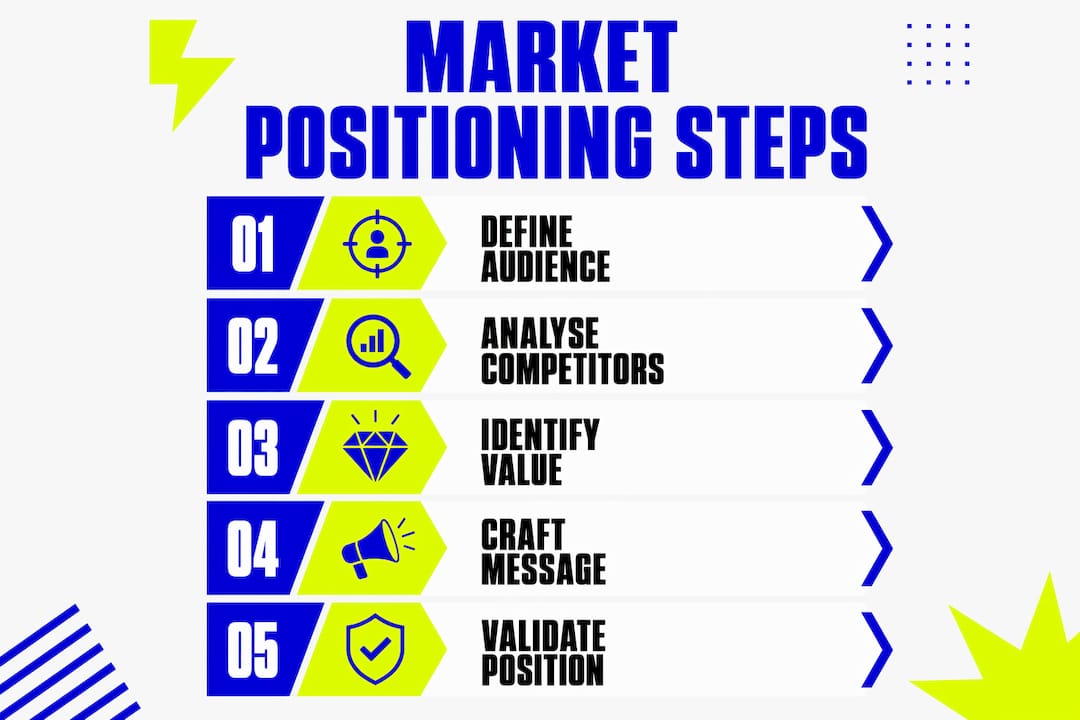
Building a positioning strategy follows a clear sequence. Here is how to work through it.
-
Conduct a competitive analysis. Map out your main competitors. Identify how they position themselves, what language they use, and where the gaps are. You are looking for a space they are not occupying that your audience genuinely values.
-
Define your target audience with precision. Go beyond demographics. Understand the specific problem your audience is trying to solve, the language they use to describe it, and the alternatives they are currently considering. Interviews and customer surveys are far more reliable than assumptions.
-
Develop your unique value proposition. Focus on 3 to 5 unique differentiators rather than listing every feature. Ask yourself what Terry Sadowski from Pragmatic Institute calls the three anchoring questions: “What problem are we solving?”, “Who is it for?”, and “Why does anyone care?” These keep your UVP grounded in customer reality rather than internal enthusiasm.
-
Choose your positioning approach. There are several recognised approaches. You can position on quality, on price, on a specific use case, on a particular audience segment, or against a named competitor. Each has trade-offs. Quality positioning requires proof. Price positioning attracts price-sensitive buyers who may leave for a cheaper option. Use-case positioning works well for specialist tools or services.
-
Align your teams internally. Positioning only works when everyone communicates it consistently. Your sales team, your content writers, your customer service staff, and your designers all need to understand and reflect the same position. This is where the internal positioning statement earns its keep.
-
Review and refine regularly. Markets shift. Competitors enter. Customer priorities change. Positioning is a continuous process, not a one-time document. Build a quarterly review into your marketing calendar to check whether your position still holds.
What common pitfalls undermine market positioning?
Most positioning failures come down to a handful of recurring mistakes. Recognising them early saves considerable time and money.
- Vague or generic positioning. Unclear positioning makes businesses invisible in crowded markets. Phrases like “we deliver quality service” or “we put customers first” say nothing distinctive. Every competitor says the same thing. If your positioning could apply to any business in your sector, it is not positioning at all.
- Parity positioning. This is where companies focus on features their competitors also have. Parity positioning dilutes differentiation and weakens competitive advantage. Listing shared capabilities does not give customers a reason to choose you specifically.
- Wrong market category. Selecting the wrong category is possibly the most expensive positioning mistake a business can make. If you position a premium consultancy alongside budget freelancers, you will lose on price every time, even though you are not competing on price. Category selection determines who you are compared against.
- Confusing positioning with messaging. Positioning defines the strategic space you occupy. Messaging translates that into words for your audience. Many businesses skip the positioning step and go straight to writing copy. The result is clever words with no strategic anchor. Positioning must be set before messaging to be effective.
Common branding mistakes UK SMEs make often trace back to these exact positioning failures. Fixing the strategy upstream makes every downstream marketing decision easier and more consistent.
Pro Tip: Test your positioning by asking a trusted customer to describe what makes you different from your competitors. If their answer does not match your intended position, you have a gap to close.
How does market positioning differ from branding and product positioning?
These three concepts are closely related but serve distinct purposes. Conflating them leads to muddled strategy.
| Concept | Focus | Time horizon | Example |
|---|---|---|---|
| Market positioning | Where your brand sits relative to competitors in the market | Medium to long term | Volvo positioned as the safety-first car brand |
| Product positioning | How a specific product is framed for a specific audience | Short to medium term | Volvo XC90 positioned for premium family buyers |
| Brand positioning | The emotional identity and values associated with your brand | Long term | Volvo as a brand associated with trust and reliability |
Market positioning is broader and more enduring than product positioning, which tends to be more specific and shorter-lived. Brand positioning operates at the emotional and values level, building associations over years rather than campaigns. Your messaging and value propositions sit downstream of all three. They are the outputs, not the strategy itself.
For UK businesses, the practical implication is this: define your market position first, then use it to guide product positioning decisions and brand identity development. Kukoocreative’s work on brand positioning for UK small businesses illustrates how this sequence plays out in practice for professional services firms.
Key takeaways
Effective market positioning is the foundation every other marketing and branding decision is built upon, and without it, even well-funded campaigns fail to convert.
| Point | Details |
|---|---|
| Define positioning clearly | Market positioning is the strategic place your brand occupies in customers’ minds relative to competitors. |
| Use the five pillars | Target audience, market category, UVP, proof points, and competitive frame are all required for strong positioning. |
| Follow the process | Competitive analysis, audience definition, UVP development, team alignment, and regular review form the core sequence. |
| Avoid key pitfalls | Vague claims, parity features, wrong category selection, and skipping to messaging all undermine positioning. |
| Distinguish related concepts | Market positioning, product positioning, and brand positioning serve different purposes and operate on different timescales. |
Why positioning is the conversation most UK businesses are not having
After working with business owners across the UK for over a decade, the pattern I see most often is this: teams invest heavily in design, advertising, and social media before they have ever agreed on what position they actually hold in the market. The result is beautiful creative work pointing in three different directions at once.
The businesses that grow with confidence are the ones that treat positioning as a board-level conversation, not a marketing department task. When your leadership team can articulate in one sentence why a customer should choose you over every alternative, your marketing becomes dramatically more focused. Your designers know what to communicate. Your sales team knows what story to tell. Your content team knows what problems to address.
The other thing I have observed is that UK businesses often underestimate how quickly their position can drift. A competitor enters with a sharper message. A market shift changes what customers value. Suddenly the position you defined two years ago no longer reflects reality. Building a regular review into your strategy calendar is not optional. It is what keeps your positioning honest and your growth on track.
Explore branding strategies for better success to see how positioning translates into practical brand decisions for UK service businesses.
— Kukoo
Bring your positioning to life with Kukoocreative
Once your market positioning strategy is clear, the next step is translating it into a visual identity that communicates it instantly. Your logo, colour palette, and design language are the first things customers see. They either reinforce your position or contradict it.

At Kukoocreative, we have spent over a decade helping UK business owners turn their positioning into visual identities that build recognition and competitive edge. From logo design to full brand asset creation, every decision we make is anchored in your strategic position. If you are ready to make your positioning visible, start with our logo design brief and let us build something that genuinely reflects where you stand in your market.
FAQ
What is the simplest definition of market positioning?
Market positioning is the process of defining how your brand or product is perceived relative to competitors in the minds of your customers. It shapes every aspect of how you communicate and compete.
How do I start building a market positioning strategy?
Begin with a competitive analysis to identify gaps, then define your target audience precisely and develop a unique value proposition focused on 3 to 5 genuine differentiators. Document this in an internal positioning statement before writing any customer-facing copy.
What is the difference between positioning and messaging?
Positioning defines the strategic space your brand occupies in the market. Messaging translates that position into the words and stories you share with customers. Positioning must be established first, or messaging lacks direction.
Why do businesses get market positioning wrong?
The most common failures are vague claims that apply to any competitor, focusing on shared features rather than genuine differences, and selecting the wrong market category. Each of these makes it harder for customers to understand why they should choose you.
How often should I review my market positioning?
A quarterly review is good practice. Markets shift, competitors evolve, and customer priorities change. Positioning that was accurate two years ago may no longer reflect your competitive reality or your audience’s needs.