
TL;DR:
- Behavioral targeting uses user actions to personalize messages, but it requires clear consent under UK GDPR and PECR.
- For compliance, businesses should prioritize first-party data, transparent consent mechanisms, and consider lower-risk alternatives like contextual or session-based targeting.
Behavioural targeting is the practice of using an individual’s recorded on-site and cross-session actions to decide which message, offer, or creative they see next. For UK business owners, the bottom line is straightforward: it can genuinely improve conversions and brand relevance, but only when you have explicit, informed consent in place under UK GDPR and PECR. Start with first-party data from your own website, keep your consent UX honest, and you will be on solid ground. The ICO is clear that consent must be freely given, specific, and easy to withdraw — not buried in a cookie banner designed to frustrate.
Table of Contents
- How does behavioural targeting work?
- How does behavioural targeting differ from contextual targeting?
- What does behavioural targeting look like for branding and web design?
- What are the UK legal requirements for behavioural targeting?
- How do you implement behavioural targeting compliantly, step by step?
- What alternatives and hybrid approaches work for UK SMEs?
- What does implementation cost and how long does it take?
- Key takeaways
- Kukoo’s perspective on behavioural targeting for UK brands
- Kukoocreative: privacy-first branding and web design for UK businesses
- Useful sources and further reading
How does behavioural targeting work?
The process runs in four connected stages: capture, store, segment, and trigger.
- Capture. Cookies, tracking pixels, analytics tags, and server logs collect behavioural signals such as pages visited, scroll depth, time on page, clicks, search queries, and past purchases.
- Store. That data is held in a data management platform, a customer data platform, or your analytics tool, linked to a browser identifier, device ID, or logged-in user profile.
- Segment. Rules or machine-learning models group visitors by inferred intent. Someone who has visited your pricing page three times in a week sits in a different segment from a first-time blog reader.
- Trigger. When a visitor matches a segment rule, a personalised CTA, retargeted ad, or tailored message fires in real time. Exit-intent overlays and cart-abandonment notifications are common examples of real-time triggers built on this logic.
Historical profiles power long-term retargeting campaigns. Real-time signals, such as a visitor reaching 80% scroll depth on a service page, power in-session personalisation. Both rely on the same underlying data flow.
How does behavioural targeting differ from contextual targeting?
The distinction matters for compliance as much as for performance.
| Dimension | Behavioural targeting | Contextual targeting |
|---|---|---|
| What it uses | Cross-session user actions and profiles | Content of the page being viewed right now |
| Privacy risk | Higher — requires profiling and consent | Lower — no cross-session profiling needed |
| Relevance | Personally tailored to the individual | Matched to page topic, not the person |
| Consent requirement | Explicit consent under UK GDPR/PECR | Generally simpler to justify; often no tracking cookies |
| Best for | Retargeting, conversion journeys, loyalty | Brand awareness, new audiences, brand safety |
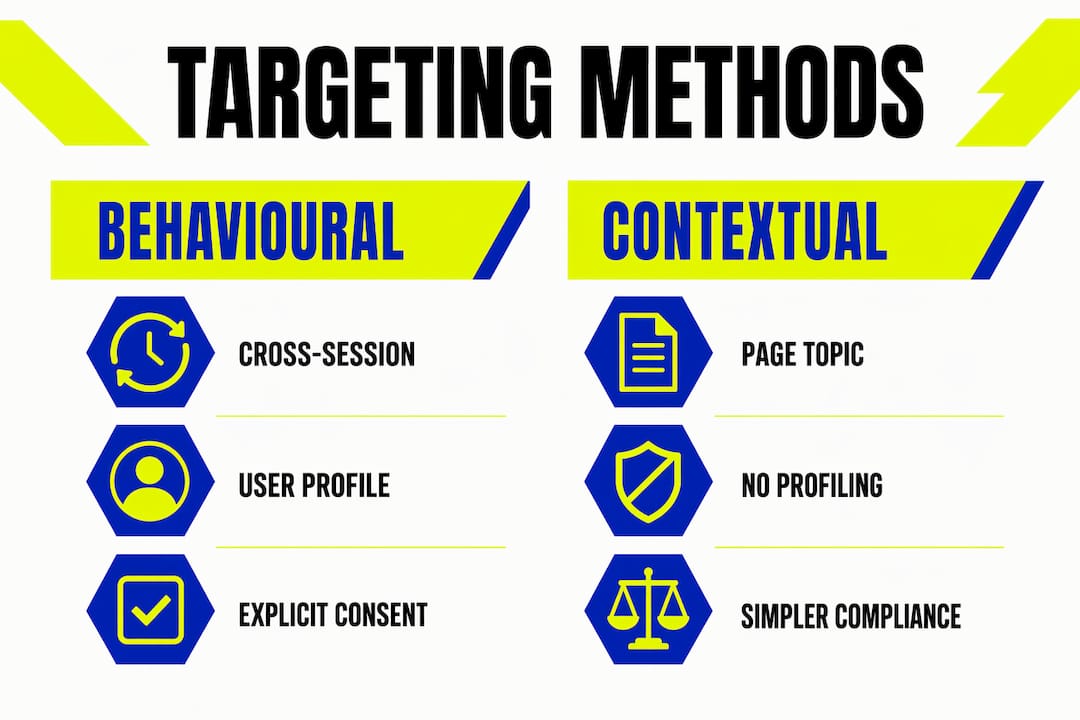
Contextual advertising is less privacy-invasive and simpler to justify under PECR because it does not profile users across sessions. The ICO recommends it as the safer compliance route for publishers and brands that cannot guarantee robust consent mechanisms.
Pro Tip: If you are running brand-awareness campaigns or advertising on third-party sites where you cannot control consent quality, contextual targeting is the cleaner choice. Reserve behavioural approaches for your own website, where you control the consent layer.
What does behavioural targeting look like for branding and web design?
Practical, brand-oriented use cases make the concept tangible.
- Personalised CTAs. A visitor who has read two case studies sees “See our portfolio” rather than a generic “Get in touch.” Matching the CTA to demonstrated interest consistently lifts click-through. Kukoocreative’s CTA placement guide covers the timing and positioning principles that make this work.
- Journey-based messaging. First-time visitors see brand story content; returning visitors who have viewed the pricing page see a specific offer or a testimonial relevant to their industry.
- Lead abandonment flows. A visitor who starts a contact form and leaves can be shown a follow-up message on their next visit, or retargeted via a consented email sequence.
- Repeat visitor recognition. Showing a returning visitor “Welcome back” content, or surfacing the service page they previously spent the most time on, reduces friction and signals that your brand pays attention.
For measurement, track conversion rate by segment, engagement depth (scroll and time on page), and revenue per visit. A/B testing a personalised CTA against a generic one on a high-traffic page is the fastest way to validate whether the investment is paying off. First-party behavioural data and privacy-aware personalisation deliver higher ROI and a better user experience than undifferentiated mass messaging.
Behavioural signals from your own website are the most reliable data you own. They reflect real intent from people who have already found you — and that is a far stronger foundation for personalisation than any third-party audience list.
What are the UK legal requirements for behavioural targeting?
This is where many businesses get into trouble. The rules are not ambiguous.
Under UK GDPR and PECR, using cookies or pixels to collect behavioural data for advertising requires explicit, informed, and unambiguous consent. That consent must be as easy to withdraw as it was to give. The ICO will scrutinise consent mechanisms that are unclear, forced, or difficult to reverse.
Legitimate interests cannot substitute for consent when it comes to individual-level cross-session profiling. It can, however, support company-level (firmographic) targeting in a B2B context, provided you complete a Legitimate Interests Assessment and can demonstrate the processing is proportionate.
“Consent or pay” models must offer a broadly equivalent service to users who decline personalised advertising. If the free tier is materially degraded, the ICO’s equivalence standard means that consent may be found invalid under Article 7(4) UK GDPR.
Compliance checklist for your website:
- Granular consent options (separate toggles for analytics, personalisation, and advertising)
- Clear description of each purpose at the point of consent
- Easy, one-step withdrawal mechanism
- Consent logs stored and auditable
- Data Protection Impact Assessment (DPIA) for high-risk profiling activities
How do you implement behavioural targeting compliantly, step by step?
- Map your data. List every signal you want to collect. Classify each as personal or non-personal. Decide whether first-party (your own site) or third-party data is needed — first-party is almost always the right starting point for UK SMEs.
- Set up a consent management platform (CMP). Choose a CMP that supports granular opt-ins, clear purpose descriptions, and easy withdrawal. Integrate it with your tag manager before any tracking fires.
- Configure event tracking. Use a tag manager (Google Tag Manager is widely used) to fire tracking tags only after consent is confirmed. Set up events for key actions: page views, scroll depth, form starts, CTA clicks.
- Define your segments. Start simple: “visited pricing page twice,” “downloaded a resource,” “returning visitor, no enquiry.” Three to five segments are enough for an initial test.
- Build your first experiment. A pricing-page visitor who returns within seven days sees a personalised CTA. Measure conversion rate against the control. Run for at least two weeks before drawing conclusions.
- Select vendors carefully. Prioritise tools with strong privacy postures, clear data ownership terms, and straightforward integration with your CMS or CRM. Check that data is not shared with third parties without your knowledge.
- Review consent UX with your designer. The consent banner and withdrawal flow are part of your brand experience. A confusing or aggressive banner damages trust before a visitor has even seen your content.
Pro Tip: Audit your existing cookie banner before building any personalisation layer. If it pre-ticks boxes, hides the “reject all” option, or makes withdrawal harder than consent, fix that first. The ICO has been explicit: meaningful control over tracking is non-optional.
What alternatives and hybrid approaches work for UK SMEs?
Not every business needs full cross-session behavioural profiling. Three lower-risk approaches are worth considering.

Contextual targeting places ads or content based on the page topic rather than the user’s history. No cross-session cookies, no profiling, and a much simpler compliance position. For brand campaigns aimed at new audiences, it often performs comparably to behavioural targeting at a fraction of the regulatory risk.
Firmographic targeting uses IP-level or company signals to infer the visitor’s organisation, sector, or size. For B2B businesses, this sits more comfortably under legitimate interests than individual profiling does, provided you complete a Legitimate Interests Assessment. UK B2B websites commonly use this approach for top-of-funnel personalisation while reserving consent-based behavioural tracking for high-value conversion journeys.
Session-based personalisation responds only to what a visitor does within a single session, with no persistent identifier carried across visits. It requires no cross-session cookie and is therefore far easier to justify. A visitor who views three service pages in one session can be shown a relevant CTA without any consent complexity.
A hybrid model combines all three: firmographic signals at the top of the funnel, session-based personalisation in the middle, and consent-based behavioural targeting for returning visitors who have opted in. Recommended by practitioners working in the UK market, this approach balances reach, relevance, and regulatory safety. For further context on data privacy compliance, a structured approach to regulation is well worth reading before you build.
What does implementation cost and how long does it take?
Costs and timelines vary by scope, but a realistic framework for UK SMEs looks like this.
- Discovery and planning (weeks 1–2). Map data needs, audit existing tracking, choose your CMP and tag manager. Primary cost: internal time or agency consultancy fees.
- Consent and tracking build (weeks 3–6). CMP configuration, tag manager setup, event tracking QA, and security review. Tooling costs range from free tiers (Google Tag Manager) to paid CMP licences. Development effort is the main variable.
- Personalisation rules and content (weeks 7–10). Define segments, build personalised CTAs or landing page variants, and connect your CRM or analytics platform.
- Testing and optimisation (weeks 11–12 onwards). Run A/B tests, review KPIs, and iterate. A minimum viable programme can be live in 6–12 weeks. A full programme with multiple segments, retargeting, and CRM integration typically runs 3–6 months.
Ongoing costs include CMP licensing, analytics tooling, and the development time to maintain and expand personalisation rules as your site evolves. Legal analysis from Mills & Reeve notes that publishers and advertisers should factor compliance costs into their revenue model as personalised advertising becomes harder to deliver without robust consent infrastructure.
Key takeaways
Behavioural targeting works for UK businesses when it is built on first-party data, explicit consent, and a privacy-first technical setup from day one.
| Point | Details |
|---|---|
| Consent is non-negotiable | UK GDPR and PECR require explicit, withdrawable consent before any cross-session behavioural tracking fires. |
| Start with first-party data | Your own site signals are more reliable and easier to justify than third-party audience lists. |
| Contextual targeting is lower risk | For brand campaigns or new audiences, contextual approaches avoid profiling and simplify compliance. |
| Hybrid models suit most SMEs | Combine firmographic, session-based, and consent-based behavioural targeting to balance reach and regulatory safety. |
| Kukoocreative as your partner | Kukoocreative builds privacy-aware websites and brand identities designed to support compliant personalisation from the ground up. |
Kukoo’s perspective on behavioural targeting for UK brands
The conversation around behavioural targeting often gets polarised: either it is presented as a silver bullet for conversion, or it is dismissed as too risky under GDPR. Neither position is particularly useful for a business owner trying to make a practical decision.
What we see consistently is that the businesses getting the best results are not the ones with the most sophisticated tracking stacks. They are the ones who have invested in a well-designed website with clear user journeys, strong brand identity, and a consent experience that does not make visitors feel surveilled. When you have those foundations, even simple first-party signals, such as which service page a returning visitor gravitates towards, give you enough to personalise meaningfully without touching the edges of what the ICO scrutinises.
The ethical dimension matters too. Visitors who feel that a brand is paying attention in a helpful way respond positively. Visitors who feel tracked without their knowledge do not come back. That distinction shapes every recommendation we make when designing conversion-focused websites for UK clients. A credible brand and a trustworthy website experience are the most durable personalisation strategy available.
Kukoocreative: privacy-first branding and web design for UK businesses
If you are ready to put behavioural targeting to work, the most important first step is a website built to support it: clear user journeys, a consent layer that reflects your brand values, and CTAs positioned to convert the right visitor at the right moment.

Kukoocreative has spent over a decade designing brand identities and websites for UK business owners who want to stand out and convert. From visual identity creation to full web design and systems development, every project is built with conversion and compliance in mind. Whether you are starting from scratch or improving an existing site, the work begins with understanding your audience and your goals. Take a look at the Kukoocreative portfolio to see what that looks like in practice, then get in touch to discuss your project.
Useful sources and further reading
- ICO guidance on online advertising, cookies and consent — the primary reference for UK GDPR and PECR obligations around behavioural and contextual advertising.
- ICO: consent-or-pay equivalence standard — essential reading if you are considering a pay-or-consent model on your website.
- ASA guidance on online behavioural advertising — covers transparency, opt-out mechanisms, and prohibited collection practices under the UK advertising codes.
- IAB UK: Legitimate Interests Assessments under UK GDPR — practical framework for completing an LIA for digital advertising use cases.
- Mills & Reeve: personalised advertising and revenue risk — legal analysis of the commercial implications of tightening consent rules.
For complex setups involving cross-device tracking, data sharing with third parties, or high-volume profiling, seek advice from a qualified data protection solicitor or a registered Data Protection Officer before you build.
This article is general information, not legal advice. Confirm the current rules with the ICO or a qualified data protection professional for your specific situation.