
TL;DR:
- Negative space actively shapes perception, controls hierarchy, and signals quality in design. Proper use of space improves readability, communicates confidence, and enhances brand identity through deliberate balance. Educating clients on space as a communication tool ensures better design decisions and stronger visual impact.
Negative space is defined as the deliberate, unoccupied area surrounding or between the subjects of a composition. Far from being empty, it shapes perception as powerfully as the visible elements themselves. The role of negative space in design is to direct attention, establish hierarchy, and signal quality. Designers who understand this principle, from James Mattison to the teams at Venngage and Coursera, consistently demonstrate that negative space drives brand perception as much as colour, typography, or imagery.
How does negative space influence perception and readability?
Negative space reduces cognitive load. When a layout breathes, the viewer’s brain processes information faster and retains it longer. Deliberate spacing guides attention and reduces the sense of overwhelm that cluttered interfaces create. This is not a stylistic preference. It is a functional requirement for legibility.
The psychological effects are well documented. Wider, intentional negative space signals premium and luxury branding, while cluttered layouts imply a lower budget look. That gap in perception is significant. A brand that crowds its materials communicates urgency and scarcity. A brand that breathes communicates confidence and quality.
Negative space also defines relationships between elements. Elements placed close together are perceived as belonging to the same group, while space between them signals separation. This is the Gestalt principle of proximity at work. Designers who control spacing control meaning.
The effect on readability is direct:
- Hierarchy: Generous space around a headline tells the eye where to start reading.
- Focus: Isolated elements attract attention. Space is the spotlight.
- Comprehension: Readers absorb content more easily when paragraphs and sections have room to breathe.
- Mood: Minimal space creates calm and authority. Tight space creates energy and urgency.
- Navigation: Clear spacing helps readers move through content without losing their place.
Pro Tip: When reviewing a layout, squint at it. The areas your eye lands on first are where your spacing is working. The areas that blur into noise are where it is not.
What are common misconceptions about negative space?
The most damaging misconception is that negative space is wasted space. Clients see an empty margin and think the designer has not finished the job. This misunderstanding is the single greatest challenge in applying negative space effectively. The greatest challenge in negative space use is client communication, not design technique.
The reality is the opposite. Every margin, every gap, every pause in a layout is a deliberate decision. Negative space is not leftover but an active communication tool that signals quality and confidence. Removing it does not add value. It destroys hierarchy and makes everything compete for attention at once.
Three misconceptions come up repeatedly in client feedback sessions:
- “There is too much empty space.” Space is not empty. It is the frame that makes the subject visible. A painting without a frame loses context. A logo without breathing room loses authority.
- “Can we make the logo bigger?” Scaling up a logo into its surrounding space collapses the negative space that gives it presence. Bigger is not always stronger.
- “Let’s add more information.” Adding content without adding space creates visual noise. Every new element needs its own space to be understood.
Educating clients on these points transforms the conversation. When designers frame negative space as a communication strategy rather than a stylistic choice, stakeholders respond differently.
“Defending white space is more effective when framed as a communication strategy rather than a subjective preference. Arguments based on clarity and message communication convince stakeholders more successfully.” — James Mattison
How to use negative space to strengthen brand identity
Negative space and positive space are complementary forces in composition. One cannot work without the other. The skill lies in balancing them so that neither dominates at the expense of the other.

The most memorable logos in history use negative space as an active design element. The FedEx logo hides an arrow between the E and the x. The WWF panda is defined as much by its white areas as its black ones. These are not accidents. They are the result of designers who understood that negative space sets the tone of a composition and reinforces brand messaging at a subconscious level.
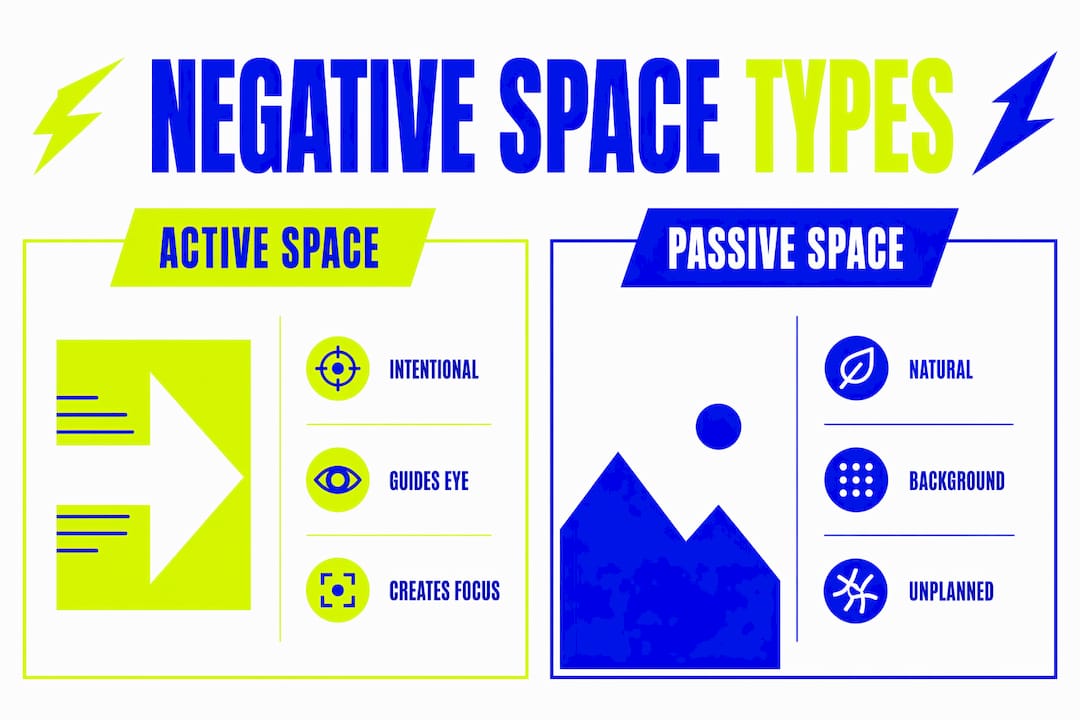
Active vs passive white space
Understanding the difference between active and passive white space sharpens every layout decision.
| Type | Definition | Example |
|---|---|---|
| Active white space | Intentionally placed to guide the eye and create emphasis | Space around a call to action button |
| Passive white space | Occurs naturally as a by-product of layout | Space between words in a paragraph |
Active white space is the intentional space created by deliberate design decisions. Passive white space occurs naturally, such as the gaps between words or the margins of a page. Both matter, but active white space is where a designer’s skill shows.
Protecting negative space during client feedback
Client feedback is where negative space goes to die. A stakeholder adds a strapline here, a phone number there, and suddenly the layout is fighting itself. Protecting space requires a plan before feedback begins.
- Lock key spacing values in your design file before sharing with clients.
- Present the design at actual size, not zoomed out. Space reads differently at scale.
- Show a comparison: the original layout alongside a version with reduced spacing. Let the client see the difference.
Pro Tip: Build a “minimum clear space” rule into every logo and layout you deliver. Document it in the brand guidelines so future designers and clients cannot accidentally collapse it.
For designers working on negative space in logos, this principle is especially critical. A logo’s surrounding space is part of its visual identity, not an afterthought.
What tools and workflows support effective negative space use?
The right tools make spacing decisions visible and measurable. Without them, spacing becomes guesswork.
Adobe Illustrator and Figma both offer features that help designers measure and control spacing precisely. Figma’s auto layout and spacing tokens allow designers to set consistent gaps across components. Adobe Illustrator’s alignment panel and smart guides make it straightforward to distribute space evenly between objects.
Workflows that support good spacing decisions include:
- Grids and baseline grids: Set a grid before you place a single element. Every spacing decision then relates to a consistent unit, which creates visual harmony across the whole composition.
- Spacing tokens in design systems: Tools like Figma allow teams to define spacing values (8px, 16px, 32px) as tokens. This means spacing is consistent across every screen and component without relying on individual judgement.
- Whitespace audits: Before finalising a layout, review it with all colour removed. A greyscale version reveals whether spacing is doing the structural work or whether the design is relying on colour to create separation.
- Design briefs that include spacing requirements: Incorporating negative space considerations at the brief stage prevents the problem of adding space as an afterthought. Ask clients upfront: what feeling should this design communicate? The answer shapes your spacing decisions from the start.
- Version control and locked layers: In both Figma and Adobe Illustrator, locking spacing layers or frames prevents accidental changes during collaborative editing sessions.
The 12 creative branding strategies that consistently produce strong brand recognition all share one characteristic: deliberate, protected spacing at every level of the design system.
Key takeaways
Negative space is a structural requirement for legible, credible design. Removing it does not add content. It removes clarity.
| Point | Details |
|---|---|
| Negative space directs attention | Deliberate spacing tells the viewer where to look and in what order. |
| Wider spacing signals quality | Design studies show that generous spacing correlates with premium brand perception. |
| Client education is the hardest part | Framing space as a communication tool, not a stylistic choice, wins stakeholder buy-in. |
| Active and passive space both matter | Active white space is intentional; passive white space is structural. Plan for both. |
| Tools make spacing measurable | Figma and Adobe Illustrator both provide features to lock and measure spacing consistently. |
Why I always defend the space first
After years of working on brand identities at Kukoocreative, the pattern is clear. The designs that clients remember, and the ones that perform best in the market, are almost never the busiest ones. They are the ones that had the confidence to leave space.
The hardest conversation in any design project is not about colour or typography. It is about space. Clients feel uncomfortable with emptiness. They interpret it as incompleteness. My job, and yours, is to reframe that discomfort. Space is not absence. It is presence. It is the thing that makes everything else visible.
I have found that showing a before and after comparison is more persuasive than any explanation. Put a cluttered version next to a version with protected spacing and let the client’s eye do the work. They almost always choose the version with more space, once they can see the difference rather than just imagine it.
The brands that stand the test of time, from Apple’s product pages to Penguin’s book covers, use space as a primary design element. That is not a coincidence. Space communicates confidence. It says: we are not trying to fill every gap because we do not need to. That is exactly the message a credible brand wants to send.
— Kukoo
How Kukoocreative puts negative space to work for your brand
At Kukoocreative, we have spent over a decade building brand identities that communicate clearly and look credible at every size. Negative space is not an afterthought in our process. It is a deliberate decision made at the brief stage and protected through every round of feedback.

Whether you are briefing a new logo or reviewing an existing brand identity, the way space is used will shape how your audience perceives you. A well-considered layout signals confidence. A crowded one signals noise. If you want to understand how logo design shapes your brand, or you are ready to brief a project where space is treated as seriously as colour and type, Kukoocreative is the partner to call. Take a look at our design portfolio to see how we put these principles into practice.
FAQ
What is negative space in design?
Negative space is the deliberate, unoccupied area surrounding or between the subjects of a composition. It shapes perception, directs attention, and signals quality as actively as the visible elements do.
Why is negative space important for brand identity?
Wider, intentional negative space signals premium and luxury branding, while cluttered layouts imply a lower budget look. Space communicates confidence and quality at a subconscious level.
What is the difference between active and passive white space?
Active white space is intentionally placed by the designer to guide the eye and create emphasis. Passive white space occurs naturally, such as the gaps between words in a paragraph.
How do I convince clients to keep negative space?
Frame space as a communication strategy, not a stylistic preference. Arguments based on clarity and message communication convince stakeholders more successfully than aesthetic arguments alone.
Which tools help designers control negative space?
Adobe Illustrator and Figma both offer grids, guides, and spacing measurement features that make it straightforward to lock and maintain consistent spacing across a design system.