
Consistency is not just a buzzword for British businesses in Leeds—research shows brands with consistent presentation increase revenue by up to 23 percent. For local small business owners, dependable branding builds trust and makes your organisation instantly recognisable, meaning customers know exactly what to expect. This guide details straightforward steps to help you shape a reliable brand identity that connects with your Leeds audience and grows your reputation.
Table of Contents
- Defining Consistency in Branding Essentials
- Key Elements of Consistent Brand Identity
- How Consistency Shapes Customer Perception
- Brand Consistency in Leeds: Practical Tactics
- Common Mistakes and How to Avoid Them
Key Takeaways
| Point | Details |
|---|---|
| Brand Consistency | Strategic alignment of visual identity, messaging, and communication fosters emotional value and builds recognition across all touchpoints. |
| Customer Perception | Consistency instils familiarity and trust, leading to stronger loyalty and an emotional connection with the brand. |
| Local Branding Tactics | Regional authenticity should complement core identity, ensuring a unified brand presence that resonates with local audiences. |
| Avoiding Common Mistakes | Establishing clear brand guidelines and regular audits prevents fragmentation and maintains trust and recognition in branding efforts. |
Defining Consistency in Branding Essentials
Brand consistency represents the strategic alignment of messaging, visual identity, and organisational communication across all business touchpoints. Research reveals that consistency synthesises complementary elements to create emotional value by establishing a recognisable and stable brand presence.
At its core, branding consistency means maintaining uniform representation through visual design, tone of communication, and core messaging. This approach ensures that whether a potential customer encounters your brand on social media, your website, printed materials, or during a face-to-face interaction, they experience a cohesive and predictable brand personality. Brand personality alignment across marketing channels directly correlates with organisational reputation and performance.
Key elements of brand consistency include:
- Visual identity (logo, colour palette, typography)
- Communication tone and language
- Core messaging and value propositions
- Customer interaction standards
- Digital and physical brand representation
Pro tip: Develop a comprehensive brand guideline document that details every aspect of your brand’s visual and communication standards, ensuring all team members can maintain consistent representation.
Key Elements of Consistent Brand Identity
Building a robust brand identity requires strategic attention to multiple interconnected elements that work together to create a unified organisational image. Research highlights that consistent brand identity encompasses a cohesive visual representation reflecting an organisation’s core values and heritage, ensuring every communication reinforces the same core message.
The primary components of a consistent brand identity include visual design, messaging, and brand personality. Visual design involves maintaining uniform logo usage, colour schemes, typography, and graphic elements across all platforms. Messaging requires developing a consistent tone of voice and communication style that remains recognisable whether presented through digital marketing, printed materials, or direct customer interactions. Brand personality must be deliberately communicated uniformly across all marketing channels to strengthen organisational reputation.
Key elements to maintain consistent brand identity include:
- Standardised logo placement and usage guidelines
- Uniform colour palette across all marketing materials
- Consistent typography and font selections
- Aligned communication tone and language
- Coherent visual storytelling
- Predictable customer experience design
Pro tip: Create a comprehensive brand style guide that details precise visual and communication standards, enabling every team member to represent your brand authentically and consistently.
How Consistency Shapes Customer Perception
Customer perception is fundamentally influenced by the predictability and reliability of a brand’s communication and visual representation. Research from Brunel University London demonstrates that consistent brand identification directly correlates with stronger customer loyalty and emotional connection, revealing how repeated, uniform interactions build deep-rooted trust.

The psychological mechanism behind consistent branding is relatively straightforward: when customers encounter a brand that presents itself uniformly across different platforms and interactions, they develop a sense of familiarity and reliability. Consistent brand personality across various channels significantly enhances the perceived sophistication and trustworthiness of an organisation, creating a powerful narrative of dependability that resonates with potential customers.
Key psychological impacts of brand consistency include:
Here’s a summary of how brand consistency influences customer perception and trust:
| Branding Factor | Customer Impact | Business Benefit |
|---|---|---|
| Unified messaging | Builds reliability | Enhances brand reputation |
| Predictable visuals | Increases familiarity | Strengthens customer loyalty |
| Consistent interactions | Reinforces credibility | Boosts long-term confidence |
| Cohesive brand personality | Creates emotional bond | Drives positive brand reviews |
- Establishing predictable brand expectations
- Reducing cognitive uncertainty
- Creating emotional reassurance
- Reinforcing brand credibility
- Building long-term customer confidence
- Generating positive emotional associations
Pro tip: Conduct regular brand audits to ensure your messaging, visual design, and customer interactions maintain a consistent narrative that reinforces your brand’s core identity and values.
Brand Consistency in Leeds: Practical Tactics
Local branding requires a nuanced approach that balances regional authenticity with organisational identity. Practical branding strategies in Leeds demand a sophisticated integration of local community engagement with consistent messaging and visual elements, ensuring businesses maintain a distinctive yet unified presence.
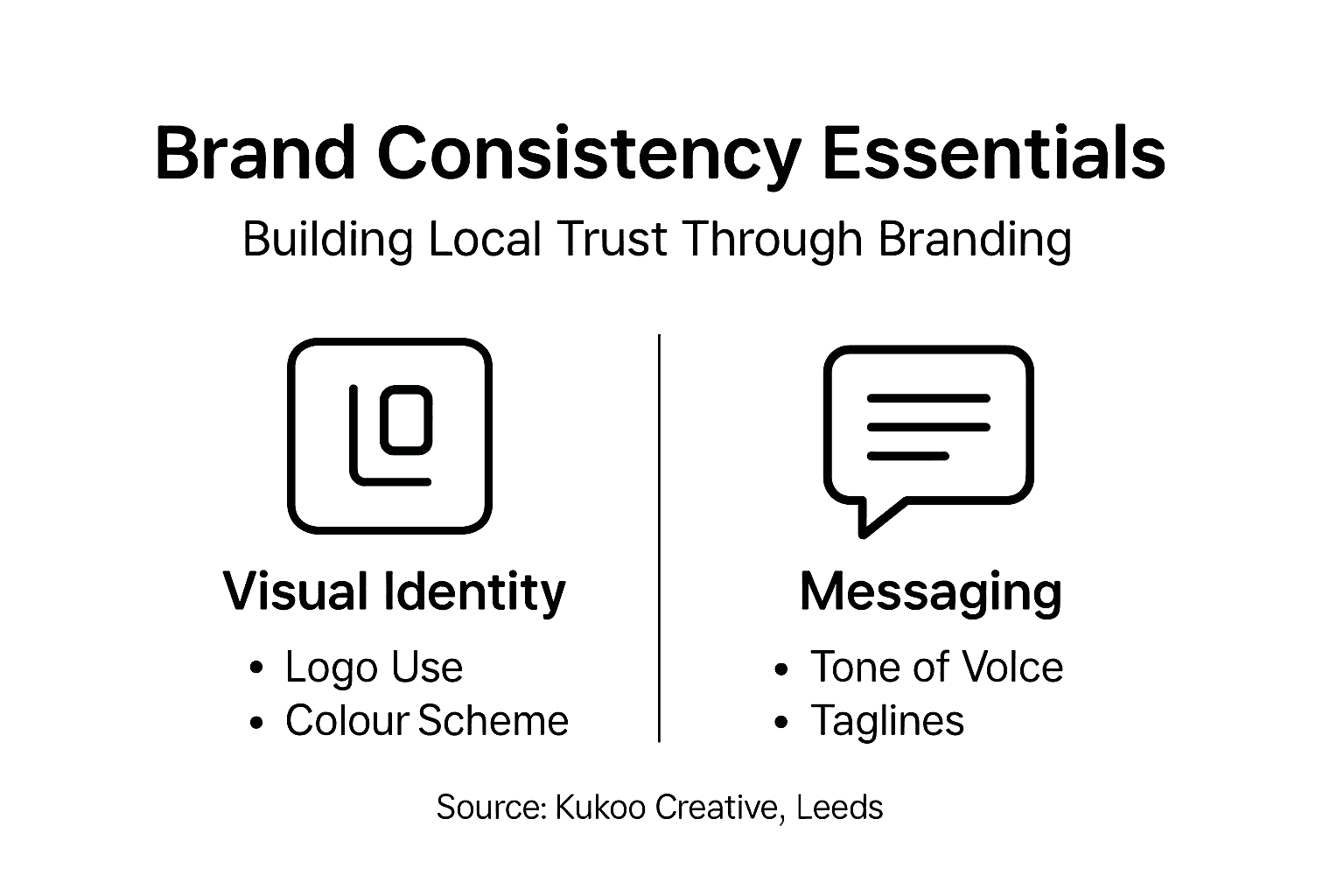
For Leeds-based organisations, brand consistency involves carefully crafting communication strategies that resonate with local audiences while preserving core brand values. Digital and physical branding efforts must be standardised to create an integrated approach that builds local trust and recognition, particularly in a competitive regional marketplace where differentiation matters.
Practical tactics for maintaining brand consistency in Leeds include:
- Developing a localised brand voice that reflects regional dialect and culture
- Creating region-specific marketing materials that align with overall brand guidelines
- Implementing consistent visual design across digital and physical platforms
- Training local teams on brand representation and communication standards
- Regularly auditing brand touchpoints for alignment and coherence
- Adapting national brand strategies to suit local Leeds market nuances
Pro tip: Conduct monthly brand alignment workshops with your Leeds team to ensure everyone understands and can authentically represent your organisation’s consistent brand identity.
Common Mistakes and How to Avoid Them
Brand consistency can quickly unravel through seemingly minor oversights that accumulate over time. Research reveals that many organisations struggle with fragmented messaging and inconsistent brand communications across different marketing channels, which can significantly undermine brand credibility and customer trust.
The most critical mistakes businesses make include neglecting comprehensive brand guidelines, allowing visual identity to drift, and failing to maintain a unified communication strategy across all platforms. Outdated visual identities and lack of clear differentiation can rapidly erode a brand’s market positioning, making it essential to proactively manage and update branding elements.
Common brand consistency pitfalls to avoid include:
Below is a comparison of common brand consistency mistakes and effective solutions:
| Mistake | Consequence | Solution |
|---|---|---|
| Fragmented messaging | Erodes brand trust | Establish clear communication guidelines |
| Inconsistent logo application | Damages recognition | Use standardised visual assets |
| Varied colour schemes | Confuses customers | Adhere to defined colour palette |
| Lack of staff training | Mixed customer experience | Provide regular brand representation workshops |
- Inconsistent logo usage across different media
- Varying colour palettes in marketing materials
- Misaligned messaging tone across communication channels
- Neglecting to train staff on brand representation
- Failing to regularly audit brand touchpoints
- Allowing individual departments to create independent visual styles
- Ignoring digital platform-specific brand adaptations
Pro tip: Create a comprehensive brand style guide with clear, visual examples and specific usage rules to ensure every team member understands and can consistently represent your brand.
Strengthen Your Brand Consistency and Build Trust in Leeds
The article highlights the challenges businesses face in maintaining consistent brand identity across local markets like Leeds. Many struggle with fragmented messaging and inconsistent visual design, which can erode customer trust and dilute brand recognition. If you want to overcome these pain points by establishing a unified visual identity, aligned messaging, and a cohesive brand personality that connects emotionally with your audience, expert guidance is essential.
At Kukoo Creative, we have over a decade of experience partnering with business owners to create impactful designs—from logos to websites—that ensure brand consistency at every touchpoint. Our tailored solutions support your goal to maintain a consistent tone and visual style, helping you build predictability, credibility, and trust locally. Whether you need a complete brand refresh or ongoing support to enforce brand guidelines, our team helps you present a reliable and recognisable brand to your community.
Explore how our design services can bring your brand vision to life.
Don’t let inconsistent branding hold you back. Connect with us today to start building brand trust and loyalty with every customer interaction. Visit Kukoo Creative to take the first step towards a stronger, consistent brand presence in Leeds.
Frequently Asked Questions
What is brand consistency and why is it important?
Brand consistency refers to the uniform representation of messaging, visual identity, and communication across all business touchpoints. It is important because it helps establish a recognisable brand presence and builds trust with customers.
How can I ensure my brand maintains a consistent visual identity?
To maintain a consistent visual identity, develop a comprehensive brand style guide that outlines your logo usage, colour palette, typography, and graphic elements. Regular audits can help ensure adherence to these guidelines across all platforms.
What role does messaging play in brand consistency?
Messaging plays a crucial role in brand consistency as it defines the tone of voice and communication style used in marketing and customer interactions. A unified messaging strategy helps reinforce a cohesive brand personality and strengthens customer trust.
What are common mistakes to avoid when trying to maintain brand consistency?
Common mistakes include fragmented messaging, inconsistent logo usage, and varying colour schemes. To avoid these pitfalls, establish clear guidelines, conduct regular training for staff, and perform regular brand audits to ensure all elements align with the brand identity.