Standing out in Leeds often means more than offering a great product or service. When every competitor is vying for the same customer’s attention, the way your brand looks and feels can make all the difference. Research shows that brand recognition creates crucial consumer awareness, paving the way for customer loyalty and trust. This guide uncovers practical visual design strategies that help Leeds businesses strengthen their identity and build lasting connections with customers.
Table of Contents
- Defining Brand Recognition And Its Role
- Brand Recognition Versus Brand Awareness
- Key Visual Elements That Drive Recognition
- Building Recognition Through Design Consistency
- Common Mistakes Small Firms Should Avoid
Key Takeaways
| Point | Details |
|---|---|
| Brand Recognition is Essential | Strong brand recognition helps small businesses stand out and fosters consumer trust, leading to potential loyalty. |
| Consistency is Key | Maintaining consistent visual elements across all platforms enhances brand recognition and consumer confidence. |
| Simplicity Enhances Memorability | Avoiding clutter in design allows for quicker brand recall, making it easier for customers to identify the brand. |
| Adapt for All Media | Ensure branding assets are versatile to maintain integrity across various platforms and formats to prevent a disjointed consumer experience. |
Defining Brand Recognition and Its Role
Brand recognition represents a fundamental marketing concept where consumers can identify a specific brand through distinctive visual or auditory elements. This cognitive connection transforms abstract business identities into memorable experiences that resonate with potential customers.
According to research by Rossiter, brand recognition establishes crucial consumer awareness that forms the foundation for brand attitude and potential loyalty. Small businesses particularly benefit from developing strong recognition strategies that help them stand out in competitive marketplaces. The process involves creating consistent visual signals like logos, colour schemes, and design elements that trigger immediate brand recall.
Consumer decision-making heavily relies on these recognition signals. When potential customers encounter familiar brand markers, they experience a psychological comfort that makes selecting that brand feel safer and more predictable. Visual and auditory brand identification plays a critical role in transforming unknown businesses into trusted market participants.
Pro tip: Invest in creating 2-3 distinctive visual elements that customers can instantly associate with your business, such as a memorable colour palette, unique logo design, or consistent typography across all marketing materials.
Brand Recognition Versus Brand Awareness
Brand recognition and brand awareness are closely related marketing concepts that are often mistaken for one another, yet they represent distinct stages in a consumer’s relationship with a business. While they might seem similar, understanding their nuanced differences is crucial for developing effective marketing strategies.
Brand recognition is a specific component of brand awareness that focuses on consumers’ ability to identify a brand through visual or auditory cues like logos, packaging, or sound signatures. It represents the first critical step where potential customers can distinguish a brand from competitors. Think of it as the initial visual handshake between a business and its audience.
In contrast, brand awareness is a broader concept that encompasses the overall familiarity and depth of knowledge consumers have about a brand. Brand awareness explores what consumers understand about a company’s values, positioning, and reputation. While recognition is about identifying the brand, awareness delves into understanding its essence, personality, and unique selling propositions.
For small businesses, recognising this distinction is vital. Recognition creates the initial visibility, while awareness builds the emotional connection that transforms casual observers into loyal customers. The progression typically moves from recognition (seeing the logo) to awareness (understanding the brand’s story and values).
Here is a summary highlighting the key differences between brand recognition and brand awareness:
| Aspect | Brand Recognition | Brand Awareness |
|---|---|---|
| Primary Focus | Identifying a brand by cues | Understanding brand values |
| Typical Cues | Logos, colours, sounds | Reputation, messaging, personality |
| Impact on Consumers | Triggers quick recall | Builds deeper loyalty |
| Role in Buyer Journey | First impression | Long-term engagement |
Pro tip: Develop a consistent visual identity that makes your brand instantly recognisable, then progressively build deeper brand awareness by sharing your unique story and values through targeted marketing communications.
Key Visual Elements That Drive Recognition
Brand recognition relies on a strategic combination of visual elements that create an immediate and memorable impression. Small businesses must understand how these components work together to establish a distinctive visual identity that stands out in a crowded marketplace.
Gestalt design principles fundamentally shape logo perception by governing how consumers visually process and remember brand marks. These principles include proximity, similarity, closure, and figure-ground relationships, which help create logos that are both visually engaging and easily recognisable. A well-designed logo becomes a powerful shorthand for a company’s entire brand personality.
Consistent visual elements extend beyond logos to encompass colour palettes, typography, and overall design language. Logo simplicity and clarity are crucial for consumer recognition, with balanced designs that maintain clear hierarchy and contrast being most effectively processed by the human brain. This means small businesses should focus on creating clean, uncluttered visual representations that communicate their essence quickly and effectively.

The strategic application of these visual elements across all brand touchpoints reinforces recognition. From business cards and websites to social media profiles and packaging, maintaining a cohesive visual strategy helps build a strong, memorable brand identity that resonates with potential customers.
Pro tip: Create a comprehensive brand style guide that documents your exact colour codes, typography, logo usage, and design principles to ensure consistent visual representation across all marketing materials.
Building Recognition Through Design Consistency
Design consistency represents the strategic backbone of brand recognition, transforming disconnected visual elements into a powerful, unified brand narrative. Small businesses must understand that every visual touchpoint contributes to creating a memorable and trustworthy brand identity.
Design consistency preserves brand identity and equity while allowing room for subtle innovation. This delicate balance means maintaining core visual elements like colour palettes, typography, and logo usage across all platforms, from business cards to digital marketing materials. Consistency signals professionalism and builds customer confidence by creating a predictable and reliable brand experience.
Fonts and colours play a crucial role in brand recognition, with each design choice communicating subtle messages about a company’s personality and values. The strategic use of specific typefaces and colour schemes can evoke emotional responses, helping customers quickly identify and connect with a brand. Maintaining consistent contrast and readability ensures that these visual elements remain effective across different media and contexts.
Small businesses should view design consistency as an ongoing commitment rather than a one-time effort. This means regularly auditing visual materials, creating comprehensive brand guidelines, and training team members to understand and apply these design principles consistently.
Pro tip: Develop a comprehensive brand style guide that includes precise colour hex codes, approved font families, logo usage rules, and acceptable variations to ensure uniform brand representation across all marketing channels.
Common Mistakes Small Firms Should Avoid
Brand recognition is a delicate process where small businesses can easily undermine their efforts through seemingly minor design and marketing missteps. Understanding and avoiding these common pitfalls can significantly improve a company’s visual communication and market perception.
One of the most critical errors small firms make is inconsistent branding across different platforms. This means using varying logo designs, colour schemes, or typography on websites, social media, printed materials, and physical signage. Such inconsistency confuses potential customers and dilutes the brand’s visual identity. Every touchpoint should reinforce the same visual narrative, creating a cohesive and professional image that builds trust and recognition.
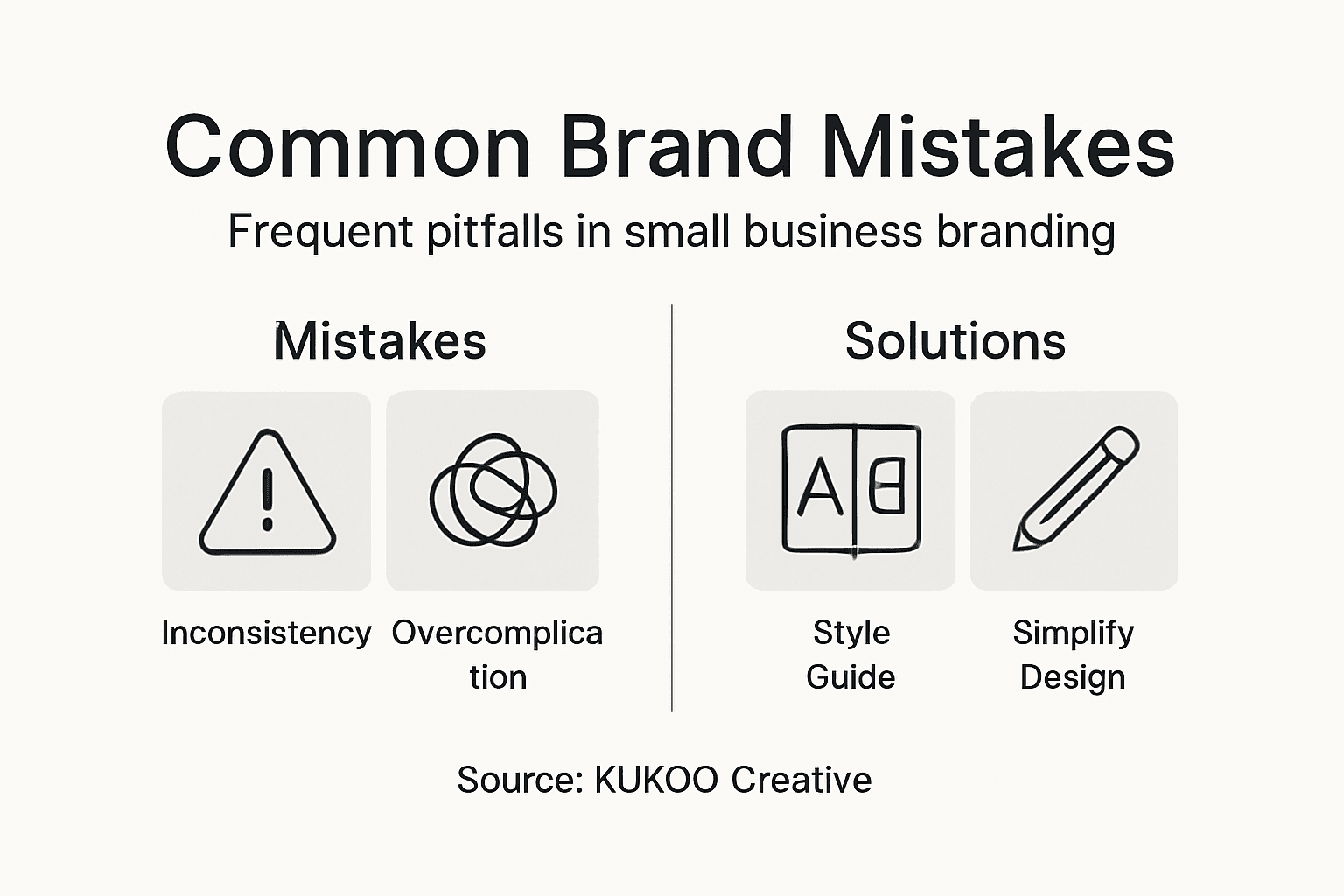
Another frequent mistake is overcomplicating visual design. Small businesses often attempt to include too many design elements, colours, or fonts, believing complexity demonstrates creativity. In reality, cluttered designs reduce brand memorability, making it harder for customers to quickly identify and remember the brand. Simplicity and clarity should be the guiding principles, with each design choice serving a specific communicative purpose.
Many small firms also neglect to adapt their branding for different media and contexts. A logo that looks crisp on a website might become illegible on a business card or appear distorted on social media profile pictures. Developing versatile design assets that maintain their integrity across various sizes and platforms is crucial for consistent brand recognition.
The following table outlines common branding mistakes and their possible negative impact on small businesses:
| Mistake | Possible Consequence | Solution Focus |
|---|---|---|
| Inconsistent visual identity | Consumer confusion, weak recall | Use a brand style guide |
| Overly complex design | Poor memorability, unclear messaging | Prioritise simplicity and clarity |
| Ignoring different platforms | Brand looks unprofessional | Adapt assets for all media |
Pro tip: Regularly audit your brand’s visual materials and create a comprehensive style guide that includes specific rules for logo usage, colour reproduction, typography, and acceptable variations to ensure consistent representation across all marketing channels.
Elevate Your Brand Recognition with Expert Design Support
Building consistent brand recognition is a clear challenge for many small businesses. This article highlights common pain points such as maintaining design consistency, simplifying complex visuals, and creating memorable brand elements that truly resonate with customers. At KUKOO Creative, we understand how crucial it is to develop a distinctive and cohesive visual identity that strengthens your position in a competitive market and builds lasting trust.
Whether you need a powerful logo, a defined colour palette, or a comprehensive style guide, our experienced team has partnered with business owners just like you for over a decade. Explore how our design services can help you avoid the typical pitfalls of brand inconsistency and create visuals that trigger quick brand recall while conveying your unique story.

Ready to transform your brand recognition and connect with the people who matter most? Visit KUKOO Creative today and take the first step towards a visual identity that truly reflects your business values and captures customer attention.
Frequently Asked Questions
What is brand recognition, and why is it important for small businesses?
Brand recognition is the ability of consumers to identify a brand through specific visual or auditory cues, such as logos and colours. It is important for small businesses as it helps them stand out in competitive marketplaces, fosters consumer trust, and can lead to increased customer loyalty.
How does brand recognition differ from brand awareness?
Brand recognition focuses specifically on identifying a brand through cues like logos or sounds, while brand awareness encompasses a broader understanding of a brand’s values, personality, and reputation. Recognition is the first step in creating familiarity, while awareness builds a deeper emotional connection with consumers.
What visual elements are essential for driving brand recognition?
Key visual elements that drive brand recognition include an effective logo, a cohesive colour palette, and consistent typography. These elements should be simple, memorable, and used uniformly across all marketing materials to ensure a strong brand identity.
What common mistakes should small businesses avoid when building brand recognition?
Small businesses should avoid inconsistent branding across platforms, overly complex design elements, and neglecting to adapt their branding for different media. Consistency and clarity are crucial for effective brand recognition, and regular audits of visual materials can help maintain a cohesive brand image.